A lot happened in the year 1989, including the debut of a TV sitcom in which nothing happened. That show, of course, was Seinfeld, and we’ll be doing a deep dive into this iconic comedy over the coming weeks.
But first, to get a sense of the times and trends that helped shape this series, here’s a quick look at the notable films that premiered in 1989.
Bill & Ted’s Excellent Adventure
Bill & Ted’s Excellent Adventure is a 1989 American science fiction comedy film directed by Stephen Herek and written by Chris Matheson and Ed Solomon. The first installment of the Bill & Ted franchise stars Keanu Reeves, Alex Winter and George Carlin. Winter and Reeves reprised their roles in two sequels: Bill & Ted’s Bogus Journey (1991) and Bill & Ted Face the Music (2020).
Heathers
Heathers is a 1989 American black comedy film written by Daniel Waters and directed by Michael Lehmann, in both of their respective film debuts. The film stars Winona Ryder, Christian Slater, Shannen Doherty, Lisanne Falk, Kim Walker, and Penelope Milford. Its plot portrays four teenage girls—three of whom are named Heather—in a clique at an Ohio high school, one of whose lives is disrupted by the arrival of a misanthrope intent on murdering the popular students and staging their deaths as suicides. It has since become popular as a cult film and is regarded in polls as one of the greatest coming-of-age films of all time.
Major League
Major League is a 1989 American sports comedy film produced by Chris Chesser and Irby Smith, written and directed by David S. Ward, that stars Tom Berenger, Charlie Sheen, Wesley Snipes, James Gammon, Bob Uecker, Rene Russo, Margaret Whitton, Dennis Haysbert, and Corbin Bernsen. It is the first installment in the Major League film series and spawned two sequels (Major League II and Major League: Back to the Minors), neither of which repeated the success of the original film.
Say Anything…
Say Anything… is a 1989 American teen romantic comedy drama film written and directed by Cameron Crowe (in his feature directorial debut). The film follows the romance between Lloyd Dobler (John Cusack), an average student, and Diane Court (Ione Skye), the class valedictorian, immediately after their graduation from high school. The film received positive reviews from critics. In 2002, Entertainment Weekly ranked Say Anything… as the greatest modern movie romance, and it was ranked number 11 on Entertainment Weekly’s list of the 50 Best High School Movies.
Field of Dreams
Field of Dreams is a 1989 American sports fantasy drama film written and directed by Phil Alden Robinson, based on Canadian novelist W. P. Kinsella’s 1982 novel Shoeless Joe. The film stars Kevin Costner as a farmer who builds a baseball field in his cornfield that attracts the ghosts of baseball legends, including Shoeless Joe Jackson (Ray Liotta) and the Chicago Black Sox. Amy Madigan, James Earl Jones, and Burt Lancaster (in his final film role) also star. The film received generally positive reviews from critics, and was nominated for three Academy Awards: Best Picture, Best Original Score and Best Adapted Screenplay. In 2017, it was selected for preservation in the United States National Film Registry by the Library of Congress as “culturally, historically, or aesthetically significant.”
Indiana Jones and the Last Crusade
Indiana Jones and the Last Crusade is a 1989 American action-adventure film directed by Steven Spielberg, from a story co-written by executive producer George Lucas. It is the third installment in the Indiana Jones franchise and a sequel to Raiders of the Lost Ark (1981). Harrison Ford returns in the title role, while his father is portrayed by Sean Connery. Other cast members featured include Alison Doody, Denholm Elliott, Julian Glover, River Phoenix, and John Rhys-Davies. In the film, set largely in 1938, Indiana searches for his father, a Holy Grail scholar, who has been kidnapped and held hostage by the Nazis while on a journey to find the Holy Grail. The Last Crusade was released by Paramount Pictures. This film was a financial success, earning $475.8 million at the worldwide box office, and won the Academy Award for Best Sound Effects Editing. A sequel, Indiana Jones and the Kingdom of the Crystal Skull, followed in 2008. A fifth film is scheduled for release in Summer 2023.
Dead Poets Society
Dead Poets Society is a 1989 American drama film directed by Peter Weir, written by Tom Schulman, and starring Robin Williams. Set in 1959 at the fictional elite conservative boarding school Welton Academy, it tells the story of an English teacher who inspires his students through his teaching of poetry. The film was a commercial success and received numerous accolades, including Academy Award nominations for Best Director, Best Picture, and Best Actor for Robin Williams. The film won the BAFTA Award for Best Film, the César Award for Best Foreign Film and the David di Donatello Award for Best Foreign Film. Schulman received an Academy Award for Best Original Screenplay for his work.
Star Trek V: The Final Frontier
Star Trek V: The Final Frontier is a 1989 American science fiction film directed by William Shatner and based on the television series Star Trek created by Gene Roddenberry. It is the fifth installment in the Star Trek film series, and takes place shortly after the events of Star Trek IV: The Voyage Home (1986). Its plot follows the crew of the USS Enterprise-A as they confront renegade Vulcan Sybok, who is searching for God at the center of the galaxy. It had the highest opening gross of any Star Trek film at that point and was number one in its first week at the box office; however, its grosses quickly dropped in subsequent weeks. The film received generally mixed to negative reviews by critics on release, and, according to its producer, “nearly killed the franchise.” The next entry in the series, Star Trek VI: The Undiscovered Country (1991), received a much more positive reception.
Ghostbusters II
Ghostbusters II is a 1989 American supernatural comedy film directed and produced by Ivan Reitman, and written by Dan Aykroyd and Harold Ramis. The film stars Bill Murray, Aykroyd, Sigourney Weaver, Ramis, Rick Moranis, Ernie Hudson, and Annie Potts. It is the sequel to the 1984 film Ghostbusters and the second film in the Ghostbusters franchise. Set five years after the events of the first film, the Ghostbusters have been sued and put out of business after the destruction caused during their battle with the deity Gozer. When a new paranormal threat emerges, the Ghostbusters reunite to combat it and save the world. Ghostbusters II was released on June 16, 1989 to generally negative reviews. Critics responded unfavorably to what they perceived as largely a copy of the original and a softening of its cynical, dark humor to be more family-friendly, although the performances of Peter MacNicol and Rick Moranis were repeatedly singled out for praise.
As the sequel to the then-highest-grossing comedy film of all time, Ghostbusters II was expected to dominate the box office. Instead, the film earned $215.4 million during its theatrical run compared with the original’s $282.2 million, making it the eighth-highest-grossing film of the year. The film failed to replicate the cultural impact and following of Ghostbusters. Although some critics retrospectively praised it, Ghostbusters II is generally seen as a poor follow-up to Ghostbusters and responsible for stalling the franchise for decades. The film spawned a series of merchandise including video games, board games, comic books, music, toys, and haunted houses. Despite the relative failure of Ghostbusters II, a second sequel was pursued through to the early 2010s. Following the 2016 series reboot, Ghostbusters: Answer the Call, a sequel to Ghostbusters II titled Ghostbusters: Afterlife was released in 2021.
Batman
Batman is a 1989 superhero film based on the DC Comics character of the same name, created by Bob Kane and Bill Finger. Produced by Jon Peters and Peter Guber, it is the first installment of Warner Bros.’ initial Batman film series. The film was directed by Tim Burton and stars Jack Nicholson, Michael Keaton, Kim Basinger, Robert Wuhl, Pat Hingle, Billy Dee Williams, Michael Gough, and Jack Palance. The film takes place early in the title character’s war on crime and depicts his conflict with his archenemy The Joker. Batman was both critically and financially successful, earning over $400 million in box office totals. Critics and audiences particularly praised Nicholson and Keaton’s performances, Burton’s direction, the production design, and Elfman’s score. It was the fifth-highest-grossing film in history at the time of its release.
The film received several Saturn Award nominations and a Golden Globe nomination for Nicholson’s performance, and won the Academy Award for Best Art Direction. It also inspired the equally successful Batman: The Animated Series, paving the way for the DC Animated Universe, and has influenced Hollywood’s modern marketing and development techniques of the superhero film genre. The film was followed by three sequels: Batman Returns (1992), with both Burton and Keaton returning; Batman Forever (1995), which featured Val Kilmer in the lead role; and Batman & Robin (1997), which featured George Clooney in the role.
Honey, I Shrunk the Kids
Honey, I Shrunk the Kids is a 1989 American comic science fiction film. It is the first installment of a film franchise and served as the directorial debut of Joe Johnston. The film stars Rick Moranis, Matt Frewer, Marcia Strassman, and Kristine Sutherland. In the film, a struggling inventor accidentally shrinks his kids, along with the neighbors’ kids, down to the size of a quarter-inch. After being accidentally thrown out with the trash, they must work together and venture their way back through a backyard wilderness filled with dangerous insects and man-made hazards. It was distributed by Buena Vista Pictures Distribution. It was an unexpected box office success, grossing $222 million worldwide (equivalent to $485.3 million in 2021) and becoming the highest-grossing live-action Disney film of all time, a record it held for five years. Its success led to two sequels, beginning with Honey, I Blew Up the Kids in 1992, as well as a television series and several theme-park attractions. An animated short film, Tummy Trouble starring Roger Rabbit, was shown in theaters with the film during its box office run.
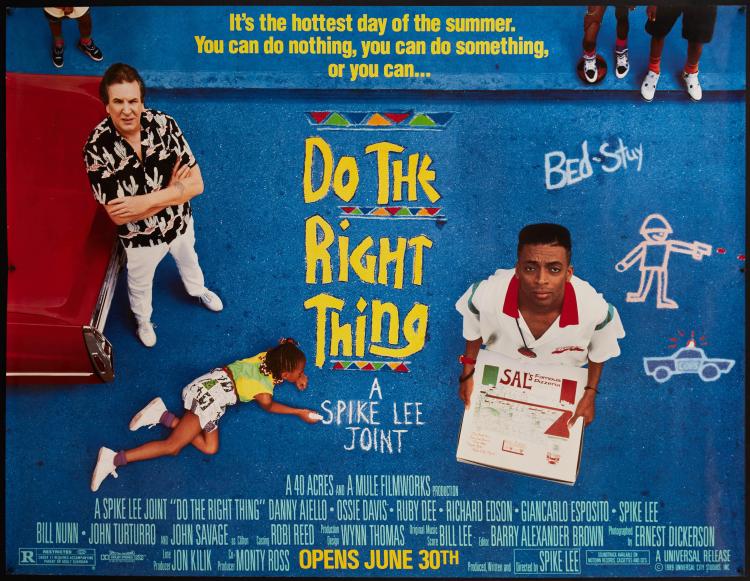
Do the Right Thing
Do the Right Thing is a 1989 American comedy-drama film produced, written, and directed by Spike Lee. It stars Lee, Danny Aiello, Ossie Davis, Ruby Dee, Richard Edson, Giancarlo Esposito, Bill Nunn, John Turturro, and Samuel L. Jackson, and is the feature film debut of Martin Lawrence and Rosie Perez. The story explores a Brooklyn neighborhood’s simmering racial tension between its African-American residents and the Italian-American owners of a local pizzeria, culminating in tragedy and violence on a hot summer day. The film was a critical and commercial success and received numerous accolades, including Academy Award nominations for Best Original Screenplay and Best Supporting Actor for Aiello’s portrayal of Sal the pizzeria owner. It is often listed among the greatest films of all time. In 1999, the film was deemed “culturally, historically, or aesthetically significant” by the Library of Congress, and was selected for preservation in the National Film Registry.
The Karate Kid Part III
The Karate Kid Part III is a 1989 American martial arts drama film, the third entry in the Karate Kid franchise and a sequel to The Karate Kid Part II (1986). It stars Ralph Macchio, Pat Morita, Robyn Lively, and Thomas Ian Griffith in his film debut. As was the case with the first two films in the series, it was directed by John G. Avildsen and written by Robert Mark Kamen, with stunts choreographed by Pat E. Johnson and music composed by Bill Conti. In the film, the returning John Kreese, with the help of his best friend Terry Silver, attempts to gain revenge on Daniel and Mr. Miyagi which involves hiring a ruthless martial artist and harming their relationship. Though moderately successful at the box office, The Karate Kid Part III received generally negative reviews, with criticism aimed at its rehashing of elements found in its two predecessors, though Griffith’s performance as Silver received praise from some critics. It was followed by The Next Karate Kid in 1994.
Weekend at Bernie’s
Weekend at Bernie’s is a 1989 American black comedy film directed by Ted Kotcheff and written by Robert Klane, loosely based on the 1959 novella The Two Deaths of Quincas Wateryell by Jorge Amado. The film stars Andrew McCarthy and Jonathan Silverman as young insurance corporation employees who discover that their boss, Bernie, is dead, after arriving at his house. While attempting to convince people that Bernie is still alive until they can leave to prevent them from being falsely suspected for causing his death, they discover that Bernie had ordered their own assassinations to cover up his embezzlement. It grossed $30 million on a $15 million budget. The film’s success inspired a sequel, Weekend at Bernie’s II (1993).
Lethal Weapon II
Lethal Weapon II is a 1989 American buddy cop action film directed by Richard Donner, and starring Mel Gibson, Danny Glover, Joe Pesci, Joss Ackland, Derrick O’Connor and Patsy Kensit. It is a sequel to the 1987 film Lethal Weapon and the second installment in the Lethal Weapon film series. Gibson and Glover respectively reprise their roles as LAPD officers, Martin Riggs and Roger Murtaugh, who protect an irritating federal witness (Pesci), while taking on a gang of South African drug dealers hiding behind diplomatic immunity. The film was nominated for an Academy Award for Best Sound Editing (for Robert G. Henderson). The film received mostly positive reviews and earned more than $227 million worldwide.
License to Kill
License to Kill is a 1989 spy film, the sixteenth in the James Bond series produced by Eon Productions, and the second and final film to star Timothy Dalton as the MI6 agent James Bond. It sees Bond suspended from MI6 as he pursues the drug lord Franz Sanchez, who has ordered an attack against Bond’s CIA friend Felix Leiter and the murder of Felix’s wife after their wedding. License to Kill was the fifth and final Bond film directed by John Glen, the last to feature Robert Brown as M and Caroline Bliss as Miss Moneypenny. It was also the last to feature the work of the screenwriter Richard Maibaum, the title designer Maurice Binder and the producer Albert R. Broccoli, all of whom died in the following years.
License to Kill was the first Bond film to not use the title of an Ian Fleming story. Originally titled License Revoked, the name was changed during post-production due to American test audiences associating the term with driver’s license. Although its plot is largely original, it contains elements of the Fleming novel Live and Let Die and the short story “The Hildebrand Rarity”, interwoven with a sabotage premise influenced by Akira Kurosawa’s film Yojimbo. For budget reasons, License to Kill became the first Bond film shot entirely outside the United Kingdom: principal photography took place on location in Mexico and the US, while interiors were filmed at Estudios Churubusco instead of Pinewood Studios. The film earned over $156 million worldwide and received generally positive reviews, with praise for the stunts, but attracted criticism for its darker tone, which carried into Dalton’s portrayal of Bond.
When Harry Met Sally…
When Harry Met Sally… is a 1989 American romantic comedy-drama film written by Nora Ephron and directed by Rob Reiner. It stars Billy Crystal as Harry and Meg Ryan as Sally. The story follows the title characters from the time they meet in Chicago just before sharing a cross-country drive, through twelve years of chance encounters in New York City. The film addresses but doesn’t resolve questions along the lines of “Can men and women ever just be friends?” Columbia Pictures released When Harry Met Sally… in selected cities, letting word of mouth generate interest, before gradually expanding distribution. The film grossed $92.8 million in North America, and was released to critical acclaim. Ephron received a British Academy Film Award, an Oscar nomination, and a Writers Guild of America Award nomination for her screenplay. The film is ranked 23rd on AFI’s “100 Years… 100 Laughs” list of the top comedy films in American cinema and number 60 on Bravo’s “100 Funniest Movies”. In early 2004, the film was adapted for the stage in a production starring Luke Perry and Alyson Hannigan.
Friday the 13th Part VIII: Jason Takes Manhattan
Friday the 13th Part VIII: Jason Takes Manhattan is a 1989 American slasher film written and directed by Rob Hedden, and starring Jensen Daggett, Scott Reeves, Peter Mark Richman, and Kane Hodder as Jason Voorhees, reprising his role from Friday the 13th Part VII: The New Blood. It is the eighth installment in the Friday the 13th franchise. Set several years after The New Blood, the film follows Jason as he stalks a group of high school graduates on a ship en route to New York City. It was the final film in the series to be distributed by Paramount Pictures in the United States until 2009, with the subsequent installments being distributed by New Line Cinema. Jason Takes Manhattan grossed $14.3 million at the domestic box office, making it the poorest-performing film in the Friday the 13th series to date. The film received overwhelmingly negative reviews for what critics saw as weak humor, unintelligent plotting, and a failure to effectively deliver on the promise of its subtitle. The next installment in the series, Jason Goes to Hell: The Final Friday, was released in 1993.
Turner & Hooch
Turner & Hooch is a 1989 American buddy cop comedy film starring Tom Hanks and Beasley the Dog as the eponymous characters respectively. The film also co-stars Mare Winningham, Craig T. Nelson and Reginald VelJohnson. It was directed by Roger Spottiswoode and co-written by Daniel Petrie Jr., who also served as an executive producer. Following the film’s success, it spawned a franchise including a television movie sequel, and a legacy sequel television series. Touchstone Pictures acquired the screenplay for Turner & Hooch for $1 million, which was the highest amount ever paid by Touchstone for any script at the time.
Nightmare on Elm Street 5: The Dream Child
A Nightmare on Elm Street 5: The Dream Child is a 1989 American gothic slasher film directed by Stephen Hopkins and written by Leslie Bohem. It is the fifth installment in the A Nightmare on Elm Street franchise, and stars Lisa Wilcox, and Robert Englund as Freddy Krueger. The film follows Krueger, using a now pregnant Alice Johnson’s baby’s dreams to claim new victims. The Dream Child grossed $22.1 million on a budget of $8 million, a steep decline in box office receipts from Dream Warriors and The Dream Master, while still a box office success and the highest grossing slasher film of 1989. It received mostly negative reviews from critics.
Uncle Buck
Uncle Buck is a 1989 American comedy film written, directed by John Hughes, and starring John Candy and Amy Madigan with supporting roles by Jean Louisa Kelly (in her film debut), Macaulay Culkin, Gaby Hoffmann, Garrett M. Brown and Elaine Bromka. The film tells the story of a bachelor who babysits his brother’s rebellious teenage daughter and her younger brother and sister while the parents are away. Uncle Buck was released by Universal Pictures and grossed $79.2 million against a $15 million budget. The film was met with mixed reviews.
Sex, Lies, and Videotape
Sex, Lies, and Videotape, is a 1989 American independent drama film written and directed by Steven Soderbergh. The plot tells the story of a troubled man who videotapes women discussing their sexuality and fantasies, and his impact on the relationships of a troubled married couple and the wife’s younger sister. Sex, Lies, and Videotape won the Palme d’Or at the 1989 Cannes Film Festival, making Soderbergh the youngest solo director to win the award; he was 26 at the time. The film was influential in revolutionizing the independent film movement in the early 1990s. In 2006, Sex, Lies, and Videotape was added to the United States Library of Congress’ National Film Registry, deemed “culturally, historically, or aesthetically significant”.
Crimes and Misdemeanors
Crimes and Misdemeanors is a 1989 American existential comedy-drama film written and directed by Woody Allen, who stars alongside Martin Landau, Mia Farrow, Anjelica Huston, Jerry Orbach, Alan Alda, Sam Waterston, and Joanna Gleason. The film was met with critical acclaim, receiving three Academy Award nominations: Allen, for Best Director and Best Original Screenplay, and Landau, for Best Actor in a Supporting Role. Several publications have ranked Crimes and Misdemeanors as one of Allen’s greatest films.
The Fabulous Baker Boys
The Fabulous Baker Boys is a 1989 American romantic comedy-drama musical film, written and directed by Steve Kloves. Primarily set in Seattle, Washington, the film follows a piano duo consisting of brothers, who hire an attractive singer to revive their waning career. After a period of success, complications ensue when the younger brother develops a romantic interest in the singer. Brothers Jeff and Beau Bridges star as the titular musicians, with Michelle Pfeiffer playing lounge singer Susie Diamond. The Fabulous Baker Boys was released to critical acclaim, receiving praise for its three leads’ performances, particularly Pfeiffer’s. The National Board of Review named it one of the year’s 10 best films. However, the film underperformed at the box office, grossing $18.4 million against its $11.5 million budget.
The Fabulous Baker Boys was nominated for four Academy Awards at the 62nd Academy Awards: Best Actress (for Pfeiffer), Best Cinematography, Best Film Editing, and Best Original Score. Pfeiffer won nearly every acting award for which she was nominated during the 1989-1990 awards season, including the Golden Globe Award for Best Actress in a Motion Picture – Drama, but lost the Academy Award to Jessica Tandy. The film is best remembered for Pfeiffer’s sultry performance of “Makin’ Whoopee” on top of a grand piano, which several media publications consider to be one of the most famous and sexiest scenes in film history.
Halloween 5: The Revenge of Michael Myers
Halloween 5: The Revenge of Michael Myers is a 1989 American slasher film co-written and directed by Dominique Othenin-Girard, and starring Donald Pleasence and Danielle Harris. The fifth installment in the Halloween series, it follows serial killer Michael Myers who again returns to the town of Haddonfield to murder his niece, Jamie Lloyd, who, traumatized from his previous attack on her, has been institutionalized following her attempt to murder her foster mother. The film received generally negative reviews from critics and was a box office disappointment, only grossing $11.6 million domestically against a $5.5 million budget.
Henry V
Henry V is a 1989 British historical drama film adapted for the screen and directed by Kenneth Branagh, based on William Shakespeare’s play of the same name about King Henry V of England. The film stars Branagh in the title role with Paul Scofield, Derek Jacobi, Ian Holm, Emma Thompson, Alec McCowen, Judi Dench, Robbie Coltrane, Brian Blessed, and Christian Bale in supporting roles. The film received worldwide critical acclaim and is considered to be one of the best Shakespeare film adaptations ever made. For her work on the film, Phyllis Dalton won an Academy Award for Best Costume Design and Kenneth Branagh, in his directorial debut, received Oscar nominations for Best Actor and Best Director.
My Left Foot
My Left Foot: The Story of Christy Brown, also known simply as My Left Foot, is a 1989 biographical comedy-drama film directed by Jim Sheridan adapted by Sheridan and Shane Connaughton from the 1954 memoir of the same name by Christy Brown. A co-production of Ireland and the United Kingdom, it stars Daniel Day-Lewis as Brown, an Irish man born with cerebral palsy, who could control only his left foot. Brown grew up in a poor working-class family, and became a writer and artist. Brenda Fricker, Ray McAnally, Hugh O’Conor, Fiona Shaw, and Cyril Cusack are featured in supporting roles. The film was theatrically released on February 24, 1989 to critical and commercial success. Reviewers praised the film’s screenplay and direction, its message, and especially the performances of Day-Lewis and Fricker, while the film grossed $14.7 million on a £600,000 budget.
At the 62nd Academy Awards, the film received five nominations, including for the Best Picture, with Day-Lewis and Fricker winning Best Actor and Best Supporting Actress, respectively. In 2018, the British Film Institute ranked it as the 53rd greatest British film of the 20th century.
All Dogs Go to Heaven
All Dogs Go to Heaven is a 1989 animated musical fantasy adventure comedy-drama film directed by Don Bluth and co-directed by Gary Goldman (his directorial debut) and Dan Kuenster. It tells the story of Charlie B. Barkin (voiced by Burt Reynolds), a German Shepherd that is murdered by his former friend, Carface Carruthers (voiced by Vic Tayback, in his penultimate film role). Charlie withdraws from his place in Heaven to return to Earth where his best friend, Itchy Itchiford (voiced by Dom DeLuise), still lives, in order to take revenge on Carface. Instead, he ends up befriending a young orphan girl named Anne-Marie (voiced by Judith Barsi in her final film role; posthumously). In the process, Charlie learns an important lesson about kindness, friendship and love.
The film is an Irish, British and American venture, produced by Goldcrest Films and Sullivan Bluth Studios Ireland Ltd. On its cinema release, it competed directly with Walt Disney Feature Animation’s The Little Mermaid, released on the same day. While it did not repeat the box-office success of Sullivan Bluth’s previous feature films, An American Tail and The Land Before Time, it was successful on home video, becoming one of the biggest-selling VHS releases ever. It inspired a theatrical sequel, a television series, and a holiday direct-to-video film.
The Little Mermaid
The Little Mermaid is a 1989 American animated musical fantasy film produced by Walt Disney Feature Animation and released by Walt Disney Pictures. The 28th Disney animated feature film, it is loosely based on the 1837 Danish fairy tale of the same name by Hans Christian Andersen. The film tells the story of a teenage mermaid princess named Ariel, who dreams of becoming human and falls in love with a human prince named Eric, which leads her to make a magic deal with the sea witch, Ursula, to become human and be with him. The Little Mermaid was written and directed by John Musker and Ron Clements and produced by Musker and Howard Ashman, who also wrote the film’s songs with Alan Menken. Menken also composed the film’s score. The film stars the voices of Jodi Benson, Christopher Daniel Barnes, Pat Carroll, Samuel E. Wright, Jason Marin, Kenneth Mars, and Buddy Hackett.
Walt Disney planned to put the story in a proposed package film containing Andersen’s stories, but scrapped the project. In 1985, while working on The Great Mouse Detective (1986), Clements and Musker decided to adapt the fairy tale and proposed it to Disney Studios chairman Jeffrey Katzenberg, who initially declined due to its similarities to a proposed sequel to the 1984 film Splash, but ultimately approved of it. Ashman became involved and brought in Menken. With supervision from Katzenberg, they made a Broadway-style structure with musical numbers as the staff was working on Oliver & Company (1988). Katzenberg warned that the film would earn less since it appealed to females, but he eventually became convinced that it would be Disney’s first blockbuster hit. The Little Mermaid was released to theaters to critical acclaim, earning praise for the animation, music, and characters. It was also a commercial success, garnering $84 million at the domestic box office during its initial release, and $235 million in total lifetime gross worldwide.
Along with the major success of both the 1986 Disney animated film The Great Mouse Detective and the 1988 Disney/Amblin live-action/animated film Who Framed Roger Rabbit, The Little Mermaid is given credit for breathing life back into the art of Disney animated feature films after some films produced by Disney were struggling. It also marked the start of the era known as the Disney Renaissance. The film won two Academy Awards for Best Original Score and Best Original Song (“Under the Sea”). The film’s success led to a media franchise. A direct-to-video sequel was released in 2000, focusing on Ariel’s daughter, Melody. A prequel followed in 2008. The first film was adapted into a stage musical with a book by Doug Wright and additional songs by Alan Menken and new lyricist Glenn Slater opened in Denver in July 2007 and began performances on Broadway January 10, 2008, starring Sierra Boggess. Other derived works and material inspired by the film, include a live-action film adaptation, directed by Rob Marshall, currently scheduled for release in 2023, and a 2019 live musical presentation of the film aired on ABC as part of “The Wonderful World of Disney.”
Steel Magnolias
Steel Magnolias is a 1989 American comedy-drama film directed by Herbert Ross and starring Academy Award winner Sally Field, Dolly Parton, Shirley MacLaine, Daryl Hannah, Olympia Dukakis and Julia Roberts. The picture is a film adaptation of Robert Harling’s 1987 play of the same name about the bond a group of women share in a small-town Southern community, and how they cope with the death of one of their own. The supporting cast features Tom Skerritt, Dylan McDermott, Sam Shepard and Kevin J. O’Connor. Robert Harling based the story in part on his sister, Susan Harling Robinson. She died in 1985 of complications from Type 1 diabetes. In the film, Julia Roberts plays Shelby, the character based on Susan.
Back to the Future Part II
Back to the Future Part II is a 1989 American science fiction film directed by Robert Zemeckis from a screenplay by Bob Gale and a story by both. It is the sequel to the 1985 film Back to the Future and the second installment in the Back to the Future franchise. The film stars Michael J. Fox, Christopher Lloyd, Lea Thompson, Thomas F. Wilson, Elisabeth Shue (replacing Claudia Wells), and Jeffrey Weissman (replacing Crispin Glover), and follows Marty McFly (Fox) and his friend Dr. Emmett “Doc” Brown (Lloyd) as they travel from 1985 to 2015 to prevent Marty’s son from sabotaging the McFly family’s future. When their arch-nemesis Biff Tannen (Wilson) steals Doc’s DeLorean time machine and uses it to alter history for his benefit, the duo must return to 1955 to restore the timeline. Back to the Future Part II was released by Universal Pictures. The film initially received mixed reviews from critics and grossed over $332 million worldwide in its initial run, making it the third highest-grossing film of 1989.
National Lampoon’s Christmas Vacation
National Lampoon’s Christmas Vacation is a 1989 American Christmas comedy film and the third installment in National Lampoon magazine’s Vacation film series. Christmas Vacation was directed by Jeremiah S. Chechik, written and co-produced by John Hughes, and starring Chevy Chase, Beverly D’Angelo, and Randy Quaid with supporting roles by Miriam Flynn, William Hickey, Mae Questel, Diane Ladd, John Randolph, E.G. Marshall, Doris Roberts, Juliette Lewis, and Johnny Galecki, and special appearances by Julia Louis-Dreyfus, Nicholas Guest, Ellen Hamilton Latzen, Brian Doyle-Murray, and Natalia Nogulich. Based on Hughes’ short story “Christmas ’59” that was published in National Lampoon, it tells the story of the Griswold family spending Christmas vacation at home with their relatives and the ensuing mayhem.
The War of the Roses
The War of the Roses is a 1989 American satirical black comedy film based upon the 1981 novel of the same name by Warren Adler. The film follows a wealthy couple with a seemingly perfect marriage. When their marriage begins to fall apart, material possessions become the center of an outrageous and bitter divorce battle. The film co-stars Michael Douglas, Kathleen Turner, and Danny DeVito. The three actors had previously worked together in Romancing the Stone and its sequel The Jewel of the Nile. DeVito directed the film, which also had producer James L. Brooks and actor Dan Castellaneta working on a project outside of The Simpsons. The opening title sequence was created by Saul Bass and Elaine Makatura Bass. In both the novel and the film, the married couple’s family name is Rose, and the title is an allusion to the battles between the warring houses of York and Lancaster who were contending for the English throne during the late Middle Ages. In Germany, the film was such a huge success that its German title Der Rosenkrieg became synonymous with high-conflict divorce and is now regularly used in the media.
Enemies, A Love Story
Enemies, A Love Story is a 1989 American romantic drama film directed by Paul Mazursky, based on the 1966 novel Enemies, A Love Story (Yiddish: Soynim, di Geshikhte fun a Libe) by Isaac Bashevis Singer. The film stars Ron Silver, Anjelica Huston, Lena Olin and Margaret Sophie Stein. The film received positive reviews from critics and three nominations at the 62nd Academy Awards; Best Supporting Actress (for Huston and Olin) and Best Adapted Screenplay.
Driving Miss Daisy
Driving Miss Daisy is a 1989 American comedy-drama film directed by Bruce Beresford and written by Alfred Uhry, based on his 1987 play of the same name. The film stars Jessica Tandy, Morgan Freeman, and Dan Aykroyd. Freeman reprised his role from the original Off-Broadway production. The story defines Daisy and her point of view through a network of relationships and emotions by focusing on her home life, synagogue, friends, family, fears, and concerns over a twenty-five-year period. Driving Miss Daisy was a critical and commercial success upon its release and at the 62nd Academy Awards received nine nominations, and won four: Best Picture, Best Actress (for Tandy), Best Makeup, and Best Adapted Screenplay. As of 2022, it is the most recent PG-rated film to have won Best Picture.
Glory
Glory is a 1989 American historical war drama film directed by Edward Zwick about the 54th Massachusetts Infantry Regiment, one of the Union Army’s earliest African-American regiments in the American Civil War. It stars Matthew Broderick as Colonel Robert Gould Shaw, the regiment’s commanding officer, and Denzel Washington, Cary Elwes, and Morgan Freeman as fictional members of the 54th. The screenplay by Kevin Jarre was based on the books Lay This Laurel (1973) by Lincoln Kirstein and One Gallant Rush (1965) by Peter Burchard and the personal letters of Shaw. The film depicts the soldiers of the 54th from the formation of their regiment to their heroic actions at the Second Battle of Fort Wagner. Glory was co-produced by TriStar Pictures and Freddie Fields Productions, and distributed by Tri-Star Pictures in the United States. It premiered in limited release in the United States on December 14, 1989, and in wide release on February 16, 1990, grossing $27 million worldwide on an $18 million budget. The film was nominated for five Academy Awards and won three, including Best Supporting Actor for Washington. It also won awards from the British Academy of Film and Television Arts, the Golden Globe Awards, the Kansas City Film Critics Circle, the Political Film Society, and the NAACP Image Awards.
Born on the Fourth of July
Born on the Fourth of July is a 1989 American biographical anti-war drama film based on the 1976 autobiography by Ron Kovic. Directed by Oliver Stone, and written by Stone and Kovic, it stars Tom Cruise, Kyra Sedgwick, Raymond J. Barry, Jerry Levine, Frank Whaley, and Willem Dafoe. The film depicts the life of Kovic (Cruise) over a 20-year period, detailing his childhood, his military service and paralysis during the Vietnam War, and his transition to anti-war activism. It is the second installment in Stone’s trilogy of films about the Vietnam War, following Platoon (1986) and preceding Heaven & Earth (1993). Upon release, Born on the Fourth of July was praised by critics for its story, Cruise’s performance and Stone’s direction. The film was successful at the box office as it grossed over $162 million worldwide, becoming the tenth highest-grossing film of 1989. At the 62nd Academy Awards, it received eight nominations, including Best Picture and Best Actor for Cruise, his first nomination, and the film won for Best Director, Stone’s second in that category, and Best Film Editing. The film also won four Golden Globe Awards for Best Motion Picture – Drama, Best Actor – Motion Picture Drama, Best Director and Best Screenplay.
Roger & Me
Roger & Me is a 1989 American documentary film written, produced, directed by, and starring Michael Moore, in his directorial debut. Moore portrays the regional economic impact of General Motors CEO Roger Smith’s action of closing several auto plants in his hometown of Flint, Michigan, reducing GM’s employees in that area from 80,000 in 1978 to about 50,000 in 1992. As of August 2015, GM employs approximately 7,200 workers in the Flint area, according to The Detroit News, and 5,000 workers according to MSNBC. In 2013, the film was selected for preservation in the United States National Film Registry by the Library of Congress as being “culturally, historically or aesthetically significant.”
 SCREEN TIME WITH SAM