A lot happened in the year 1987, including the debut of a family-friendly TV sitcom set in San Francisco. The name of the show was Full House, and we’ll be doing a deep dive into this popular comedy over the coming weeks.
But first, to get a sense of the times and trends that helped shape this series, here’s a quick look at the notable books that were published in 1987.
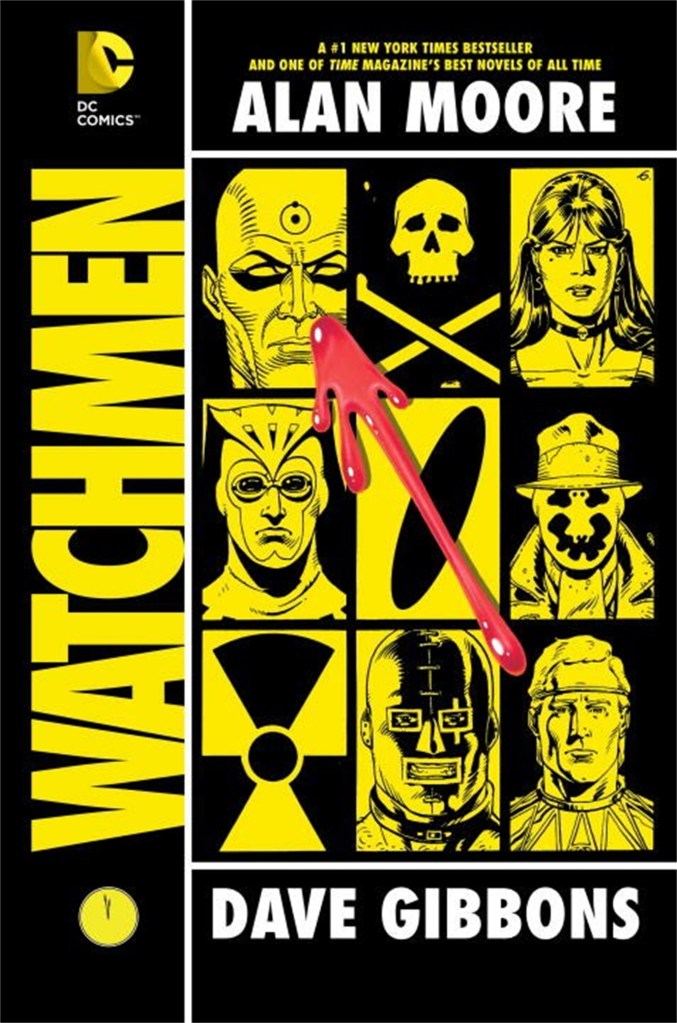
Watchmen
by Alan Moore
Watchmen is an American comic book maxiseries by the British creative team of writer Alan Moore, artist Dave Gibbons and colorist John Higgins. It was published monthly by DC Comics in 1986 and 1987 before being collected in a single-volume edition in 1987. Watchmen originated from a story proposal Moore submitted to DC featuring superhero characters that the company had acquired from Charlton Comics. As Moore’s proposed story would have left many of the characters unusable for future stories, managing editor Dick Giordano convinced Moore to create original characters instead.
Moore used the story as a means to reflect contemporary anxieties, to deconstruct and satirize the superhero concept and political commentary. Watchmen depicts an alternate history in which superheroes emerged in the 1940s and 1960s and their presence changed history so that the United States won the Vietnam War and the Watergate scandal was never exposed. In 1985, the country was edging toward World War III with the Soviet Union, freelance costumed vigilantes were outlawed and most former superheroes were retired or working for the government. The story focuses on the protagonists’ personal development and moral struggles as an investigation into the murder of a government-sponsored superhero pulls them out of retirement.
Gibbons used a nine-panel grid layout throughout the series and added recurring symbols such as a blood-stained smiley face. All but the last issue feature supplemental fictional documents that add to the series’ backstory, and the narrative is intertwined with that of another story, an in-story pirate comic titled Tales of the Black Freighter, which one of the characters reads. Structured at times as a nonlinear narrative, the story skips through space, time and plot. In the same manner, entire scenes and dialogue have parallels with others through synchronicity, coincidence and repeated imagery.
A commercial success, Watchmen has received critical acclaim both in the comics and mainstream press. Watchmen was recognized in Time’s List of the 100 Best Novels as one of the best English language novels published since 1923. In a retrospective review, the BBC’s Nicholas Barber described it as “the moment comic books grew up”. Moore opposed this idea, stating, “I tend to think that, no, comics hadn’t grown up. There were a few titles that were more adult than people were used to. But the majority of comics titles were pretty much the same as they’d ever been. It wasn’t comics growing up. I think it was more comics meeting the emotional age of the audience coming the other way.”
After a number of attempts to adapt the series into a feature film, director Zack Snyder’s Watchmen was released in 2009. A video game series, Watchmen: The End Is Nigh, was released in the same year to coincide with the film’s release.
DC Comics published Before Watchmen, a series of nine prequel miniseries, in 2012, and Doomsday Clock, a 12-issue limited series and sequel to the original Watchmen series, from 2017 to 2019 – both without Moore’s or Gibbons’ involvement. The second series integrated the Watchmen characters within the DC Universe, home to more recognizable DC superheroes like Superman, Batman and Wonder Woman. A television continuation to the original comic, set 34 years after the comic’s timeline, was broadcast on HBO from October to December 2019 with Gibbons’ involvement. A comic continuation of the HBO series, titled Rorschach and written by Tom King, began publication in October 2020. Moore has expressed his displeasure with later adaptations and asked that Watchmen not be adapted for future works
Madame Doubtfire
by Anne Fine
Madame Doubtfire, known as Alias Madame Doubtfire in the United States, is a 1987 novel written for teenage and young adult audiences. The novel is based on a family with divorced parents. Well received upon its publication in the UK, it was shortlisted for awards, including the Guardian Children’s Fiction Prize and Whitbread Children’s Book Award. In November 1993, six years after its publication, the novel was adapted into Mrs. Doubtfire, a film starring Robin Williams and Sally Field.
The Whale Rider
by Witi Ihimaera
Set in the 1980s in Whangara, a Māori community on the eastern edge of New Zealand’s North Island, the novel The Whale Rider is a retelling of the myth of Paikea. Kahu is the eldest great-grandchild of chieftain Koro Apirana; had she been a boy, she would have been the natural future leader of the tribe. She is attuned to the traditional Māori way of life, and may have inherited the ability to speak to whales. In 2002 it was adapted into a film, Whale Rider, directed by Niki Caro.
The Z was Zapped
by Chris Van Allsburg
The Z Was Zapped is a picture book published by Houghton Mifflin. The book tells the story “in 26 acts”, each showing how each letter in the alphabet caught some bad luck. The artwork has a stark look by using black and white pencil drawings. Each destruction of the letters takes place on a proscenium theater stage. Examples include: The A was in an avalanche, The B was badly bitten, The C was cut to ribbons, The Z was zapped.
The Runaways
by Ruth Thomas
The Runaways is a children’s novel published by Hutchinson. It features eleven-year-old Julia and Nathan who find “an enormous sum of money”, do not report it, and flee the city when they are threatened with punishment. Opening in the East End of London where Thomas was a primary school teacher, the story moves to places including Brighton and Exmoor. Thomas and The Runaways won the Guardian Children’s Fiction Prize, a once-in-a-lifetime book award judged by a panel of British children’s writers. It drew critical acclaim, with The Guardian declaring it “A first rate novel”. Lippincott published the first U.S. edition in 1989.
Steel Magnolias
by Robert Harling
Steel Magnolias is a stage play by Robert Harling, based on his experience with his sister’s death. The play is a comedy-drama about the bond among a group of Southern women in northwest Louisiana. The title suggests the “female characters are as delicate as magnolias but as tough as steel”. The magnolia specifically references a magnolia tree they are arguing about at the beginning.
And the Band Played On: Politics, People, and the AIDS Epidemic
by Randy Shilts
This book chronicles the discovery and spread of the human immunodeficiency virus (HIV) and acquired immune deficiency syndrome (AIDS) with a special emphasis on government indifference and political infighting—specifically in the United States—to what was then perceived as a specifically gay disease. Shilts’s premise is that AIDS was allowed to happen: while the disease is caused by a biological agent, incompetence and apathy toward those initially affected allowed its spread to become much worse.
The book is an extensive work of investigative journalism, written in the form of an encompassing timeline; the events that shaped the epidemic are presented as sequential matter-of-fact summaries. Shilts describes the impact and the politics involved in battling the disease on particular individuals in the gay, medical, and political communities. Shilts began his discussion in 1977 with the first confirmed case of AIDS, that of Grethe Rask, a Danish doctor working in Africa. He ends with the announcement by actor Rock Hudson in 1985 that he was dying of AIDS, when international attention on the disease exploded.
And the Band Played On was critically acclaimed and became a best-seller. Judith Eannarino of the Library Journal called it “one of the most important books of the year”, upon its release. It made Shilts both a star and a pariah for his coverage of the disease and the bitter politics in the gay community. He described his motivation to undertake the writing of the book in an interview after its release, saying, “Any good reporter could have done this story, but I think the reason I did it, and no one else did, is because I am gay. It was happening to people I cared about and loved.” The book was later adapted into an HBO film of the same name in 1993. Shilts was tested for HIV while he was writing the book; he died of complications from AIDS in 1994.
Paco’s Story
by Larry Heinemann
Paco Sullivan is the only man in Alpha Company to survive a cataclysmic Viet Cong attack on FireBase Harriette in Vietnam. Everyone else is annihilated. When a medic finally rescues Paco almost two days later, he is waiting to die, flies and maggots covering his burnt, shattered body. He winds up back in the US with his legs full of pins, daily rations of Librium and Valium, and no sense of what to do next. One evening, on the tail of a rainstorm, he limps off the bus and into the small town of Boone, determined to find a real job and a real bed—but no matter how hard he works, nothing muffles the anguish in his mind and body. Brilliantly and vividly written, Paco’s Story—winner of a National Book Award—plunges you into the violence and casual cruelty of the Vietnam War, and the ghostly aftermath that often dealt the harshest blows.
Misery
by Stephen King
Misery is an American psychological horror thriller novel. The novel’s narrative is based on the relationship of its two main characters – the romance novelist Paul Sheldon and his deranged self-proclaimed number one fan Annie Wilkes. When Paul is seriously injured following a car accident, former nurse Annie brings him to her home, where Paul receives treatment and doses of pain medication. Paul realizes that he is a prisoner and is forced to indulge his captor’s whims.
The novel’s title has two meanings: it is the name carried by the central heroine of Paul’s book series, and King described such a state of emotion during the novel’s writing. He has stated that Annie is a stand-in for cocaine. King has outlined the creation of Misery in his memoirs, and mentioned that the image of Annie Wilkes came to him in a dream. King planned the book to be released under the pseudonym Richard Bachman, but his identity was discovered before the book’s release.
Misery won the first Bram Stoker Award for Novel in 1987 and was nominated for the 1988 World Fantasy Award for Best Novel. Critical reception of Misery was positive – reviewers praised King for avoiding the fantasy elements of his past works, and noted the novel’s parallels with King’s personal life and the study of the relationship between celebrities and their fans. The novel, which took fourth place in the 1987 bestseller list, was adapted into an Academy Award-winning film directed by Rob Reiner in 1990, and into a theatrical production starring Laurie Metcalf and Bruce Willis in 2015.
Patriot Games
by Tom Clancy
Patriot Games is a thriller novel. Without Remorse, released six years later, is an indirect prequel, and it is chronologically the first book featuring Jack Ryan, the main character in most of Clancy’s novels. The novel focuses on Ryan being the target of Irish terrorist group Ulster Liberation Army for thwarting their kidnapping attempt on the Prince and Princess of Wales in London. It debuted at number one on the New York Times bestseller list. A film adaptation, starring Harrison Ford as Ryan, premiered on June 5, 1992.
Presumed Innocent
by Scott Turrow
Presumed Innocent is Scott Turow’s first novel. It is about a prosecutor charged with the murder of his colleague, an attractive and intelligent prosecutor named Carolyn Polhemus. It is told in the first person by the accused, Rožat “Rusty” Sabich. A motion picture adaptation starring Harrison Ford was released in 1990.
The Black Dahlia
by James Ellroy
The Black Dahlia is a crime fiction novel. Its subject is the 1947 murder of Elizabeth Short in Los Angeles, California, which received wide attention because her corpse was horrifically mutilated and discarded in an empty residential lot. The investigation ultimately led to a broad police corruption scandal. While rooted in the facts of the Short murder and featuring many real-life people, places and events, Ellroy’s novel blends facts and fiction, most notably in providing a solution to the crime when in reality it has never been solved.
This book is considered the one that gained Ellroy critical attention as a serious writer of literature, expanding his renown beyond the crime novels of his early career. The Black Dahlia is the first book in Ellroy’s L.A. Quartet, a cycle of novels set in 1940s and 1950s Los Angeles. He portrays the city in this period as a hotbed of political corruption and depravity. The Quartet continues with The Big Nowhere, L.A. Confidential, and White Jazz.
Beloved
by Toni Morrison
Set in the period after the American Civil War, the novel Beloved tells the story of a dysfunctional family of formerly enslaved people whose Cincinnati home is haunted by a malevolent spirit. The narrative of Beloved derives from the life of Margaret Garner, an enslaved person in the slave state of Kentucky who escaped and fled to the free state of Ohio in 1856.
Garner was subject to capture under the Fugitive Slave Act of 1850, and when U.S. marshals broke into the cabin where she and her husband had barricaded themselves, she was attempting to kill her children—and had already killed her youngest daughter—in hopes of sparing them from being returned to slavery. Morrison’s main inspiration for the novel was an account of the event titled “A Visit to the Slave Mother who Killed Her Child” in an 1856 newspaper article initially published in the American Baptist and reproduced in The Black Book, an anthology of texts of Black history and culture that Morrison had edited in 1974.
The novel won the Pulitzer Prize for Fiction a year after its publication, and was a finalist for the 1987 National Book Award. A survey of writers and literary critics compiled by The New York Times ranked it as the best work of American fiction from 1981 to 2006. It was adapted as a 1998 movie of the same name, starring Oprah Winfrey.
The Bonfire of the Vanities
by Tom Wolfe
The Bonfire of the Vanities is a drama about ambition, racism, social class, politics, and greed in 1980s New York City, and centers on three main characters: WASP bond trader Sherman McCoy, Jewish assistant district attorney Larry Kramer, and British expatriate journalist Peter Fallow.
The novel was originally conceived as a serial in the style of Charles Dickens’ writings: it ran in 27 installments in Rolling Stone starting in 1984. Wolfe heavily revised it before it was published in book form. The novel was a bestseller and a phenomenal success, even in comparison with Wolfe’s other books. It has often been called the quintessential novel of the 1980s, and in 1990 was adapted into a critically maligned film of the same name by Brian De Palma.
World’s End
by T. C. Boyle
World’s End is a historical fiction novel. The novel, characterized by dark satire, tells the story of several generations of families in the Hudson River Valley. It was the winner of the 1988 PEN/Faulkner Award for American Fiction.
Trump: The Art of the Deal
by Donald Trump and Tony Schwartz
Part memoir and part business-advice book, The Art of the Deal was the first book credited to Trump, and helped to make him a household name. It reached number 1 on The New York Times Best Seller list, stayed there for 13 weeks, and altogether held a position on the list for 48 weeks. The book received additional attention during Trump’s 2016 campaign for the presidency of the United States. Trump cited it as one of his proudest accomplishments and his second-favorite book after the Bible. Schwartz called writing the book his “greatest regret in life, without question,” and both he and the book’s publisher, Howard Kaminsky, alleged that Trump had played no role in the actual writing of the book. Trump has personally given conflicting accounts on the question of authorship
Mort
by Terry Pratchet
Mort is a fantasy novel, it is the fourth Discworld novel and the first to focus on the character Death, who only appeared as a side character in the previous novels. The title is the name of its main character, and is also a play on words: in French and Catalan, mort means “death”. The French language edition is titled Mortimer, and the Catalan language edition is titled Morth.
In the BBC’s 2003 Big Read contest, viewers voted on the “Nation’s Best-loved Book”; Mort was among the Top 100 and chosen as the most popular of Pratchett’s novels.
In 2004, Pratchett stated that Mort was the first Discworld novel with which he was “pleased”, stating that in previous books, the plot had existed to support the jokes, but that in Mort, the plot was integral.
 SCREEN TIME WITH SAM