A lot happened in the year 1987, including the debut of a family-friendly TV sitcom set in San Francisco. The name of the show was Full House, and we’ll be doing a deep dive into this popular comedy over the coming weeks.
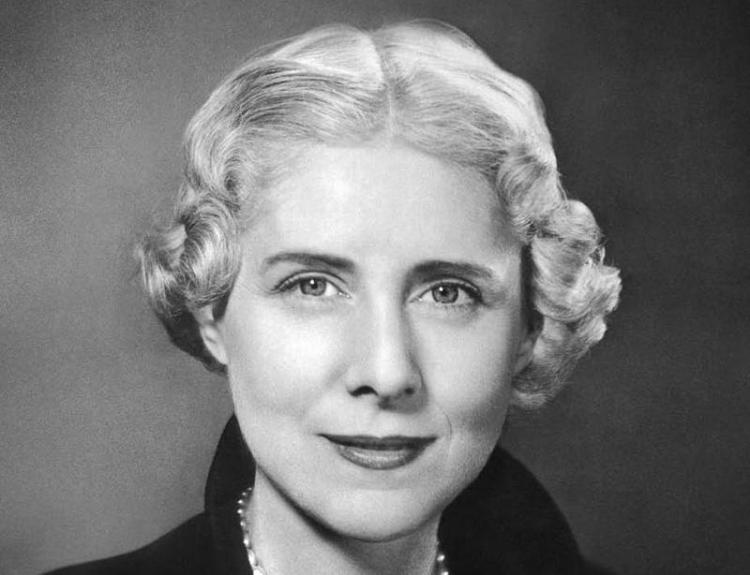
But first, to get a sense of the times and trends that helped shape this series, here’s a notable obituary from 1987 — Clare Boothe Luce.
Clare Boothe Luce was an American writer, politician, U.S. ambassador, and public conservative figure. A versatile author, she is best known for her 1936 hit play The Women, which had an all-female cast. Her writings extended from drama and screen scenarios to fiction, journalism, and war reportage. She was married to Henry Luce, publisher of Time, Life, Fortune, and Sports Illustrated.
Politically, Luce was a leading conservative in later life and was well known for her anti-communism. In her youth, she briefly aligned herself with the liberalism of President Franklin Roosevelt as a protégé of Bernard Baruch but later became an outspoken critic of Roosevelt. Although she was a strong supporter of the Anglo-American alliance in World War II, she remained outspokenly critical of British colonialism in India.
Known as a charismatic and forceful public speaker, especially after her conversion to Roman Catholicism in 1946, she campaigned for every Republican presidential candidate from Wendell Willkie to Ronald Reagan.
In 1973, President Richard Nixon named her to the President’s Foreign Intelligence Advisory Board (PFIAB). She remained on the board until President Jimmy Carter succeeded President Gerald Ford in 1977. By then, she had put down roots in Washington, D.C., that would become permanent in her last years. In 1979, she was the first woman to be awarded the Sylvanus Thayer Award by the United States Military Academy at West Point.
President Reagan reappointed Luce to PFIAB. She served on the board until 1983.
In 1986, Luce was the recipient of the Golden Plate Award of the American Academy of Achievement.
President Reagan awarded her the Presidential Medal of Freedom in 1983. She was the first female member of Congress to receive this award. Upon presenting her with the Presidential Medal of Freedom, Reagan said this of Luce:
“A novelist, playwright, politician, diplomat, and advisor to Presidents, Clare Boothe Luce has served and enriched her country in many fields. Her brilliance of mind, gracious warmth and great fortitude have propelled her to exceptional heights of accomplishment. As a Congresswoman, Ambassador, and Member of the President’s Foreign Intelligence Advisory Board, Clare Boothe Luce has been a persistent and effective advocate of freedom, both at home and abroad. She has earned the respect of people from all over the world, and the love of her fellow Americans.”
Luce died of brain cancer on October 9, 1987, at age 84, at her Watergate apartment in Washington, D.C. She is buried at Mepkin Abbey, South Carolina, a plantation that she and Henry Luce had once owned and given to a community of Trappist monks. She lies in a grave adjoining her mother, daughter, and husband.
Revered in her later years as a heroine of the feminist movement, Luce had mixed feelings about the role of women in society. As a congresswoman in 1943, she was invited to co-sponsor a submission of the Equal Rights Amendment, offered by Representative Louis Ludlow of Indiana, but claimed that the invitation got lost in her mail. Luce never ceased to advise women to marry and provide supportive homes for their husbands. (During her ambassadorial years, at a dinner in Luxembourg attended by many European dignitaries, Luce was heard declaring that all women wanted from men was “babies and security”.) Yet, her own professional career as a successful editor, writer, playwright, reporter, legislator, and diplomat remarkably showed how a woman of humble origins and no college education could raise herself to an escalating series of public heights. Luce bequeathed a large part of her personal fortune of some $50 million to an academic program, the Clare Boothe Luce Program, designed to encourage the entry of women into technological fields traditionally dominated by men. Because of her determination and unwillingness to let her gender stand in the way of her personal and professional achievements, Luce is considered to be an influential role model by many women. Starting from humble beginnings, Luce never allowed her initial poverty or her male counterparts’ lack of respect to keep her from achieving as much as if not more than many of the men surrounding her. In 2017, she was inducted into the National Women’s Hall of Fame.
Since 1989, the Clare Boothe Luce Program (CBLP) has become a significant source of private funding support for women in science, mathematics, and engineering. All awards must be used exclusively in the United States (not applicable for travel or study abroad). Student recipients must be U.S. citizens and faculty recipients must be citizens or permanent residents. Thus far, the program has supported more than 1,500 women. The terms of the bequest require the following criteria: at least fifty percent of the awards go to Roman Catholic colleges, universities, and one high school (Villanova Preparatory School); grants are made only to four-year degree-granting institutions, not directly to individuals.
The program is divided into three distinct categories: undergraduate scholarships and research awards; graduate and postdoctoral fellowships; tenure-track appointment support at the assistant or associate professorship level.
The Clare Boothe Luce Policy Institute (CBLPI) was founded in 1993 by Michelle Easton. The non-profit think tank seeks to advance American women through conservative ideas and espouses much the same philosophy as that of Clare Boothe Luce, in terms of both foreign and domestic policy. The CBLPI sponsors a program that brings conservative speakers to college campuses such as conservative commentator Ann Coulter. The Clare Boothe Luce Award, established in 1991, is The Heritage Foundation’s highest award for distinguished contributions to the conservative movement. Prominent recipients include Ronald Reagan, Margaret Thatcher, and William F. Buckley Jr.
 SCREEN TIME WITH SAM