
Welcome to this podcast installment of my look at the classic family sitcom Full House. Click the play button below to listen.
DISCLAIMER: Some material for this post was derived from various public sources on the Web.
An in-depth look at popular television shows, TV movies, miniseries, and the people behind them
Welcome to this podcast installment of my look at the classic family sitcom Full House. Click the play button below to listen.
DISCLAIMER: Some material for this post was derived from various public sources on the Web.
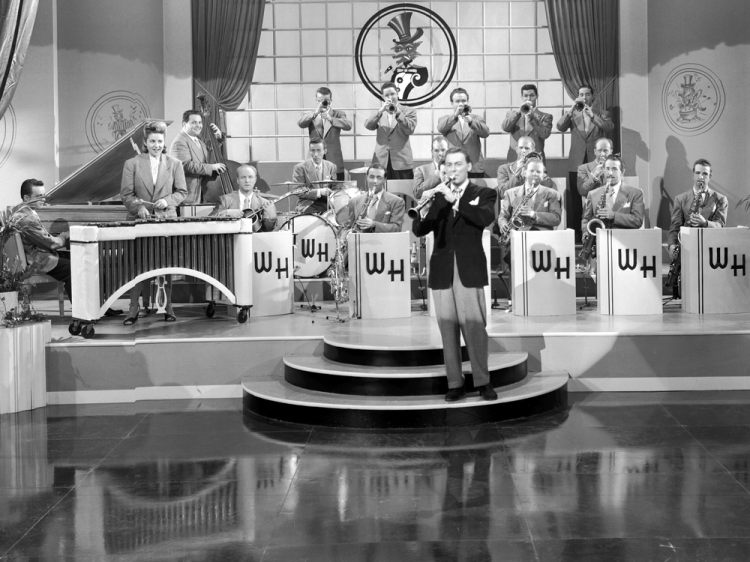
A lot happened in the year 1987, including the debut of a family-friendly TV sitcom set in San Francisco. The name of the show was Full House, and we’ll be doing a deep dive into this popular comedy over the coming weeks.
But first, to get a sense of the times and trends that helped shape this series, here’s a notable obituary from 1987 — Woody Herman.
Woody Herman was an American jazz clarinetist, saxophonist, singer, and big band leader. Leading groups called “The Herd”, Herman came to prominence in the late 1930s and was active until his death in 1987. His bands often played music that was cutting edge and experimental; their recordings received numerous Grammy nominations.
As a child he worked as a singer and tap-dancer in vaudeville, then started to play the clarinet and saxophone by age 12. In 1931 he met Charlotte Neste, an aspiring actress; the couple married on September 27, 1936. Woody Herman joined the Tom Gerun band and his first recorded vocals were “Lonesome Me” and “My Heart’s at Ease”. Herman also performed with the Harry Sosnick orchestra, Gus Arnheim and Isham Jones. Isham Jones wrote many popular songs, including “It Had to Be You” and at some point was tiring of the demands of leading a band. Jones wanted to live off the residuals of his songs; Herman saw the chance to lead his former band and eventually acquired the remains of the orchestra after Jones’ retirement.
Herman’s first band became known for its orchestrations of the blues, and was sometimes billed as “The Band That Plays The Blues”. This band recorded for the Decca label, at first serving as a cover band, doing songs by other Decca artists. The first song recorded was “Wintertime Dreams” on November 6, 1936. In January 1937, George T. Simon ended a review of the band with the words: “This Herman outfit bears watching; not only because it’s fun listening to in its present stages, but also because it’s bound to reach even greater stages.” After two and a half years on the label, the band had its first hit, “Woodchopper’s Ball” recorded in 1939. Herman remembered that “Woodchopper’s Ball” started out slowly. “[I]t was really a sleeper. But Decca kept re-releasing it, and over a period of three or four years it became a hit. Eventually it sold more than five million copies—the biggest hit I ever had.” In January 1942, Herman would have his highest rated single, singing Harold Arlen’s “Blues in the Night” backed by his orchestra. Other hits for the band include “Blue Flame” and “Do Nothin’ Till You Hear from Me”. Musicians and arrangers that stood out included Cappy Lewis on trumpet and saxophonist/arranger Deane Kincaide. “The Golden Wedding” (1941), arranged by James “Jiggs” Noble, featured an extended drum solo by Frankie Carlson.
The trumpeter Dizzy Gillespie wrote three arrangements for Herman, “Woody’n You”, “Swing Shift” and “Down Under”. These were arranged in 1942. “Woody’n You” was not used at the time. “Down Under” was recorded July 24, 1942. Herman’s commissioning Gillespie to write arrangements for the band and hiring Ralph Burns as a staff arranger heralded a change in the style of music the band was playing.
In February 1945, the band started a contract with Columbia Records. Herman liked what drew many artists to Columbia, Liederkranz Hall, at the time the best recording venue in New York City. The first side Herman recorded was “Laura”, the theme song of the 1944 movie. Herman’s version was so successful that it prevented Columbia from releasing the arrangement that Harry James had recorded days earlier. The Columbia contract coincided with a change in the band’s repertoire. The 1944 group, which he called the First Herd, was known for its progressive jazz. The First Herd’s music was heavily influenced by Duke Ellington and Count Basie. Its lively, swinging arrangements, combining bop themes with swing rhythm parts, were greatly admired. As of February 1945, the personnel included Sonny Berman, Pete Candoli, Bill Harris, Flip Phillips, Billy Bauer, Ralph Burns, and Davey Tough. On February 26, 1945, in New York City, the Woody Herman band recorded “Caldonia”.
Neal Hefti and Ralph Burns collaborated on the arrangement of “Caldonia” that the Herman band used. “Ralph caught Louis Jordan [singing “Caldonia”] in an act and wrote the opening twelve bars and the eight-bar tag.” “But the most amazing thing on the record was a soaring eight bar passage by trumpets near the end.” These eight measures have wrongly been attributed to a Gillespie solo, but were in fact originally written by Neal Hefti. George T. Simon compares Hefti with Gillespie in a 1944 review for Metronome magazine saying, “Like Dizzy […], Hefti has an abundance of good ideas, with which he has aided Ralph Burns immensely”.
In 1946, the band won DownBeat, Metronome, Billboard and Esquire polls for best band, nominated by their peers in the big band business.
Classical composer Igor Stravinsky wrote the Ebony Concerto, one in a series of compositions commissioned by Herman with solo clarinet, for this band in 1945. Herman recorded the work at Belock Recording Studio in Bayside, New York. Herman called it a “very delicate and a very sad piece.” Stravinsky felt that the jazz musicians would have a hard time with the various time signatures. Saxophonist Flip Philips said: “During the rehearsal […] there was a passage I had to play there and I was playing it soft, and Stravinsky said ‘Play it, here I am!’ and I blew it louder and he threw me a kiss!” Stravinsky observed the massive amount of smoking at the recording session: “the atmosphere looked like Pernod clouded by water.” Ebony Concerto was performed live by the Herman band on March 25, 1946, at Carnegie Hall.
Despite the Carnegie Hall success and other triumphs, Herman was forced to disband the orchestra in 1946 at the height of its success. This was his only financially successful band; he left it to spend more time with his wife and family. During this time, he and his family had just moved into the former Hollywood home of Humphrey Bogart and Lauren Bacall. One reason Herman may have disbanded was his wife Charlotte’s growing alcoholism and pill addiction. Charlotte Herman joined Alcoholics Anonymous and gave up everything she was addicted to. Woody said, laughing: “I went to an AA meeting with Charlotte and my old band was sitting there.” Many critics cite December 1946 as the actual date the big-band era ended, when seven other bands, in addition to Herman’s, dissolved.
In 1947, Herman organized the Second Herd. This band was also known as “The Four Brothers Band”. This derives from the song recorded December 27, 1947, for Columbia Records, “Four Brothers”, written by Jimmy Giuffre, featuring the saxophone section of Zoot Sims, Serge Chaloff, Herbie Steward, and Stan Getz. The other musicians of this band included Al Cohn, Gene Ammons, Lou Levy, Oscar Pettiford, Terry Gibbs, and Shelly Manne. Among this band’s hits were “Early Autumn”, and “The Goof and I”. The band was popular enough that they went to Hollywood in the mid-1940s. Herman and his band appear in the movie New Orleans (1947) with Billie Holiday and Louis Armstrong.
In 1947, Herman was Emcee and also played at the third Cavalcade of Jazz concert held at Wrigley Field in Los Angeles which was produced by Leon Hefflin, Sr. on September 7, 1947. The Valdez Orchestra, The Blenders, T-Bone Walker, Slim Gaillard, The Honeydrippers, Johnny Otis and his Orchestra, Sarah Vaughn and the Three Blazers also performed that same day.
Herman’s other bands include the Third Herd (1950–56) and various later editions during the 1960s. In the 1950s, the Third Herd successfully toured Europe. He was known for hiring the best young musicians and using their arrangements. In the early and mid 1960s, Herman fronted a Herd featuring Michael Moore, drummer Jake Hanna, tenor saxophonist Sal Nistico, trombonists Phil Wilson and Henry Southall and trumpeters like Bill Chase, Paul Fontaine and Duško Gojković. By 1968, the Herman library came to be heavily influenced by rock and roll. He was also known to feature brass and woodwind instruments rarely associated with jazz, such as the bassoon, oboe or French horn.
In concert, as the evening wore on and the crowd started dissipating, Herman would often leave the stage and let the band continue the last set on its own; but Terry Gibbs confirmed that the band never sounded the same without Herman being present.
In the early 1970s, he toured frequently and began to work more in jazz education, offering workshops and taking on younger sidemen. For this reason, he got the nickname Road Father and the bands were known as the “Young Thundering Herds.” In January 1973, Herman was one of the featured halftime performers at Super Bowl VII. In 1974, Woody Herman’s band appeared without their leader for Frank Sinatra’s television special The Main Event and album The Main Event – Live. Both were recorded mainly on October 13, 1974, at Madison Square Garden in New York City. On November 20, 1976, a reconstituted Woody Herman band played at Carnegie Hall in New York City, celebrating Herman’s fortieth anniversary as a bandleader.
By the 1980s, Herman had returned to more straight-ahead jazz but augmented with rock and fusion. Herman signed a recording contract with Concord Records around 1980. In 1981, John S. Wilson reviewed one of Herman’s first Concord recordings Woody Herman Presents a Concord Jam, Vol. I. Wilson’s review says that the recording presents a band that is less frenetic than his bands from the forties to the seventies. Instead, it takes the listener back to the relaxed style of Herman’s first band of the thirties that recorded for Decca.
Herman continued to perform into the 1980s, after the death of his wife and with his health in decline, chiefly to pay back taxes that were owed because of his business manager’s bookkeeping in the 1960s. Herman owed the IRS millions of dollars and was in danger of eviction from his home. With this added stress, Herman still kept performing. In a December 5, 1985, review of the band at the Blue Note jazz club for The New York Times, John S. Wilson pointed out: “In a one-hour set, Mr. Herman is able to show off his latest batch of young stars—the baritone saxophonist Mike Brignola, the bassist Bill Moring, the pianist Brad Williams, the trumpeter Ron Stout—and to remind listeners that one of his own basic charms is the dry humor with which he shouts the blues.” Wilson also spoke about arrangements by Bill Holman and John Fedchock for special attention. Wilson spoke of the continuing influence of Duke Ellington on Woody Herman bands from the 1940s to the 1980s. Before Woody Herman died in 1987 he delegated most of his duties to leader of the reed section, Frank Tiberi. Tiberi leads the current version of the Woody Herman orchestra. Tiberi said at the time of Herman’s death that he would not change the band’s repertoire or library. Herman died on October 29, 1987, and had a Catholic funeral on November 2 at St. Victor’s in West Hollywood, California. He is interred in a niche in the columbarium behind the Cathedral Mausoleum in the Hollywood Forever Cemetery.
Awards won by the Woody Herman orchestras with major publications: “Voted best swing band in 1945 DownBeat poll; Silver Award by critics in 1946 and 1947 Esquire polls; won Metronome poll, band division, 1946 and 1953.
A documentary film titled Woody Herman: Blue Flame – Portrait of a Jazz Legend was released on DVD in late 2012 by the jazz documentary filmmaker Graham Carter, owner of Jazzed Media, to salute Herman and his centenary in May 2013.

A lot happened in the year 1987, including the debut of a family-friendly TV sitcom set in San Francisco. The name of the show was Full House, and we’ll be doing a deep dive into this popular comedy over the coming weeks.
But first, to get a sense of the times and trends that helped shape this series, here’s a notable obituary from 1987 — Woody Hayes.
Woody Hayes was an American football player and coach. He served as the head coach at Denison University (1946–1948), Miami University in Oxford, Ohio (1949–1950), and Ohio State University (1951–1978), compiling a career college football record of 238 wins, 72 losses, and 10 ties. He was inducted into the College Football Hall of Fame as a coach in 1983.
During his 28 seasons as the head coach of the Ohio State Buckeyes football program, Hayes’s teams were selected five times as national champions, from various pollsters, including three (1954, 1957, 1968) from major wire-service: AP Poll and Coaches’ Poll. Additionally, his Buckeye teams captured 13 Big Ten Conference titles, and amassed a record of 205–61–10.
Over the last decade of his coaching tenure at Ohio State, Hayes’s Buckeye squads faced off in a fierce rivalry against the Michigan Wolverines coached by Bo Schembechler, a former player under and assistant coach to Hayes. During that stretch in the Michigan–Ohio State football rivalry, dubbed “The Ten Year War”, Hayes and Schembechler’s teams won or shared the Big Ten Conference crown every season and usually each placed in the national rankings.
Upon returning to Denison in 1946, Hayes had a hard first year, winning only 2 games, over Capital and the season finale against Wittenberg. However, that victory sparked a 19-game winning streak, a surge that propelled him into the head coaching position at Miami University. Miami is recognized as the “Cradle of Coaches” because of its history of outstanding coaches starting their careers there, such as Paul Brown, Ara Parseghian, Weeb Ewbank, Bill Mallory, Sid Gillman, Randy Walker, and Bo Schembechler. After the 1947 season, Gillman moved down the road to coach at the University of Cincinnati, which was then Miami’s chief rival. Hayes and Gillman maintained a sparkling feud between themselves, combining mutual distaste for the other’s coaching style, and because they were in recruiting competition in the same general area.
In his second year with the Miami Redskins, Hayes led the 1950 team to an appearance in the Salad Bowl, where they defeated Arizona State. That success led him to accept the Ohio State head coaching position on February 18, 1951, in a controversial decision after the university rejected the applications of other more well-known coaches, including former Buckeyes’ head coach Paul Brown, incumbent Buckeye assistant Harry Strobel, and Missouri head coach Don Faurot.
As head coach of the Ohio State Buckeyes, Hayes led his teams to a 205–61–10 record (.761), including three consensus national championships (1954, 1957, and 1968), two other non-consensus national titles (1961 and 1970), 13 Big Ten conference championships, and eight Rose Bowl appearances. Hayes was a three-time winner of The College Football Coach of the Year Award, now known as the Paul “Bear” Bryant Award, and was “the subject of more varied and colorful anecdotal material than any other coach past or present, including fabled Knute Rockne”, according to biographer Jerry Brondfield.
Hayes’ basic coaching philosophy was that “nobody could win football games unless they regarded the game positively and would agree to pay the price that success demands of a team.” His conservative style of football (especially on offense) was often described as “three yards and a cloud of dust”—in other words, a “crunching, frontal assault of muscle against muscle, bone upon bone, will against will.” The basic, bread-and-butter play in Hayes’ playbook was a fullback off-guard run or a tailback off tackle play. Hayes was often quoted as saying “only three things can happen when you pass (a completion, an incompletion, and an interception) and two of them are bad.”
In spite of this apparent willingness to avoid change, Hayes became one of the first major college head coaches to recruit African-American players, including Jim Parker, who played both offensive and defensive tackle on Hayes’ first national championship team in 1954. While Hayes was not the first to recruit African-Americans to Ohio State, he was the first to recruit and start African-Americans in large numbers there and to hire African-American assistant coaches.
Another Hayes recruit, Archie Griffin, was the only two-time Heisman Trophy winner in seven decades of selections. Altogether, Hayes had 58 players earn All-America honors under his tutelage. Many notable football coaches, such as Lou Holtz, Bill Arnsparger, Bill Mallory, Dick Crum, Bo Schembechler, Doyt Perry, Ara Parseghian and Woody’s successor, Earle Bruce, served as his assistants at various times.
Hayes often used illustrations from historical events to make a point in his coaching and teaching. When Hayes was first hired to be the head coach at Ohio State, he was also made a “full professor of physical education”, having earned an M.A. degree in educational administration from Ohio State in 1948. The classes he taught were usually full, and he was called “Professor Hayes” by students. Hayes also taught mandatory English and vocabulary classes to his freshman football players. One of his students was a basketball player named Bobby Knight, who later became a legendary basketball coach.
During his time at Ohio State, Hayes’ relationships with students and faculty members were particularly good. Even those members of the faculty who believed that the role of intercollegiate athletics was growing out of control respected Hayes personally for his commitment to academics, the standards of integrity with which he ran his program, and the genuine enthusiasm he brought to his hobby as an amateur historian. Hayes often ate lunch or dinner at the university’s faculty club, interacting with faculty and administrators.
As a coach and an educator, Hayes was one of the first to use the motion picture as a teaching and learning tool. He was also memorable in that he could often be seen walking across campus, taking the time to visit with students. When talking to young people, Hayes treated all with respect, without regard to race or socio-economic class. This behavior was helpful to Ohio State in quelling the violence and damage from anti-war demonstrations that other college campuses suffered in the late 1960s and early 1970s. He took the time to communicate with student leaders. Then-team quarterback Rex Kern said, “Woody was out there on the Oval with the protesters, and he’d grab a bullhorn and tell the students to express their beliefs but not be destructive. He believed in Nixon, and he believed in the Establishment, but he wasn’t afraid to talk to the students. He wanted to stay close to the action.” Hayes was considered one of the few authority figures that students then had respect for. His enthusiasm for coaching and winning was such that many across the nation consider the following maxim to be true: “What Vince Lombardi was to professional football, Woody Hayes was to college football.”
During his tenure at Ohio State, Hayes joked that he considered himself to be Notre Dame’s best recruiter because if he could not convince a recruit to come to Ohio State instead of Michigan he would try to steer the recruit to Notre Dame, whom Ohio State did not play. While Hayes’ public stance was that he refused to play Notre Dame because he was afraid of polarizing the Catholic population in Ohio, Notre Dame’s long-time athletic director Edward “Moose” Krause said that Hayes had told him that Hayes liked having Michigan as the only tough game on the Ohio State schedule and that having the Buckeyes play Notre Dame would detract from that. Despite Hayes’ apparent fear of playing more than one “tough” game a year, Ohio State still managed to schedule regular-season games with Nebraska, Washington, Southern California, UCLA, and Oklahoma during his tenure.
After losses or ties, Hayes conducted locker room interviews while naked. A journalist from his tenure noted, “He was an ugly guy so it would clear the locker room out pretty fast.”
On December 29, 1978, the Buckeyes played in the Gator Bowl against Clemson. Late in the fourth quarter, Clemson was leading Ohio State 17–15. Freshman quarterback Art Schlichter managed to get Ohio State into field goal range. On third and 5 at the Clemson 24-yard line with 2:30 left and the clock running, Hayes called a pass rather than a run, because Schlichter was having a great game up to that point. Schlichter’s next pass was intercepted by Clemson nose guard Charlie Bauman, who returned it toward the Ohio State sideline, where he was run out of bounds. After Bauman stood up facing the OSU sideline Hayes punched him in the throat, triggering a bench-clearing brawl. Hayes stormed onto the field and was abusive towards the referee. When one of Hayes’ own players, offensive lineman Ken Fritz, tried to intervene, Hayes turned on him and had to be restrained by defensive coordinator George Hill. The Buckeyes were assessed two 15-yard unsportsmanlike conduct penalties for Hayes’ attack on Bauman and his abuse towards the referee. Bauman was not injured by Hayes’ punch and shrugged the incident off. Even though the game was being televised by ABC, neither announcer Keith Jackson nor co-announcer Ara Parseghian saw or commented about the punch. (At the time, all non-press box cameras were operated remotely from another site, and Jackson allegedly did not actually witness the punch, his view of the sidelines being blocked by the upper tier of the stadium).
After the game, Ohio State Athletic Director Hugh Hindman, who had played for Hayes at Miami University and had been an assistant under him for seven years, privately confronted Hayes in the Buckeye locker room. He said that he intended to tell school president Harold Enarson about what happened, and strongly implied that Hayes had coached his last game at Ohio State. After a heated exchange, Hindman said that he then offered Hayes a chance to resign, but Hayes refused, saying, “That would make it too easy for you. You had better go ahead and fire me.” Hindman then met with Enarson at a country club near Jacksonville, and the two agreed that Hayes had to go.
The next morning, Hindman told Hayes that he had been fired. A press conference was held at the hotel where the team had been staying. The team returned to Columbus around noon, and Hayes left the airport in a police car. Regarding Hayes’ dismissal, Enarson said that “there isn’t a university or athletic conference in this country that would permit a coach to physically assault a college athlete.” After the incident, Hayes reflected on his career by saying, “Nobody despises to lose more than I do. That’s got me into trouble over the years, but it also made a man of mediocre ability into a pretty good coach.” About two months after the incident, Hayes called Bauman in his dorm room, but did not apologize for his previous attack on him. Earle Bruce succeeded Hayes as Ohio State’s head coach.
Many years later, Leonard Downie, Jr., former executive editor of The Washington Post and student journalist at Ohio State, said he regretted not reporting an incident in the 1960s where Hayes instructed a player to take off his helmet and then hit him in the head.
According to the 1994 HBO documentary American Coaches: Men of Vision and Victory, Hindman had placed Hayes on notice at the beginning of the 1978 season, not just for the swing at the ABC cameraman during the 1977 Michigan game, but also for hitting a player during practice. In his 1989 autobiography, Michigan’s Bo Schembechler wrote that he believed Hayes, who was diabetic and may have had a high blood sugar level, didn’t believe he struck Bauman. Schembechler also pointed out that Hayes had maintained that all he was trying to do was grab the ball away.
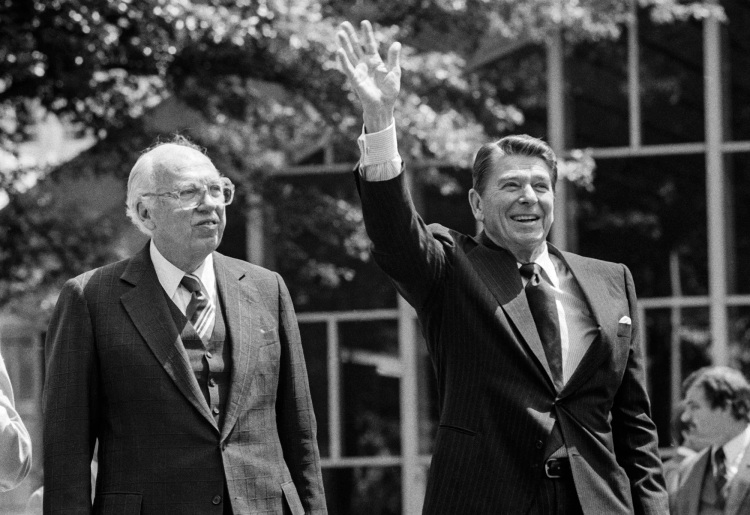
A lot happened in the year 1987, including the debut of a family-friendly TV sitcom set in San Francisco. The name of the show was Full House, and we’ll be doing a deep dive into this popular comedy over the coming weeks.
But first, to get a sense of the times and trends that helped shape this series, here’s a notable obituary from 1987 — William Casey.
William Casey was the Director of Central Intelligence from 1981 to 1987. In this capacity he oversaw the entire United States Intelligence Community and personally directed the Central Intelligence Agency (CIA).
Following his admission to the bar, he was a partner in the New York–based Buckner, Casey, Doran and Siegel from 1938 to 1942. Concurrently, as chairman of the board of editors of the Research Institute of America (1938–1949), Casey initially conceptualized the tax shelter and “explained to businessmen how little they need[ed] to do in order to stay on the right side of New Deal regulatory legislation.”
During World War II, he worked for the Office of Strategic Services, where he became head of its Secret Intelligence Branch in Europe. He served in the United States Naval Reserve until December 1944 before remaining in his OSS position as a civilian until his resignation in September 1945; as an officer, he attained the rank of lieutenant and was awarded the Bronze Star Medal for meritorious achievement.
Following the dissolution of the OSS in September 1945, Casey returned to his legal and business ventures. After serving as a special counsel to the United States Senate (1947–1948) and associate general counsel to the Point Four Program (1948), Casey founded the Institute for Business Planning in 1950; there, he amassed much of his early wealth (compounded by investments) by writing early data-driven publications on business law. He was a lecturer in tax law at the New York University School of Law from 1948 to 1962. From 1957 to 1971, he was a partner at Hall, Casey, Dickler & Howley, a New York corporate law firm, under the auspices of founding partner and prominent Republican politician Leonard W. Hall. He ran as a Republican for New York’s 3rd congressional district in 1966, but was defeated in the primary by former Congressman Steven Derounian.
He served in the Nixon administration as the chairman of the Securities and Exchange Commission from 1971 to 1973; this position led to his being called as a prosecution witness against former Attorney General John N. Mitchell and former Commerce Secretary Maurice Stans in an influence-peddling case stemming from international financier Robert Vesco’s $200,000 contribution to the Nixon reelection campaign.
He then served as Under Secretary of State for Economic Affairs (1973–1974) and chairman of the Export-Import Bank of the United States (1974–1976). During this era, he was also a member of the President’s Foreign Intelligence Advisory Board (1975–1976) and of counsel to Rogers & Wells (1976–1981).
With Antony Fisher, he co-founded the Manhattan Institute in 1978. He is the father-in-law of Owen Smith, Chairman of the Board of Trustees of the Institute of World Politics and Professor Emeritus at Long Island University.
As campaign manager of Ronald Reagan’s successful presidential campaign in 1980, Casey helped to broker Reagan’s unlikely alliance with vice presidential nominee George H. W. Bush. He then served on the transition team following the election.
After Reagan took office, Reagan named Casey to the post of Director of Central Intelligence (DCI). Outgoing Director Stansfield Turner characterized the appointment as the “Resurrection of Wild Bill,” referring to Bill Donovan, the brilliant and eccentric head of Office of Strategic Services in World War II, whom Casey had known and greatly admired.
Despite Casey’s background in intelligence, the position was not his first choice; according to Rhoda Koenig, he only agreed to take the appointment after being assured that “he could have a hand in shaping foreign policy rather than simply reporting the data on which it was based.” Breaking precedent, Reagan elevated the role to a Cabinet-level position for the duration of Casey’s appointment.
Ronald Reagan used prominent Catholics in his government to brief Pope John Paul II of developments in the Cold War. Casey would fly secretly to Rome in a windowless C-141 black jet and “be taken undercover to the Vatican.”
Casey oversaw the re-expansion of the Intelligence Community to funding and human resource levels greater than those existing before the preceding Carter Administration; in particular, he increased levels within the CIA. During his tenure, post-Watergate and Church Committee restrictions were controversially lifted on the use of the CIA to directly and covertly influence the internal and foreign affairs of countries relevant to American policy.
This period of the Cold War saw an increase in the Agency’s global, anti-Soviet activities, which started under the Carter Doctrine in late 1980.
Casey was suspected, by some, of involvement with the controversial Iran-Contra affair, in which Reagan administration personnel secretly traded arms to the Islamic Republic of Iran, and secretly diverted some of the resulting income to aid the rebel Contras in Nicaragua, in violation of U.S. law. Casey was called to testify before Congress about his knowledge of the affair. On 15 December 1986, one day before Casey was scheduled to testify before Congress, Casey suffered two seizures and was hospitalized. Three days later, Casey underwent surgery for a previously undiagnosed brain tumor. While hospitalized, Casey died less than 24 hours after former colleague Richard Secord testified that Casey supported the illegal aiding of the Contras.
In his November, 1987 book, Veil: The Secret Wars of the CIA 1981–1987, Washington Post reporter and biographer Bob Woodward, who had interviewed Casey on a number of occasions for the biography, said that he had gained entry into Casey’s hospital room for a final, four-minute encounter—a claim which was met with disbelief in many quarters as well as an adamant denial from Casey’s wife, Sofia. According to Woodward, when Casey was asked if he knew about the diversion of funds to the Nicaraguan Contras, “His head jerked up hard. He stared, and finally nodded yes.”
In his final report (submitted in August 1993), Independent Counsel Lawrence E. Walsh indicated evidence of Casey’s involvement:
“There is evidence that Casey played a role as a Cabinet-level advocate both in setting up the covert network to resupply the contras during the Boland funding cut-off, and in promoting the secret arms sales to Iran in 1985 and 1986. In both instances, Casey was acting in furtherance of broad policies established by President Reagan.
There is evidence that Casey, working with two national security advisers to President Reagan during the period 1984 through 1986—Robert C. McFarlane and Vice Admiral John M. Poindexter—approved having these operations conducted out of the National Security Council staff with Lt. Col. Oliver L. North as the action officer, assisted by retired Air Force Maj. Gen. Richard V. Secord. And although Casey tried to insulate himself and the CIA from any illegal activities relating to the two secret operations … There is evidence that he was involved in at least some of those activities and may have attempted to keep them concealed from Congress.”
However, Walsh also wrote: “Independent Counsel obtained no documentary evidence showing Casey knew about or approved the diversion. The only direct testimony linking Casey to early knowledge of the diversion came from [Oliver] North.” Posthumously, the House October Surprise Task Force eventually exonerated Casey after first holding hearings to establish a need for investigation, the outcome of the investigation, the response of Casey’s family to the task force’s closure of the investigation, and Walsh’s final Independent Counsel report.
Casey was a member of the Knights of Malta. In 1948, he purchased Locust Knoll, an 8.2 acres North Shore estate centered around a main 1854 Jacobethan house in Roslyn Harbor, New York, for $50,000. After renaming the estate Mayknoll, it remained his principal residence until his death.
Casey died of a brain tumor on May 6, 1987, at the age of 74. His Requiem Mass was said by Fr. Daniel Fagan, then pastor of St. Mary’s Roman Catholic Church in Roslyn, New York, and his funeral was led by Bishop John R. McGann, who used his pulpit to castigate Casey for his ethics and actions in Nicaragua. It was attended by President Reagan and the First Lady. Casey is buried in the Cemetery of the Holy Rood in Westbury, New York.
He was survived by his wife, the former Sophia Kurz who died in 2000, and his daughter, Bernadette Casey Smith.

A lot happened in the year 1987, including the debut of a family-friendly TV sitcom set in San Francisco. The name of the show was Full House, and we’ll be doing a deep dive into this popular comedy over the coming weeks.
But first, to get a sense of the times and trends that helped shape this series, here’s a notable obituary from 1987 — Will Sampson.
Will Sampson was a Muscogee painter, actor, and rodeo performer. He is best known for his performance as the apparently deaf and mute Chief Bromden, the title role in One Flew Over the Cuckoo’s Nest and as Crazy Horse in the 1977 western The White Buffalo, as well as his roles as Taylor in Poltergeist II: The Other Side and Ten Bears in 1976’s The Outlaw Josey Wales.
Sampson competed in rodeos for about 20 years. His specialty was bronco busting, and he was on the rodeo circuit when producers Saul Zaentz and Michael Douglas — of One Flew Over the Cuckoo’s Nest — were looking for a large Native American to play the role of Chief Bromden. Sampson stood an imposing 6’7″ (2.01 m) tall. Rodeo announcer Mel Lambert mentioned Sampson to them, and after lengthy efforts to find him, they hired him on the strength of an interview although had never acted before.
Sampson’s most notable roles were as Chief Bromden in One Flew Over the Cuckoo’s Nest and as Taylor the Medicine Man in the horror film Poltergeist II. He had a recurring role on the TV series Vega$ as Harlon Two Leaf, and starred in the movies Fish Hawk, The Outlaw Josey Wales, and Orca. Sampson appeared in the production of Black Elk Speaks with the American Indian Theater Company in Tulsa, Oklahoma, where David Carradine and other Native American actors (such as Wes Studi and Randolph Mantooth) have appeared in stage productions. He also played Crazy Horse in The White Buffalo with Charles Bronson and the archetypal Elevator Attendant in Nicolas Roeg’s 1985 film, Insignificance. In 1980 Sampson was nominated for a Genie Award for “Best Performance by a Foreign Actor” for his role in Fish Hawk.
Sampson was a visual artist. His large painting depicting the Ribbon Dance of the Muscogee (Creek) is in the collection of the Creek Council House Museum in Okmulgee, Oklahoma. His artwork has been shown at the Gilcrease Museum and the Philbrook Museum of Art.
Sampson suffered from scleroderma, a chronic degenerative condition that affected his heart, lungs, and skin. During his lengthy illness, his weight fell from 260 lb (120 kg) to 140 lb (64 kg), causing complications related to malnutrition. After undergoing a heart and lung transplant at Houston Methodist Hospital in Houston, he died on June 3, 1987, of post-operative kidney failure. Sampson was 53 years old. Sampson was interred at Graves Creek Cemetery in Hitchita, Oklahoma. Will Sampson Road, in Okmulgee County (east of Highway 75 near Preston, Oklahoma), is named after him.
During the filming of The White Buffalo, Sampson halted production by refusing to act when he discovered that producers had hired white actors to portray Native Americans for the film. In 1983, with assistance from his personal secretary Zoe Escobar, Sampson founded the “American Indian Registry for the Performing Arts” for Native American actors. He also served on the registry’s Board of Directors. Sampson’s son Tim Sampson appeared on the FX Show It’s Always Sunny In Philadelphia Season 4 episode 10 titled “Sweet Dee Has A Heart Attack”. The episode pays homage to Will Sampson and his work as Chief Bromden in One Flew Over The Cuckoo’s Nest. Tim Sampson plays “Tonto” after Frank (Danny DeVito) is mistaken as mentally incompetent and placed within a facility.
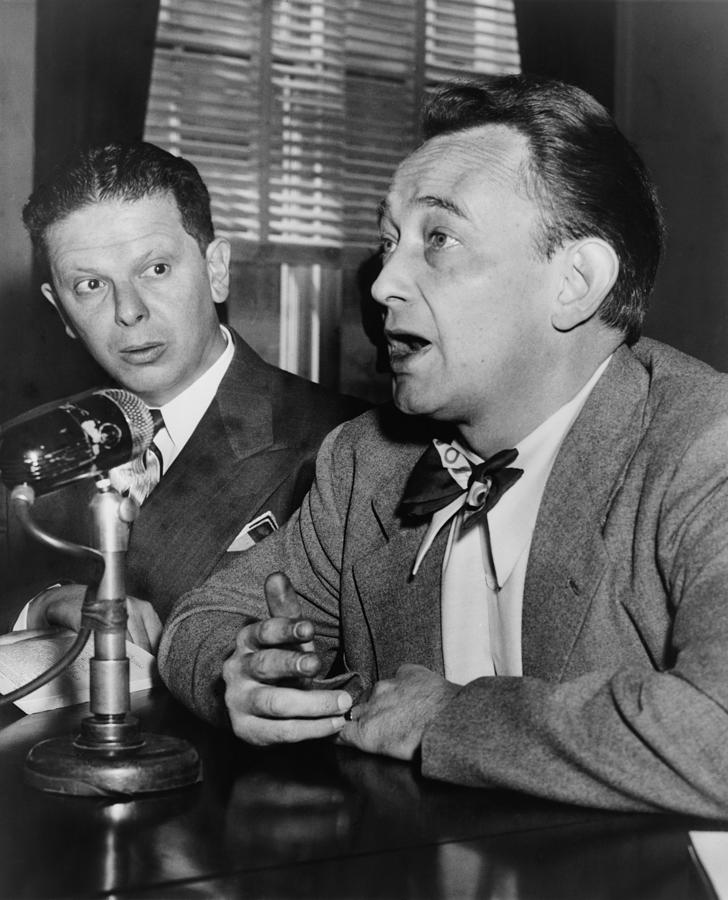
A lot happened in the year 1987, including the debut of a family-friendly TV sitcom set in San Francisco. The name of the show was Full House, and we’ll be doing a deep dive into this popular comedy over the coming weeks.
But first, to get a sense of the times and trends that helped shape this series, here’s a notable obituary from 1987 — Waldo Salt.
Waldo Salt was an American screenwriter who won Academy Awards for both Midnight Cowboy and Coming Home.
Salt was born in Chicago, Illinois, the son of Winifred (née Porter) and William Haslem Salt, an artist and business executive. He graduated from Stanford University in 1934. The first of the nineteen films he wrote or co-wrote was released in 1937 with the title The Bride Wore Red.
Salt’s career in Hollywood was interrupted when he was blacklisted after refusing to testify before the House Committee on Un-American Activities in 1951. Like many other blacklisted writers, while he was unable to work in Hollywood, Salt wrote under a pseudonym for the British television series The Adventures of Robin Hood.
After the collapse of the blacklist, Salt won Academy Awards for Best Writing, Screenplay Based on Material from Another Medium for his work on Midnight Cowboy and Coming Home, as well as earning a nomination for Serpico.
Salt is featured in the extras for the Criterion Collection’s Midnight Cowboy blu-ray release, specifically in an audio interview with Michael Childers; many photos of Waldo Salt can be seen here as he was a collaborator for the screenplay. The documentary, Waldo Salt: A Screenwriter’s Journey, is also featured on the disc.

A lot happened in the year 1987, including the debut of a family-friendly TV sitcom set in San Francisco. The name of the show was Full House, and we’ll be doing a deep dive into this popular comedy over the coming weeks.
But first, to get a sense of the times and trends that helped shape this series, here’s a notable obituary from 1987 — Rudolf Hess.
Rudolf Hess was a German politician and a leading member of the Nazi Party in Nazi Germany. Appointed Deputy Führer to Adolf Hitler in 1933, Hess held that position until 1941, when he flew solo to Scotland in an attempt to negotiate the United Kingdom’s exit from the Second World War. He was taken prisoner and eventually convicted of crimes against peace. He was still serving his life sentence at the time of his suicide in 1987.
Hess enlisted as an infantryman in the Imperial German Army at the outbreak of World War I. He was wounded several times during the war and was awarded the Iron Cross, 2nd Class, in 1915. Shortly before the war ended, Hess enrolled to train as an aviator, but he saw no action in that role. He left the armed forces in December 1918 with the rank of Leutnant der Reserve. In 1919, Hess enrolled in the University of Munich, where he studied geopolitics under Karl Haushofer, a proponent of the concept of Lebensraum (‘living space’), which became one of the pillars of Nazi ideology. Hess joined the Nazi Party on July 1, 1920 and was at Hitler’s side on November 8, 1923 for the Beer Hall Putsch, a failed Nazi attempt to seize control of the government of Bavaria. While serving a prison sentence for this attempted coup, he assisted Hitler with Mein Kampf, which became a foundation of the political platform of the Nazi Party.
After Hitler became Chancellor in January 1933, Hess was appointed Deputy Führer of the Nazi Party in April. He was elected to the Reichstag in the March elections, was made a Reichsleiter of the Nazi Party in June and in December 1933 he became Minister without Portfolio in Hitler’s cabinet. He was also appointed in 1938 to the Cabinet Council and in August 1939 to the Council of Ministers for Defence of the Reich. Hitler decreed on the outbreak of war on September 1, 1939 that Hermann Göring was his official successor, and named Hess as next in line. In addition to appearing on Hitler’s behalf at speaking engagements and rallies, Hess signed into law much of the government’s legislation, including the Nuremberg Laws of 1935, which stripped the Jews of Germany of their rights in the lead-up to the Holocaust.
On May 10, 1941, Hess made a solo flight to Scotland, where he hoped to arrange peace talks with the Duke of Hamilton, whom he believed to be a prominent opponent of the British government’s war policy. The British authorities arrested Hess immediately on his arrival and held him in custody until the end of the war, when he was returned to Germany to stand trial at the 1946 Nuremberg trials of major war criminals. During much of his trial, Hess claimed to be suffering from amnesia, but he later admitted to the court that this had been a ruse. The court convicted him of crimes against peace and of conspiracy with other German leaders to commit crimes. He served a life sentence in Spandau Prison; the Soviet Union blocked repeated attempts by family members and prominent politicians to procure his early release. While still in custody as the only prisoner in Spandau, he hanged himself in 1987 at the age of 93.
After his death, the prison was demolished to prevent it from becoming a neo-Nazi shrine. His grave, bearing the inscription “Ich hab’s gewagt” (I dared it), became a site of regular pilgrimage and demonstrations by Neo-Nazis. In 2011, authorities refused to renew the lease on the gravesite, and his remains were exhumed and cremated.
Within weeks of the outbreak of World War I, Hess enlisted in the 7th Bavarian Field Artillery Regiment, part of the 1st Royal Bavarian Division. His initial posting was against the British on the Somme; he was present at the First Battle of Ypres. On November 9, 1914, Hess transferred to the 1st Infantry Regiment, stationed near Arras. He was awarded the Iron Cross, second class, and promoted to Gefreiter (corporal) in April 1915. After additional training at the Munster Training Area, he was promoted to Vizefeldwebel (senior non-commissioned officer) and received the Bavarian Military Merit Cross. Returning to the front lines in November, he fought in Artois, participating in the battle for the town of Neuville-Saint-Vaast. After two months out of action with a throat infection, Hess served in the Battle of Verdun in May, and was hit by shrapnel in the left hand and arm on June 12, 1916 during fighting near the village of Thiaumont. After a month off to recover, he was sent back to the Verdun area, where he remained until December.
Hess was promoted to platoon leader of the 10th Company of the 18th Bavarian Reserve Infantry Regiment, which was serving in Romania. He was wounded on July 23 and again on August 8, 1917; the first injury was a shell splinter to the left arm, which was dressed in the field, but the second was a bullet wound that entered the upper chest near the armpit and exited near his spinal column, leaving a pea-sized entry wound and a cherry stone-sized exit wound on his back.
By August 20, he was well enough to travel, so he was sent to hospital in Hungary and eventually back to Germany, where he recovered in hospital in Meissen. In October he received promotion to Leutnant der Reserve and was recommended for, but did not receive, the Iron Cross, first class. At his father’s request, Hess was transferred to a hospital closer to home, arriving at Alexandersbad on October 25.
While still convalescing, Hess had requested that he be allowed to enroll to train as a pilot, so after Christmas leave with his family, he reported to Munich. He received basic flight training at Oberschleissheim and Lechfeld Air Base from March to June 1918, and advanced training at Valenciennes in France in October. On October 14, he was assigned to Jagdstaffel 35b, a Bavarian fighter squadron equipped with Fokker D.VII biplanes. He saw no action with Jagdstaffel 35b, as the war ended on November 11, 1918, before he had the opportunity.
Hess was discharged from the armed forces in December 1918. The family fortunes had taken a serious downturn, as their business interests in Egypt had been expropriated by the British. Hess joined the Thule Society, an antisemitic right-wing Völkisch group, and the Freikorps of Colonel Ritter von Epp, one of many such volunteer paramilitary organisations active in Germany at the time.
Bavaria witnessed frequent and often bloody conflicts between right-wing groups, the Freikorps, and left-wing forces as they fought for control of the state during this period. Hess was a participant in street battles in early 1919 and led a group that distributed thousands of antisemitic pamphlets in Munich. He later said that Egypt made him a nationalist, the war made him a socialist, and Munich made him an antisemite.
In 1919, Hess enrolled in the University of Munich, where he studied history and economics. His geopolitics professor was Karl Haushofer, a former general in the German Army who was a proponent of the concept of Lebensraum (“living space”), which Haushofer cited to justify the proposal that Germany should forcefully conquer additional territory in Eastern Europe. Hess later introduced this concept to Adolf Hitler, and it became one of the pillars of Nazi Party ideology. Hess became friends with Haushofer and his son Albrecht, a social theorist and lecturer.
Ilse Pröhl, a fellow student at the university, met Hess in April 1920 when they by chance rented rooms in the same boarding house. They married on December 20, 1927 and their only child, Wolf Rüdiger Hess, was born ten years later, on November 18, 1937. His name was, at least in part, to honour Hitler, who often used “Wolf” as a code name. Hess nicknamed the boy “Buz”.
After hearing the Nazi Party leader Hitler speak for the first time in 1920 at a Munich rally, Hess became completely devoted to him. They held a shared belief in the stab-in-the-back myth, the notion that Germany’s loss in World War I was caused by a conspiracy of Jews and Bolsheviks rather than a military defeat. Hess joined the Nazi Party on July 1 as member number 16. As the party continued to grow, holding rallies and meetings in ever larger beer halls in Munich, he focused his attention on fundraising and organizational activities. On November 4, 1921, he was injured while protecting Hitler when a bomb planted by a Marxist group exploded at the Hofbräuhaus during a party event. Hess joined the Sturmabteilung (SA) by 1922 and helped organize and recruit its early membership.
Meanwhile, problems continued with the economy; hyperinflation caused many personal fortunes to be rendered worthless. When the German government failed to meet its reparations payments and French troops marched in to occupy the industrial areas along the Ruhr in January 1923, widespread civil unrest was the result. Hitler decided the time was ripe to attempt to seize control of the government with a coup d’état modelled on Benito Mussolini’s 1922 March on Rome. Hess was with Hitler on the night of November 8, 1923 when he and the SA stormed a public meeting organized by Bavaria’s de facto ruler, Staatskommissar (state commissioner) Gustav von Kahr, in the Bürgerbräukeller, a large beer hall in Munich. Brandishing a pistol, Hitler interrupted Kahr’s speech and announced that the national revolution had begun, declaring the formation of a new government with World War I General Erich Ludendorff. The next day, Hitler and several thousand supporters attempted to march to the Ministry of War in the city centre. Gunfire broke out between the Nazis and the police; sixteen marchers and four police officers were killed. Hitler was arrested on November 11.
Hess and some SA men had taken a few of the dignitaries hostage on the night of the 8th, driving them to a house about 50 kilometres (31 mi) from Munich. When Hess left briefly to make a phone call the next day, the hostages convinced the driver to help them escape. Hess, stranded, called Ilse Pröhl, who brought him a bicycle so he could return to Munich. He went to stay with the Haushofers and then fled to Austria, but they convinced him to return. He was arrested and sentenced to 18 months in prison for his role in the attempted coup, which later became known as the Beer Hall Putsch. Hitler was sentenced to five years imprisonment, and the Nazi Party and SA were both outlawed.
Both men were incarcerated in Landsberg Prison, where Hitler soon began work on his memoir, Mein Kampf (“My Struggle”), which he dictated to fellow prisoners Hess and Emil Maurice. Edited by publisher Max Amann, Hess and others, the work was published in two parts in 1925 and 1926. It was later released in a single volume, which became a best-seller after 1930. This book, with its message of violent antisemitism, became the foundation of the political platform of the Nazi Party.
Hitler was released on parole on 20 December 1924 and Hess ten days later. The ban on the Nazi Party and SA was lifted in February 1925, and the party grew to 100,000 members in 1928 and 150,000 in 1929. They received only 2.6 per cent of the vote in the 1928 election, but support increased steadily up until the seizure of power in 1933.
Hitler named Hess his private secretary in April 1925 at a salary of 500 Reichsmarks per month, and named him as personal adjutant on July 20, 1929. Hess accompanied Hitler to speaking engagements around the country and became his friend and confidante. Hess was one of the few people who could meet with Hitler at any time without an appointment. His influence in the Party continued to grow. On December 15, 1932 Hess was named head of the Party Liaison Staff and Chairman of the Party Central Political Commission.
Retaining his interest in flying after the end of his active military career, Hess obtained his private pilot’s licence on April 4, 1929. His instructor was World War I flying ace Theodor Croneiss. In 1930 Hess became the owner of a BFW M.23b monoplane sponsored by the party newspaper, the Völkischer Beobachter. He acquired two more Messerschmitt aircraft in the early 1930s, logging many flying hours and becoming proficient in the operation of light single-engine aircraft.
On January 30, 1933, Hitler was appointed Reich Chancellor, his first step in gaining dictatorial control of Germany. Hess was named Deputy Führer (Stellvertreter des Führers) of the Nazi Party on April 21. On June 2, 1933 he was made one of 16 Reichsleiters in the Party hierarchy. On July 1 he was raised to the rank of Obergruppenführer in the Schutzstaffel (SS). However, by September 20 Hitler decreed that he stop using the titles of Reichsleiter and Obergruppenführer, and use only the title of “Deputy Fuhrer”. This was an acknowledgement of his primus inter pares status in the Party. Hess was appointed to the cabinet as a Reich Minister without Portfolio, on 1 December. With offices in the Brown House in Munich and another in Berlin, Hess was responsible for several departments, including foreign affairs, finance, health, education and law. Hess also was named as a member of Hans Frank’s Academy for German Law. All legislation passed through his office for approval, except that concerning the army, the police and foreign policy, and he wrote and co-signed many of Hitler’s decrees. An organiser of the annual Nuremberg Rallies, he usually gave the opening speech and introduced Hitler. Hess also spoke over the radio and at rallies around the country, so frequently that the speeches were collected into book form in 1938. Hess acted as Hitler’s delegate in negotiations with industrialists and members of the wealthier classes. As Hess had been born abroad, Hitler had him oversee the Nazi Party groups such as the NSDAP/AO that were in charge of party members living in other countries. Hitler instructed Hess to review all court decisions that related to persons deemed enemies of the Party. He was authorised to increase the sentences of anyone he felt got off too lightly in these cases, and was also empowered to take “merciless action” if he saw fit to do so. This often entailed sending the person to a concentration camp or simply ordering the person killed.
In 1933, Hess founded the Volksdeutscher Rat (Council of Ethnic Germans) to handle the Nazi Party’s relations with ethnic German minorities around the world, with a particular focus on Eastern Europe. The purpose of the council was to protect the Nazi Party from criticism that it was attempting to extend the process of Gleichschaltung to international ethnic German communities. Despite Hess’s claims to the contrary, the council members were primarily loyal to Germany rather than their current nations. The eight council members, only one of which was a member of the Nazi Party, were responsible only to Hess. All had long been known to either Hess or Haushofer, who was also involved with the council. Members publicly claimed to be uninvolved in the council, which Hess used as proof that the Nazi Party was not trying to interfere in the domestic affairs of other nations. As the council had considerable funds and appeared to be sufficiently independent of the German government to satisfy foreign governments, its activities had some impact on international German communities in the 1930s. Its most notable impact was in the Sudetenland, where in 1933 it promoted Konrad Henlein as the politician with the best hope of building a Nazi-friendly party that would win mass support without being banned by the Czechoslovak government.
The Nazi regime began to persecute Jews soon after the seizure of power. Hess’s office was partly responsible for drafting Hitler’s Nuremberg Laws of 1935. These laws had far-reaching implications for the Jews of Germany, banning marriage between non-Jewish and Jewish Germans and depriving non-Aryans of their German citizenship. Hess’s friend Karl Haushofer and his family were subject to these laws, as Haushofer had married a half-Jewish woman, so Hess issued documents exempting them from this legislation.
Hess did not build a power base or develop a coterie of followers. He was motivated by his loyalty to Hitler and a desire to be useful to him; he did not seek power or prestige or take advantage of his position to accumulate personal wealth. He lived in a modest house in Munich. Hess was devoted to the völkisch ideology and viewed many issues in terms of an alleged Jewish conspiracy against Germany. For example, he said in a speech that “Today’s League of Nations is really only a farce which functions primarily as the basis for the Jews to reach their own aims. You need only to note how many Jews sit in the League.” In a speech in 1937, Hess blamed the Spanish Civil War on “international Jewry”, called the Soviet Foreign Commissar Maxim Litvinov a “dirty Jew”, and claimed that without Hitler or Mussolini, “Jewish Asiatic Bolshevism would dominate European culture”.
On August 30, 1939, immediately prior to the outbreak of the Second World War, Hess was appointed by Hitler to the six-person Council of Ministers for Defense of the Reich which was set up to operate as a war cabinet. After the Invasion of Poland and the start of the war on September 1, 1939, Hitler made Hess second in line to succeed him, after Hermann Göring. Around the same time, Hitler appointed Hess’s chief of staff, Martin Bormann, as his personal secretary, a post formerly held by Hess. On October 8, 1939, Hess co-signed the law that annexed the Free City of Danzig, the Polish Corridor, and the part of Upper Silesia lost in 1921 to Germany. On the same day, Hess and Heinrich Himmler ordered that a racial registry be established in these areas and stated that Poles and Jews living in these areas were not to be treated as equals of Germans. A separate legal code for Poles and Jews in the annexed areas was created, imposing draconian punishments. Hess argued that a separate legal code was necessary because “the Pole is less susceptible to the infliction of ordinary punishment”. In another decree, Hess ordered that none of the buildings destroyed in Warsaw during the siege were to be rebuilt as a reminder to the Poles of their “war guilt”.
Hess’s antisemitism markedly increased after the war started, as he was convinced that the war had been caused by Jews. This became a major theme of his wartime speeches. In a speech given on April 20, 1940 to mark Hitler’s 51st birthday, Hess accused “Jews and their fellow travellers” of Germany’s capitulation in November 1918, which he called the most calamitous event in world history. In the same speech, Hess, referring to the Black Horror on the Rhine story, stated the defeat of 1918 was followed by an occupation of the Rhineland by “[n-words]”, which he again blamed on the Jews. Hess concluded his speech by saying that with Hitler in charge, there was no possibility of the current war ending similarly. “How the Jewish hounds will howl when Adolf Hitler stands before them”, he concluded.
Hess was obsessed with his health to the point of hypochondria, consulting many doctors and other practitioners for what he described to his captors in Britain as a long list of ailments involving the kidneys, colon, gall bladder, bowels and heart. Hess was a vegetarian, and he did not smoke or drink. He brought his own food to the Berghof, claiming it was biologically dynamic, but Hitler did not approve of this practice, so he discontinued taking meals with the Führer.
Hess was interested in music, enjoyed reading and loved to spend time hiking and climbing in the mountains with his wife, Ilse. He and his friend Albrecht Haushofer shared an interest in astrology, and Hess also was keen on clairvoyance and the occult. Hess continued to be interested in aviation. He won an air race in 1934, flying a BFW M.35 in a circuit around Zugspitze Mountain and returning to the airfield at Munich with a time of 29 minutes. He placed sixth of 29 participants in a similar race held the following year. With the outbreak of World War II, Hess asked Hitler to be allowed to join the Luftwaffe as a pilot, but Hitler forbade it, and ordered him to stop flying for the duration of the war. Hess convinced him to reduce the ban to one year
As the war progressed, Hitler’s attention became focused on foreign affairs and the conduct of the war. Hess, who was not directly engaged in the war, became increasingly sidelined from the affairs of the nation and from Hitler’s attention; Bormann had successfully supplanted Hess in many of his duties and had taken Hess’s position at Hitler’s side. Hess was concerned that Germany would face a war on two fronts as plans progressed for Operation Barbarossa, the invasion of the Soviet Union scheduled to take place in 1941. Hess decided to attempt to bring Britain to the negotiating table by travelling there himself to seek meetings with the British government.
On August 31, 1940, Hess met with Karl Haushofer. Haushofer told Hess that he believed that King George VI was opposed to Churchill and would dismiss him and send him to Canada at the first opportunity. Haushofer spoke of his belief that it was possible to make contact with the king via either General Ian Hamilton or the Duke of Hamilton. Hess decided they should contact his fellow aviator the Duke of Hamilton, whom he had never met. Hess chose Hamilton in the mistaken belief that he was one of the leaders of a party opposed to war with Germany, and because Hamilton was a friend of Haushofer. On Hess’s instructions, Haushofer wrote to Hamilton in September 1940, but the letter was intercepted by MI5 and Hamilton did not see it until March 1941.
A letter Hess wrote to his wife dated November 4, 1940 shows that in spite of not receiving a reply from Hamilton, he intended to proceed with his plan. He began training on the Messerschmitt Bf 110, a two-seater twin-engine aircraft, in October 1940 under instructor Wilhelm Stör, the chief test pilot at Messerschmitt. He continued to practise, including logging many cross-country flights, and found a specific aircraft that handled well—a Bf 110E-1/N—which was from then on held in reserve for his personal use. He asked for a radio compass, modifications to the oxygen delivery system, and large long-range fuel tanks to be installed on this plane, and these requests were granted by March 1941.
After a final check of the weather reports for Germany and the North Sea, Hess took off at 17:45 on May 10, 1941 from the airfield at Augsburg-Haunstetten in his specially prepared aircraft. It was the last of several attempts to depart on his mission; previous efforts had to be called off due to mechanical problems or poor weather. Wearing a leather flying suit bearing the rank of captain, he brought along a supply of money and toiletries, a torch, a camera, maps and charts, and a collection of 28 different medicines, as well as dextrose tablets to help ward off fatigue and an assortment of homeopathic remedies.
Initially setting a course towards Bonn, Hess used landmarks on the ground to orient himself and make minor course corrections. When he reached the coast near the Frisian Islands, he turned and flew in an easterly direction for twenty minutes to stay out of range of British radar. He then took a heading of 335 degrees for the trip across the North Sea, initially at low altitude, but travelling for most of the journey at 5,000 feet (1,500 m). At 20:58 he changed his heading to 245 degrees, intending to approach the coast of North East England near the village of Bamburgh, Northumberland. As it was not yet sunset when he initially approached the coast, Hess backtracked, zigzagging back and forth for 40 minutes until it grew dark. Around this time his auxiliary fuel tanks were exhausted, so he released them into the sea. Also around this time, at 22:08, the British Chain Home station at Ottercops Moss near Newcastle upon Tyne detected his presence and informed the Filter Room at Bentley Priory. Soon he was detected by several other stations, and the aircraft was designated as “Raid 42”.
Two Spitfires of No. 72 Squadron RAF, No. 13 Group RAF that were already in the air were sent to attempt an interception, but failed to find the intruder. A third Spitfire sent from Acklington at 22:20 also failed to spot the aircraft; by then it was dark and Hess had dropped to an extremely low altitude, so low that the volunteer on duty at the Royal Observer Corps (ROC) station at Chatton was able to correctly identify it as a Bf 110, and reported its altitude as 50 feet (15 m). Tracked by additional ROC posts, Hess continued his flight into Scotland at high speed and low altitude, but was unable to spot his destination, Dungavel House, so he headed for the west coast to orient himself and then turned back inland. At 22:35 a Boulton Paul Defiant sent from No. 141 Squadron RAF based at Ayr began pursuit. Hess was nearly out of fuel, so he climbed to 6,000 feet (1,800 m) and parachuted out of the plane at 23:06. He injured his foot, either while exiting the aircraft or when he hit the ground. The aircraft crashed at 23:09, about 12 miles (19 km) west of Dungavel House, the Duke of Hamilton’s home. He would have been closer to his destination had he not had trouble exiting the aircraft. Hess considered this achievement to be the proudest moment of his life.
Before his departure from Germany, Hess had given his adjutant, Karlheinz Pintsch, a letter addressed to Hitler that detailed his plans to initiate peace negotiations with the UK. Hess intended to approach the Duke of Hamilton at his home in Scotland, hoping that the duke might then be willing to advocate for and assist him negotiate peace with Germany on terms that would be acceptable to Hitler. Pintsch delivered the letter to Hitler at the Berghof around noon on May 11. After reading the letter, Hitler let loose a cry heard throughout the entire Berghof and sent for a number of his inner circle, concerned that a putsch might be underway.
Hitler worried that his allies, Italy and Japan, would perceive Hess’s act as an attempt by Hitler to secretly open peace negotiations with the British. Hitler contacted Mussolini specifically to reassure him otherwise. For this reason, Hitler ordered that the German press should characterise Hess as a madman who made the decision to fly to Scotland entirely on his own, without Hitler’s knowledge or authority. Subsequent German newspaper reports described Hess as “deluded, deranged,” indicating that his mental health had been affected by injuries sustained during World War I. Some members of the government, including Göring and Propaganda Minister Joseph Goebbels, believed this only made matters worse, because if Hess truly were mentally ill, he should not have held an important government position.
Hitler stripped Hess of all of his party and state offices, and secretly ordered him shot on sight if he ever returned to Germany. He abolished the post of Deputy Führer, assigning Hess’s former duties to Bormann, with the title of Head of the Party Chancellery. Bormann used the opportunity afforded by Hess’s departure to secure significant power for himself. Meanwhile, Hitler initiated Aktion Hess, a flurry of hundreds of arrests of astrologers, faith healers and occultists that took place around June 9. The campaign was part of a propaganda effort by Goebbels and others to denigrate Hess and to make scapegoats of occult practitioners.
US journalist Hubert Renfro Knickerbocker, who had met both Hitler and Hess, speculated that Hitler had sent Hess to deliver a message informing Winston Churchill of the forthcoming invasion of the Soviet Union, and offering a negotiated peace or even an anti-Bolshevik partnership. Soviet leader Joseph Stalin believed that Hess’s flight had been engineered by the British. Stalin persisted in this belief as late as 1944, when he mentioned the matter to Churchill, who insisted that they had no advance knowledge of the flight. While some sources reported that Hess had been on an official mission, Churchill later stated in his book The Grand Alliance that in his view, the mission had not been authorized. “He came to us of his own free will, and, though without authority, had something of the quality of an envoy”, said Churchill, and referred to Hess’s plan as one of “lunatic benevolence”.
After the war, Albert Speer discussed the rationale for the flight with Hess, who told him that “the idea had been inspired in him in a dream by supernatural forces. We will guarantee England her empire; in return she will give us a free hand in Europe.” While in Spandau prison, Hess told journalist Desmond Zwar that Germany could not win a war on two fronts. “I knew that there was only one way out – and that was certainly not to fight against England. Even though I did not get permission from the Führer to fly I knew that what I had to say would have had his approval. Hitler had great respect for the English people …” Hess wrote that his flight to Scotland was intended to initiate “the fastest way to win the war.
Shortly before midnight on May 10, 1941, Hess landed at Floors Farm, by Waterfoot, south of Glasgow, where he was discovered still struggling with his parachute by local ploughman David McLean. Identifying himself as “Hauptmann Alfred Horn”, Hess said he had an important message for the Duke of Hamilton. McLean helped Hess to his nearby cottage and contacted the local Home Guard unit, who escorted the captive to their headquarters in Busby, East Renfrewshire. He was next taken to the police station at Giffnock, arriving after midnight; he was searched and his possessions confiscated. Hess repeatedly requested to meet with the Duke of Hamilton during questioning undertaken with the aid of an interpreter by Major Graham Donald, the area commandant of Royal Observer Corps. After the interview Hess was taken under guard to Maryhill Barracks in Glasgow, where his injuries were treated. By this time some of his captors suspected Hess’s true identity, though he continued to insist his name was Horn.
Hamilton had been on duty as wing commander at RAF Turnhouse near Edinburgh when Hess had arrived, and his station had been one of those that had tracked the progress of the flight. He arrived at Maryhill Barracks the next morning, and after examining Hess’s effects, he met alone with the prisoner. Hess immediately admitted his true identity and outlined the reason for his flight. Hamilton told Hess that he hoped to continue the conversation with the aid of an interpreter; Hess could speak English well, but was having trouble understanding Hamilton. He told Hamilton that he was on a “mission of humanity” and that Hitler “wished to stop the fighting” with England.
After the meeting, Hamilton examined the remains of the Messerschmitt in the company of an intelligence officer, then returned to Turnhouse, where he made arrangements through the Foreign Office to meet Churchill, who was at Ditchley for the weekend. They had some preliminary talks that night, and Hamilton accompanied Churchill back to London the next day, where they both met with members of the War Cabinet. Churchill sent Hamilton with foreign affairs expert Ivone Kirkpatrick, who had met Hess previously, to positively identify the prisoner, who had been moved to Buchanan Castle overnight. Hess, who had prepared extensive notes to use during this meeting, spoke to them at length about Hitler’s expansionary plans and the need for Britain to let the Nazis have free rein in Europe, in exchange for Britain being allowed to keep its overseas possessions. Kirkpatrick held two more meetings with Hess over the course of the next few days, while Hamilton returned to his duties. In addition to being disappointed at the apparent failure of his mission, Hess began claiming that his medical treatment was inadequate and that there was a plot afoot to poison him.
Hess’s flight, but not his destination or fate, was first announced by Munich Radio in Germany on the evening of May 12. On May 13, Hitler sent Foreign Minister Joachim von Ribbentrop to give the news in person to Mussolini, and the British press was permitted to release full information about events that same day. On May 14, Ilse Hess finally learned that her husband had survived the trip when news of his fate was broadcast on German radio.
Two sections of the fuselage of the aircraft were initially hidden by David McLean and later retrieved. One part was sold to the former assistant secretary of the Battle of Britain Association, who gave it to a war museum in the US; this 17.5 by 23 inches (44 by 58 cm) part was later sold by Bonhams at auction. Part of the fuel tank and a strut were offered for sale via Bonhams in 2014. Other wreckage was salvaged by 63 Maintenance Unit between 11 and 16 May 1941 and then taken to Oxford to be stored. The aeroplane had been armed with four machine guns in the nose, but carried no ammunition. One of the engines is on display at the RAF Museum while the Imperial War Museum displays another engine and part of the fuselage.
From Buchanan Castle, Hess was transferred briefly to the Tower of London and then to Mytchett Place in Surrey, a fortified mansion, designated “Camp Z”, where he stayed for the next 13 months. Churchill issued orders that Hess was to be treated well, though he was not allowed to read newspapers or listen to the radio. Three intelligence officers were stationed onsite and 150 soldiers were placed on guard. By early June, Hess was allowed to write to his family. He also prepared a letter to the Duke of Hamilton, but it was never delivered, and his repeated requests for further meetings were turned down. Major Frank Foley, the leading German expert in MI6 and former British Passport Control Officer in Berlin, took charge of a year-long abortive debriefing of Hess, according to Foreign Office files released to the National Archives. Henry V. Dicks and John Rawlings Rees, psychiatrists who treated Hess during this period, noted that while he was not insane, he was mentally unstable, with tendencies toward hypochondria and paranoia. Hess repeated his peace proposal to John Simon, 1st Viscount Simon, then serving as Lord Chancellor, in an interview on June 9, 1942. Lord Simon noted that the prisoner’s mental state was not good; Hess claimed he was being poisoned and was being prevented from sleeping. He would insist on swapping his dinner with that of one of his guards, and attempted to get them to send samples of the food out for analysis.
While in Scotland, Hess claimed to have discovered a “secret force” controlling the minds of Churchill and other British leaders, filling them with an irrational hatred of Germany. Hess claimed that the force acted on Hitler’s mind as well, causing him to make poor military decisions. He said that the Jews had psychic powers that allowed them to control the minds of others, including Himmler, and that the Holocaust was part of a Jewish plot to defame Germany.
In the early morning hours of June 16, 1942, Hess rushed his guards and attempted suicide by jumping over the railing of the staircase at Mytchett Place. He fell onto the stone floor below, fracturing the femur of his left leg. The injury required that the leg be kept in traction for 12 weeks, with a further six weeks bed rest before he was permitted to walk with crutches. Captain Munro Johnson of the Royal Army Medical Corps, who assessed Hess, noted that another suicide attempt was likely to occur in the near future. Hess began around this time to complain of amnesia. This symptom and some of his increasingly erratic behaviour may have in part been a ruse, because if he were declared mentally ill, he could be repatriated under the terms of the Geneva Conventions.
Hess was moved to Maindiff Court Hospital on June 26, 1942, where he remained for the next three years. The facility was chosen for its added security and the need for fewer guards. Hess was allowed walks on the grounds and car trips into the surrounding countryside. He had access to newspapers and other reading materials; he wrote letters and journals. His mental health remained under the care of Dr. Rees. Hess continued to complain on and off of memory loss and made a second suicide attempt on February 4, 1945, when he stabbed himself with a bread knife. The wound was not serious, requiring two stitches. Despondent that Germany was losing the war, he took no food for the next week, only resuming eating when he was threatened with being force-fed.
Germany surrendered unconditionally on May 8, 1945. Hess, facing charges as a war criminal, was ordered to appear before the International Military Tribunal and was transported to Nuremberg on October 10, 1945.
The Allies of World War II held a series of military tribunals and trials, beginning with a trial of the major war criminals from November 1945 to October 1946. Hess was tried with this first group of 23 defendants, all of whom were charged with four counts—conspiracy to commit crimes, crimes against peace, war crimes and crimes against humanity, in violation of international laws governing warfare.
On his arrival in Nuremberg, Hess was reluctant to give up some of his possessions, including samples of food he said had been poisoned by the British; he proposed to use these for his defence during the trial. The commandant of the facility, Colonel Burton C. Andrus of the United States Army, advised him that he would be allowed no special treatment; the samples were sealed and confiscated. Hess’s diaries indicate that he did not acknowledge the validity of the court and felt the outcome was a foregone conclusion. He was thin when he arrived, weighing 65 kilograms (143 lb), and had a poor appetite, but was deemed to be in good health. As one defendant, Robert Ley, had managed to hang himself in his cell on October 24, the remaining prisoners were monitored around the clock. Because of his previous suicide attempts, Hess was handcuffed to a guard whenever he was out of his cell.
Almost immediately after his arrival, Hess began exhibiting amnesia, which may have been feigned in the hope of avoiding the death sentence. The chief psychiatrist at Nuremberg, Douglas Kelley of the US Military, gave the opinion that the defendant suffered from “a true psychoneurosis, primarily of the hysterical type, engrafted on a basic paranoid and schizoid personality, with amnesia, partly genuine and partly feigned”, but found him fit to stand trial. Efforts were made to trigger his memory, including bringing in his former secretaries and showing old newsreels, but he persisted in showing no response to these stimuli. When Hess was allowed to make a statement to the tribunal on November 30, he admitted that he had faked memory loss as a tactic.
The prosecution’s case against Hess was presented by Mervyn Griffith-Jones beginning on February 7, 1946. By quoting from Hess’s speeches, he attempted to demonstrate that Hess had been aware of and agreed with Hitler’s plans to conduct a war of aggression in violation of international law. He declared that as Hess had signed important governmental decrees, including the decree requiring mandatory military service, the Nuremberg racial laws, and a decree incorporating the conquered Polish territories into the Reich, he must share responsibility for the acts of the regime. He pointed out that the timing of Hess’s trip to Scotland, only six weeks before the German invasion of the Soviet Union, could only be viewed as an attempt by Hess to keep the British out of the war. Hess resumed showing symptoms of amnesia at the end of February, partway through the prosecution’s case.
The case for Hess’s defence was presented from March 22 to 26 by his lawyer, Dr Alfred Seidl. He noted that while Hess accepted responsibility for the many decrees he had signed, he said these matters were part of the internal workings of a sovereign state and thus outside the purview of a war crimes trial. He called to the stand Ernst Wilhelm Bohle, the man who had been head of the NSDAP/AO, to testify on Hess’s behalf. When Griffith-Jones presented questions about the organisation’s spying in several countries, Bohle testified that any warlike activities such as espionage had been done without his permission or knowledge. Seidl called two other witnesses, former mayor of Stuttgart Karl Strölin and Hess’s brother Alfred, both of whom repudiated the allegations that the NSDAP/AO had been spying and fomenting war. Seidl presented a summation of the defence’s case on July 25, in which he attempted to refute the charge of conspiracy by pointing out that Hitler alone had made all the important decisions. He noted that Hess could not be held responsible for any events that took place after he left Germany in May 1941. Meanwhile, Hess mentally detached himself from what was happening, declining visits from his family and refusing to read the newspapers. Hess spoke to the tribunal again on August 31, 1946 during the last day of closing statements, where he made a lengthy statement.
The court deliberated for nearly two months before passing judgement on September 30, with the defendants being individually sentenced on October 1. Hess was found guilty on two counts: crimes against peace (planning and preparing a war of aggression), and conspiracy with other German leaders to commit crimes. He was found not guilty of war crimes and crimes against humanity. He was given a life sentence, one of seven Nazis to receive prison sentences at the trial. These seven were transported by aircraft to the Allied military prison at Spandau in Berlin on July 18, 1947. The Soviet member of the tribunal, Major-General Iona Nikitchenko, filed a document recording his dissent of Hess’s sentence; he felt the death sentence was warranted.
Spandau was placed under the control of the Allied Control Council, the governing body in charge of the military occupation of Germany, which consisted of representatives from the UK, France, the United States, and the Soviet Union. Each country supplied prison guards for a month at a time on a rotating basis. After the inmates were given medical examinations—Hess refused his body search, and had to be held down—they were provided with prison garb and assigned the numbers by which they were addressed throughout their stay. Hess was Number 7. The prison had a small library and inmates were allowed to file special requests for additional reading material. Writing materials were limited; each inmate was allowed four pieces of paper per month for letters. They were not allowed to speak to one another without permission and were expected to work in the facility, helping with cleaning and gardening chores. The inmates were taken for outdoor walks around the prison grounds for an hour each day, separated by about 10 yards (9 m). Some of the rules became more relaxed as time went on.
Visitors were allowed to come for half an hour per month, but Hess forbade his family to visit until December 1969, when he was a patient at the British Military Hospital in West Berlin for a perforated ulcer. By this time, Wolf Rüdiger Hess was 32 years old and Ilse 69; they had not seen Hess since his departure from Germany in 1941. After this illness, he allowed his family to visit regularly. His daughter-in-law Andrea, who often brought photos and films of his grandchildren, became a particularly welcome visitor. Hess’s health problems, both mental and physical, were ongoing during his captivity. He cried out in the night, claiming he had stomach pains. He continued to suspect that his food was being poisoned and complained of amnesia. A psychiatrist who examined him in 1957 deemed he was not ill enough to be transferred to a mental hospital. Hess attempted suicide again in 1977.
Other than his stays in hospital, Hess spent the rest of his life in Spandau Prison. His fellow inmates Konstantin von Neurath, Walther Funk, and Erich Raeder were released because of poor health in the 1950s; Karl Dönitz, Baldur von Schirach, and Albert Speer served their time and were released; Dönitz left in 1956, Schirach and Speer in 1966. The 600-cell prison continued to be maintained for its lone prisoner from 1966 until Hess’s death in 1987, at an estimated annual cost of DM 800,000. Conditions were far more pleasant in the 1980s than in the early years; Hess was allowed to move more freely around the cell block, setting his own routine and choosing his own activities, which included television, films, reading, and gardening. A lift was installed so he could easily reach the garden, and he was provided with a medical orderly from 1982 onward.
Hess’s lawyer Alfred Seidl launched numerous appeals for his release, beginning as early as 1947. These were denied, mainly because the Soviets repeatedly vetoed the proposal. Spandau was located in West Berlin, and its existence gave the Soviets a foothold in that sector of the city. Additionally, Soviet officials believed Hess must have known in 1941 that an attack on their country was imminent. In 1967, Wolf Rüdiger Hess began a campaign to win his father’s release, garnering support from politicians such as Geoffrey Lawrence in the UK and Willy Brandt in West Germany, but to no avail, in spite of the prisoner’s advanced age and deteriorating health. In 1967, Wolf Hess founded a society that by September had collected 700 signatures on a petition calling for Hess’s release. By 1974, 350,000 people had signed the petition. The American historian Norman Goda wrote that those who campaigned to free Hess routinely exaggerated the harshness of his imprisonment. Goda states that Wolf Hess’s efforts to free his father ultimately backfired as he conflated the question of whether his father deserved release on humanitarian grounds with the question of whether his father was guilty. Wolf argued that his father was unjustly imprisoned to hide the UK’s “war guilt”, arguing that millions of lives could have been saved if only Churchill had accepted Hess’s peace offer in May 1941. In 1973, the Israeli foreign minister Abba Eban charged that Hess was not being treated as badly as his champions claimed and that he should serve his full sentence.
In September 1979, medical tests showed that Hess was suffering from potentially fatal prostate cancer. In a letter dated September 8, 1979, Hess announced that he would refuse treatment unless released, saying he deserved freedom as an “unjustly convicted man” and that if he were to die, his death would be on the consciences of the leaders of the UK, France, the Soviet Union, and the United States. Cyrus Vance wrote: “Far from representing the beginning of irrationality, Hess’s well considered attempt is to use his medical condition to ‘force’ his release”. The British Foreign Secretary, Lord Carrington, appealed for Hess’s release, but Soviet Foreign Minister Andrei Gromyko refused on the grounds that Hess had never “shown even a shadow of repentance” and was still claiming innocence. Gromyko also said that many people would take Hess’s release as confirmation of a wrongful conviction. Hess’s appeal to neo-Nazi groups in West Germany further increased the Soviet unwillingness to consider his release.
Hess continued to be an unapologetic Nazi and anti-Semite; this was usually ignored by those championing his release, who portrayed him as a harmless old man. Hess further hindered efforts to get himself released by promising to make no statements to the media if he were released, while repeatedly writing drafts of statements that he planned to make. On June 25, 1986, a Soviet guard caught Charles Gabel, the chaplain at Spandau, attempting to smuggle out a statement by Hess, causing Gabel to be fired. Hess had originally written the document as his opening address at the Nuremberg trial in 1946, which he had been unable to deliver in full after the judges cut him short. Hess tried to mail a copy of the statement to Sir Oswald Mosley in October 1946, but the letter was intercepted by his US guards. Hess’s statement (both the 1946 version and the 1986 version) claimed that Germany’s attack on the Soviet Union was preemptive; he claimed there had been overwhelming evidence that the Soviet Union had planned to attack Germany. He said in the statement that he had decided to make his flight to Scotland without informing Hitler, with the aim of informing the UK of the Soviet danger to “European civilization” and the entire world. He believed his warning would cause the UK to end its war with Germany and join in the fight against the Soviet Union.
Hess was found dead on August 17, 1987, aged 93, in a summer house that had been set up in the prison garden as a reading room; he had hanged himself using an extension cord strung over a window latch. A short note to his family was found in his pocket, thanking them for all that they had done. The Four Powers released a statement on September 17 ruling the death a suicide. He was initially buried at a secret location to avoid media attention or demonstrations by Nazi sympathisers, but his body was re-interred in a family plot at Wunsiedel on March 17,1988; his wife was buried beside him in 1995.
Hess’s lawyer Alfred Seidl felt that he was too old and frail to have managed to kill himself. Wolf Rüdiger Hess repeatedly claimed that his father had been murdered by the British Secret Intelligence Service to prevent him from revealing information about British misconduct during the war. Abdallah Melaouhi served as Hess’s medical orderly from 1982 to 1987; he was dismissed from his position at his local district parliament’s Immigration and Integration Advisory Council after he wrote a self-published book on a similar theme. According to an investigation by the British government in 1989, the available evidence did not back up the claim that Hess was murdered, and Solicitor General Sir Nicholas Lyell saw no grounds for further investigation. The autopsy results supported the conclusion that Hess had killed himself. A report declassified and published in 2012 led to questions again being asked as to whether Hess had been murdered. Historian Peter Padfield wrote that the suicide note found on the body appeared to have been written when Hess was hospitalised in 1969.
Hess’s grave in Wunsiedel became a destination for neo-Nazi pilgrimage and for demonstrations each August on the anniversary of his death. To put a stop to such pilgrimage, the parish council decided not to allow an extension on the grave’s lease when it expired in 2011. With the eventual consent of his family, Hess’s grave was re-opened on July 20, 2011. The remains were cremated and the ashes scattered at sea by family members. The gravestone, which bore the epitaph “Ich hab’s gewagt” (“I have dared”), was destroyed. Spandau Prison was demolished in 1987 to prevent it from becoming a neo-Nazi shrine.
A myth that the Spandau prisoner was not actually Hess was disproved in 2019. A study of DNA testing undertaken by Sherman McCall, formerly of the Walter Reed Army Medical Center, and Jan Cemper-Kiesslich of the University of Salzburg demonstrated a 99.99 percent match between the prisoner’s Y chromosome DNA markers and those of a living male Hess relative.
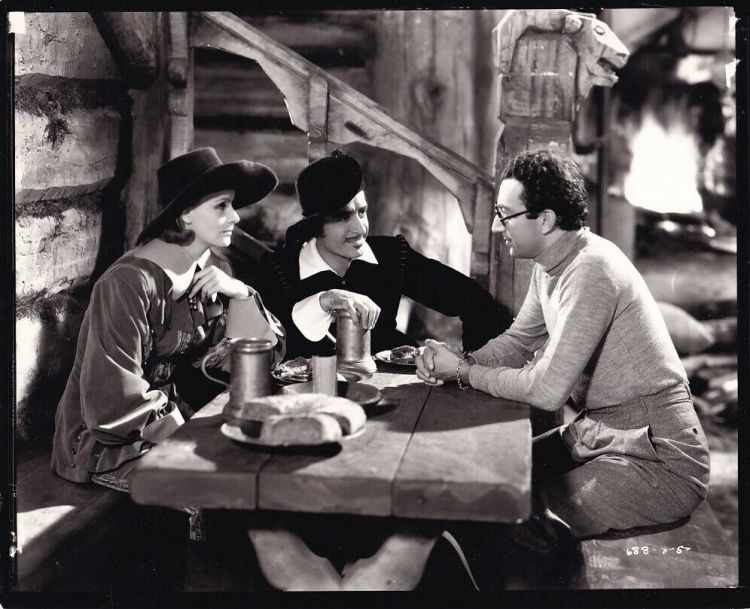
A lot happened in the year 1987, including the debut of a family-friendly TV sitcom set in San Francisco. The name of the show was Full House, and we’ll be doing a deep dive into this popular comedy over the coming weeks.
But first, to get a sense of the times and trends that helped shape this series, here’s a notable obituary from 1987 — Rouben Mamoulian.
Rouben Mamoulian was an American film and theater director. In 1925, Mamoulian was head of the School of Drama, where Martha Graham was working at the time. Among other performances, together they produced a short, two-color film titled The Flute of Krishna, featuring Eastman students. Mamoulian left Eastman shortly after, and Graham chose to leave also, even though she was asked to stay. In 1930, Mamoulian became a naturalized citizen of the United States. Child star Jackie Cooper stated in his autobiography that Rouben Mamoulian was his uncle, and this fact helped establish Cooper’s early movie career.
Mamoulian began his Broadway director career with a production of DuBose Heyward’s Porgy, which opened on October 10, 1927. He directed Wings Over Europe from late 1928 to 1929. He directed the revival of Porgy in 1929 along with George Gershwin’s operatic treatment Porgy and Bess, which opened on October 10, 1935. Mamoulian was also the first to stage such notable Broadway works as Oklahoma! (1943), Carousel (1945), and Lost in the Stars (1949).
He directed his first feature film in 1929, Applause, which was one of the early sound films. It was a landmark film owing to Mamoulian’s innovative use of camera movement and sound, and these qualities were carried to his other films released in the 1930s. Dr. Jekyll and Mr. Hyde (1931) is regularly considered the best version of Robert Louis Stevenson’s tale; Queen Christina (1933) was the last film Greta Garbo made with John Gilbert; both benefit from being made before the “Hays Code” came into full force. The musical film Love Me Tonight was released in 1932.
He directed the first three-strip Technicolor film Becky Sharp (1935), based on Thackeray’s Vanity Fair, as well as the 1937 musical High, Wide, and Handsome. His next two films earned him wide admiration, The Mark of Zorro (1940) and Blood and Sand (1941), both remakes of silent films. Blood and Sand, about bullfighting, was filmed in Technicolor, and used color schemes based on the work of Spanish artists such as Diego Velázquez and El Greco. His foray into screwball comedy in 1942 was a success with Rings on Her Fingers starring Henry Fonda and Gene Tierney.
Mamoulian’s last completed musical film was Metro-Goldwyn-Mayer’s 1957 film version of the Cole Porter musical Silk Stockings. This was one of Porter’s less successful stage musicals and was based on the 1939 Ninotchka. The film Silk Stockings starred Fred Astaire and Cyd Charisse, with Janis Paige and Peter Lorre in supporting roles.
Mamoulian’s film directing career came to an end when he was fired from two consecutive films: Porgy and Bess (1959) and Cleopatra (1963). He previously had been fired as director of Laura (1944). After directing the highly successful original stage productions of Oklahoma! and Carousel, he worked on only a few other theatrical productions, such as St. Louis Woman, which introduced Pearl Bailey to Broadway audiences.
He personally was recruited by Directors Guild of America (DGA) co-founder King Vidor in 1936 to help unionize fellow movie directors. Mamoulian’s lifelong allegiance to the DGA, and more so his general unwillingness to compromise, contributed to his being targeted in the Hollywood blacklisting of the 1950s.
He died on December 4, 1987 at the Motion Picture & Television Country House and Hospital of natural causes at the age of 90 in Woodland Hills, California. The biography Mamoulian: Life on Stage and Screen by David Luhrssen was published in 2013. Mamoulian is considered one of the greatest filmmakers of his generation, whose films were seminal in their genres; On February 9, 1960, Mamoulian received a star on the Hollywood Walk of Fame.
It has been established in DC Comics that his film The Mark of Zorro is the film that Bruce Wayne and his family saw in the theater before his parents were murdered. Mamoulian’s film The Mark of Zorro is one of the biggest inspirations of the character Batman. The biggest similarities include the cowl, the dark personality, and mystery of his identity. In Batman: The Animated Series, the character Gray Ghost was inspired by Mamoulian’s version of Zorro. He was inducted into the American Theatre Hall of Fame in 1981. In 1982 Mamoulian received a Lifetime Achievement Award from the Directors Guild of America.
In 2019, Mamoulian’s film Becky Sharp was selected by the Library of Congress for preservation in the National Film Registry for being “culturally, historically, or aesthetically significant”.
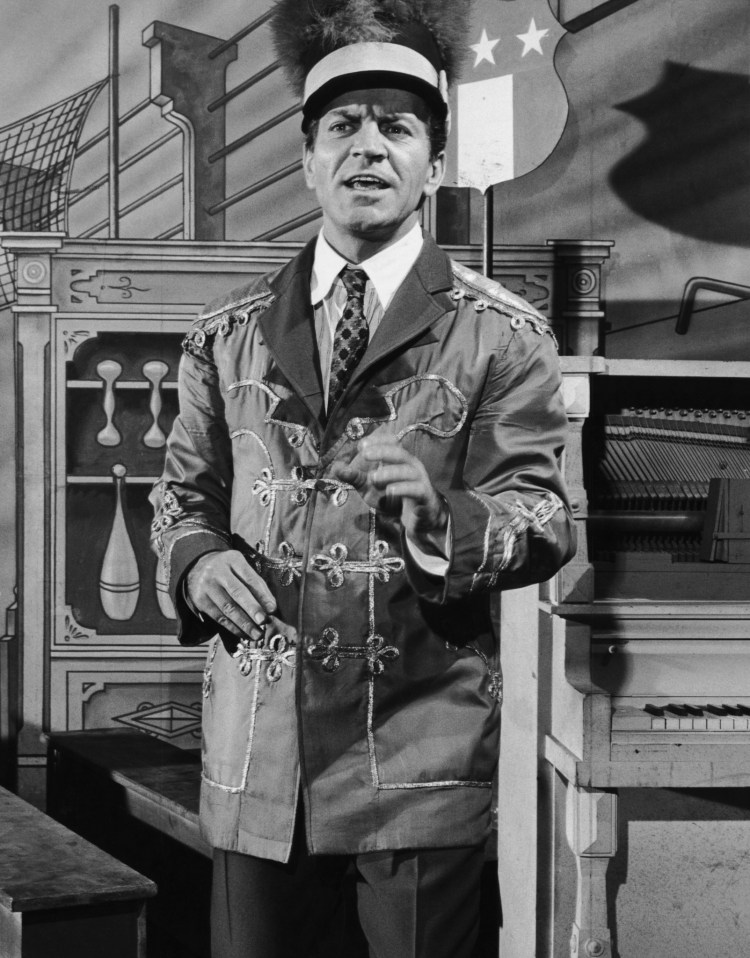
A lot happened in the year 1987, including the debut of a family-friendly TV sitcom set in San Francisco. The name of the show was Full House, and we’ll be doing a deep dive into this popular comedy over the coming weeks.
But first, to get a sense of the times and trends that helped shape this series, here’s a notable obituary from 1987 — Robert Preston.
Robert Preston was an American stage and film actor and singer of Broadway and cinema, best known for his collaboration with composer Meredith Willson and originating the role of Professor Harold Hill in the 1957 musical The Music Man and the 1962 film adaptation; the film earned him his first of two Golden Globe Award nominations. Preston collaborated twice with filmmaker Blake Edwards, first in S.O.B. (1981) and again in Victor/Victoria (1982). For portraying Carroll “Toddy” Todd in the latter, he was nominated for the Academy Award for Best Supporting Actor at the 55th Academy Awards.
He appeared in a stock company production of Julius Caesar and a Pasadena Playhouse production of Idiot’s Delight. A Paramount Pictures attorney liked his work and recruited him to the studio. The Los Angeles Times reported that Preston’s mother was employed by Decca Records, Bing Crosby’s label, and was acquainted with Crosby’s brother Everett, a talent agent; she convinced him to watch one of Preston’s performances at the Pasadena Playhouse. The result was a contract with the Crosby agency and a movie deal with Paramount Pictures, Crosby’s studio. Preston made his screen debut in 1938, in the crime dramas King of Alcatraz (1938) and Illegal Traffic.
The studio ordered Preston to stop using his family name of Meservey. As Robert Preston, the name by which he was known for his entire professional career, he appeared in many Hollywood films, predominantly but not exclusively Westerns. He was Digby Geste in the sound remake of Beau Geste (1939) with Gary Cooper and Ray Milland, and he featured in North West Mounted Police (1940), also with Cooper. He played a Los Angeles police detective in the noir This Gun for Hire (1942).
World War II interrupted Preston’s Paramount assignments. Following the Japanese attack on Pearl Harbor, he joined the United States Army Air Forces and served as an intelligence officer in the U.S. 9th Air Force with the 386th Bomb Group (Medium). At the end of the war in Europe, the 386th and Captain Robert Meservey, an S-2 Officer (intelligence), were stationed in Sint-Truiden, Belgium. Meservey’s job had been receiving intelligence reports from 9th Air Force headquarters and briefing the bomber crews on what to expect in accomplishing their missions.
When Preston resumed his movie career in 1947, it was as a freelance character actor, accepting roles for Paramount, RKO, MGM, and various independent producers. Although Preston acted in many movies, he never became a major star. In a 1984 interview, he recalled, “I played the lead in all the B pictures and the villain in all the epics. After a while, it was clear to me I had sort of reached what I was going to be in movies.” Preston found additional roles in 1950s television.
Robert Preston is probably best known for his performance as Professor Harold Hill in Meredith Willson’s musical The Music Man (1957). “They’d run through all the musical comedy people before they cast me,” Preston remembered years later. He won a Tony Award for his performance. Preston appeared on the cover of Time on July 21, 1958. He continued in the role until January 1959, when he was replaced by Eddie Albert for 18 months. In June 1960 Preston returned to the role for two weeks, until his successor, Bert Parks, became available. Parks finished the run while Preston was in Hollywood, busy with the film version of the show.
Warner Bros. executive Jack L. Warner wanted to cast James Cagney, Cary Grant, or Frank Sinatra for the lead in the movie. Warner was foiled by author-composer Meredith Willson, who had cast approval written into his contract for the property. Willson threatened to void the contract unless Robert Preston was cast. Warner was forced to comply.
In 1961, Preston was asked to make a recording as part of a program by the President’s Council on Physical Fitness to encourage schoolchildren to do more daily exercise. Copies of the recording of the song, Chicken Fat, written and composed by Meredith Willson, performed by Preston with full orchestral accompaniment, were distributed to elementary schools across the nation and played for students as they performed calisthenics. The song later became a surprise novelty hit and part of many baby-boomers’ childhood memories.
In 1962, Preston played an important supporting role, as wagonmaster Roger Morgan, in MGM’s epic How the West Was Won. That same year he appeared as Pancho Villa in a musical called We Take the Town, which closed during its Philadelphia tryout and never made it to Broadway.
In 1965, he was the male part of a duo-lead musical, I Do! I Do! with Mary Martin, for which he won his second Tony Award. He played the title role in the musical Ben Franklin in Paris, and he originated the role of Henry II in the stage production of The Lion in Winter, whom Peter O’Toole portrayed in the film version, receiving an Academy Award nomination. In 1974, he starred alongside Bernadette Peters in Jerry Herman’s Broadway musical Mack & Mabel as Mack Sennett, the famous silent film director. That same year, the film version of Mame, another famed Jerry Herman musical, was released with Preston starring, alongside Lucille Ball, in the role of Beauregard Burnside. In the film, which was not a box-office success, Preston sang “Loving You”, which Herman wrote especially for Preston’s film portrayal.
In 1978, Preston starred in another musical that didn’t make it to Broadway, The Prince of Grand Street, in which he played a matinee idol of New York’s Yiddish theater who refused to renounce the roles he had played in his youth, despite having aged out of them. With a libretto and songs by Bob Merrill and direction by Gene Saks, the show closed during its Boston tryout.
In 1979, Preston portrayed a snake-handling family patriarch Hadley Chisholm in a CBS Western miniseries, The Chisholms, with Rosemary Harris as his wife, Minerva. The story chronicled the Chisholm family losing their land in Virginia and migrating to the west to begin a new life. When CBS tried to continue the saga as a series the following year, Preston reprised his role, his character dying in the fifth episode. The series, which also featured co-stars Ben Murphy, Brett Cullen, and James Van Patten, lasted only four more episodes after Preston’s departure.
Preston appeared in several other stage and film musicals, including Victor/Victoria (1982), for which he received an Academy Award nomination. His other film roles include Ace Bonner in Sam Peckinpah’s Junior Bonner (1972), “Big Ed” Bookman in Semi-Tough (1977), and Dr. Irving Finegarten in Blake Edwards’ 1981 Hollywood satire, S.O.B. His last theatrical film role was in The Last Starfighter (1984) as an interstellar con man/military recruiter called Centauri. He said that he based his approach to the character of Centauri on that which he had taken to Professor Harold Hill. Indeed, the role of Centauri was written for him with his performance as Harold Hill in mind. In 1983, Preston played an aging gunfighter in September Gun, a CBS TV Western film opposite Patty Duke and Christopher Lloyd. He also starred in the well-received HBO 1985 movie Finnegan, Begin Again with Mary Tyler Moore. Preston’s final role was in the television film Outrage! (1986); he portrayed a grief-stricken father who seeks justice for the brutal rape and murder of his daughter.

A lot happened in the year 1987, including the debut of a family-friendly TV sitcom set in San Francisco. The name of the show was Full House, and we’ll be doing a deep dive into this popular comedy over the coming weeks.
But first, to get a sense of the times and trends that helped shape this series, here’s a notable obituary from 1987 — Rita Hayworth.
Rita Hayworth was an American actress, dancer and producer. She achieved fame during the 1940s as one of the era’s top stars, appearing in 61 films over 37 years. The press coined the term “The Love Goddess” to describe Hayworth after she had become the most glamorous screen idol of the 1940s. She was the top pin-up girl for GIs during World War II.
Hayworth is perhaps best known for her performance in the 1946 film noir Gilda, opposite Glenn Ford, in which she played the femme fatale in her first major dramatic role. She is also known for her performances in Only Angels Have Wings (1939), The Strawberry Blonde (1941), Blood and Sand (1941), The Lady from Shanghai (1947), Pal Joey (1957), and Separate Tables (1958). Fred Astaire, with whom she made two films, You’ll Never Get Rich (1941) and You Were Never Lovelier (1942), once called her his favorite dance partner. She also starred in the Technicolor musical Cover Girl (1944), with Gene Kelly. She is listed as one of the top 25 female motion picture stars of all time in the American Film Institute’s survey, AFI’s 100 Years…100 Stars.
In 1980, Hayworth was diagnosed with early-onset Alzheimer’s disease, which contributed to her death in 1987 at age 68. The public disclosure and discussion of her illness drew attention to Alzheimer’s, and helped to increase public and private funding for research into the disease.
She attended dance classes every day for a few years in a Carnegie Hall complex, where she was taught by her uncle Angel Cansino. Before her fifth birthday she was one of the Four Cansinos featured in the Broadway production of The Greenwich Village Follies at the Winter Garden Theatre. In 1926, at the age of eight, she was featured in La Fiesta, a short film for Warner Bros.
In 1927, her father took the family to Hollywood. He believed that dancing could be featured in the movies and that his family could be part of it. He established his own dance studio, where he taught such stars as James Cagney and Jean Harlow.
In 1931, Eduardo Cansino partnered with his 12-year-old daughter to form an act called the Dancing Cansinos. Her hair was dyed from brown to black to give her a more mature and “Latin” appearance. Since under California law Margarita was too young to work in nightclubs and bars, her father took her with him to work across the border in Tijuana, Mexico. In the early 1930s, it was a popular tourist spot for people from Los Angeles. Because she was working, Cansino never graduated from high school, but she completed the ninth grade at Hamilton High in Los Angeles.
Cansino took a bit part in the film Cruz Diablo (1934) at age 16, which led to another bit part in the film in Caliente (1935) with the Mexican actress Dolores del Río. She danced with her father in such nightspots as the Foreign and the Caliente clubs. Winfield Sheehan, the head of the Fox Film Corporation, saw her dancing at the Caliente Club and quickly arranged for Hayworth to do a screen test a week later. Impressed by her screen persona, Sheehan signed her for a short-term, six-month contract at Fox, under the name Rita Cansino, the first of two name changes during her film career.
During her time at Fox, Hayworth was billed as Rita Cansino and appeared in unremarkable roles, often cast as the exotic foreigner. In late 1934, aged 16, she performed a dance sequence in the Spencer Tracy film Dante’s Inferno (1935), and was put under contract in February 1935. She had her first speaking role as an Argentinian girl in Under the Pampas Moon (1935). She played an Egyptian girl in Charlie Chan in Egypt (1935), and a Russian dancer in Paddy O’Day (1935). Sheehan was grooming her for the lead in the 1936 Technicolor film Ramona, hoping to establish her as Fox Film’s new Dolores del Río.
By the end of her six-month contract, Fox had merged into 20th Century Fox, with Darryl F. Zanuck serving as the executive producer. Dismissing Sheehan’s interest in her and giving Loretta Young the lead in Ramona, Zanuck did not renew Cansino’s contract. Sensing her screen potential, salesman and promoter Edward C. Judson, with whom she would elope in 1937, got freelance work for her in several small-studio films and a part in the Columbia Pictures feature Meet Nero Wolfe (1936). Studio head Harry Cohn signed her to a seven-year contract and tried her out in small roles.
Cohn argued that her image was too Mediterranean, which limited her to being cast in “exotic” roles that were fewer in number. He was heard to say her last name sounded too Spanish. Judson acted on Cohn’s advice: Rita Cansino became Rita Hayworth when she adopted her mother’s maiden name, to the consternation of her father. With a name that emphasized Irish-American ancestry, people were more likely to regard her as a classic “American”.
With Cohn and Judson’s encouragement, Hayworth changed her hair color to dark red and had electrolysis to raise her hairline and broaden the appearance of her forehead.
Hayworth appeared in five minor Columbia pictures and three minor independent movies in 1937. The following year, she appeared in five Columbia B movies. In 1939, Cohn pressured director Howard Hawks to use Hayworth for a small, but important, role as a man-trap in the aviation drama Only Angels Have Wings, in which she played opposite Cary Grant and Jean Arthur.
Cohn began to build up Hayworth in 1940 in features such as Music in My Heart, The Lady in Question, and Angels Over Broadway. That year, she was first featured in a Life magazine cover story. While on loan to Warner Bros., Hayworth appeared as the second female lead in The Strawberry Blonde (1941), opposite James Cagney.
She returned in triumph to Columbia Pictures, and was cast in the musical You’ll Never Get Rich (1941) opposite Fred Astaire in one of the highest-budgeted films Columbia had ever made. The picture was so successful, the studio produced and released another Astaire-Hayworth picture the following year, You Were Never Lovelier. Astaire’s biographer Peter Levinson writes that the dancing combination of Astaire and Hayworth was “absolute magnetism on the screen”. Although Astaire made 10 films with Ginger Rogers, his other main dancing partner, Hayworth’s sensuality surpassed Rogers’s cool technical expertise. “Rita’s youthful exuberance meshed perfectly with Fred’s maturity and elegance”, says Levinson.
When Astaire was asked who his favorite dance partner was, he tried not answering the question, but later admitted it was Hayworth: “All right, I’ll give you a name”, he said. “But if you ever let it out, I’ll swear I lied. It was Rita Hayworth.” Astaire commented that “Rita danced with trained perfection and individuality … She was better when she was ‘on’ than at rehearsal.” Biographer Charlie Reinhart describes the effect she had on Astaire’s style:
“There was a kind of reserve about Fred. It was charming. It carried over to his dancing. With Hayworth there was no reserve. She was very explosive. And that’s why I think they really complemented each other.”
In August 1941, Hayworth was featured in an iconic Life photo in which she posed in a negligee with a black lace bodice. Bob Landry’s photo made Hayworth one of the top two pin-up girls of the World War II years; the other was Betty Grable, in a 1943 photograph. For two years, Hayworth’s photograph was the most requested pin-up photograph in circulation. In 2002, the satin nightgown Hayworth wore for the photo sold for $26,888.
In March 1942, Hayworth visited Brazil as a cultural ambassador for the Roosevelt administration’s Good Neighbor policy, under the auspices of the Office of the Coordinator of Inter-American Affairs. During the 1940s Hayworth also contributed to the OCIAA’s cultural diplomacy initiatives in support of Pan-Americanism through her broadcasts to South America on the CBS “Cadena de las Américas” radio network.
Hayworth had top billing in one of her best-known films, the Technicolor musical Cover Girl, released in 1944. The film established her as Columbia’s top star of the 1940s, and it gave her the distinction of being the first of only six women to dance on screen with both Gene Kelly and Fred Astaire. “I guess the only jewels of my life”, Hayworth said in 1970, “were the pictures I made with Fred Astaire … And Cover Girl, too.”
For three consecutive years, starting in 1944, Hayworth was named one of the top movie box-office attractions in the world. She was adept in ballet, tap, ballroom, and Spanish routines. Cohn continued to showcase Hayworth’s dance talents. Columbia featured her in the Technicolor films Tonight and Every Night (1945) with Lee Bowman and Down to Earth (1947) with Larry Parks.
Her sexy, glamorous appeal was most noted in Charles Vidor’s film noir Gilda (1946) with Glenn Ford, which caused censors some consternation. The role, in which Hayworth wore black satin and performed a legendary one-glove striptease, “Put The Blame On Mame”, made her into a cultural icon as a femme fatale.
While Gilda was in release, it was widely reported that an atomic bomb which was scheduled to be tested at Bikini Atoll in the Pacific Ocean’s Marshall Islands would bear an image of Hayworth, a reference to her bombshell status. Although the gesture was undoubtedly meant as a compliment, Hayworth was deeply offended. Orson Welles, then married to Hayworth, recalled her anger in an interview with biographer Barbara Leaming: “Rita used to fly into terrible rages all the time, but the angriest was when she found out that they’d put her on the atom bomb. Rita almost went insane, she was so angry. … She wanted to go to Washington to hold a press conference, but Harry Cohn wouldn’t let her because it would be unpatriotic.” Welles tried to persuade Hayworth that the whole business was not a publicity stunt on Cohn’s part, that it was simply homage to her from the flight crew.
On the June 30, 1946, broadcast of Orson Welles Commentaries, Welles said of the imminent test, “I want my daughter to be able to tell her daughter that grandmother’s picture was on the last atom bomb ever to explode.”
The fourth atomic bomb ever to be detonated was decorated with a photograph of Hayworth cut from the June 1946 issue of Esquire magazine. Above it was stenciled the device’s nickname, “Gilda”, in two-inch black letters.
Hayworth’s performance in Welles’s 1947 film The Lady from Shanghai was critically acclaimed. The film’s failure at the box office was attributed in part to Hayworth’s famous red hair being cut short and bleached platinum blonde for the role. Cohn had not been consulted and was furious that Hayworth’s image was changed.
Also in 1947, Hayworth was featured in a Life cover story by Winthrop Sargeant that resulted in her being nicknamed “The Love Goddess”. The term was adopted and used later as the title of a biopic and of a biography about her. In a 1980s interview, Hayworth said, “Everybody else does nude scenes, but I don’t. I never made nude movies. I didn’t have to do that. I danced. I was provocative, I guess, in some things. But I was not completely exposed.”
Her next film, The Loves of Carmen (1948) with Glenn Ford, was the first film co-produced by Columbia and Hayworth’s production company, The Beckworth Corporation. It was Columbia’s biggest moneymaker that year. She received a percentage of the profits from this and all her subsequent films until 1954, when she dissolved Beckworth to pay off debts.
In 1948, at the height of her fame, Hayworth traveled to Cannes and was introduced to Prince Aly Khan. They began a year-long courtship, and were married on May 27, 1949. Hayworth left Hollywood and sailed for France, breaking her contract with Columbia.
Because Hayworth was already one of the most well-known celebrities in the world, the courtship and the wedding received enormous press coverage around the world. Because she was still legally married to second husband Orson Welles during the early days of her courtship with the prince, Hayworth also received some negative backlash, causing some American fans to boycott her pictures. Their wedding marked the first time a Hollywood actress became a princess. On December 28, 1949, Hayworth gave birth to the couple’s only child, Princess Yasmin Aga Khan.
Though Hayworth was anxious to start a new life abroad, away from Hollywood, Aly Khan’s flamboyant lifestyle and duties proved too difficult for Hayworth. She struggled to fit in with his friends, and found it difficult to learn French. Aly Khan was also known in circles as a playboy, and it was suspected that he had been unfaithful to Hayworth during the marriage.
In 1951, Hayworth set sail with her two daughters for New York. Although the couple did reconcile for a short time, they divorced in 1953.
After the collapse of her marriage to Khan, Rita Hayworth was forced to return to Hollywood to star in her “comeback” picture, Affair in Trinidad (1952) which again paired her with Glenn Ford. Director Vincent Sherman recalled that Hayworth seemed “rather frightened at the approach of doing another picture”. She continued to clash with Columbia boss Harry Cohn and was placed on suspension during filming. Nevertheless, the picture was highly publicized. The picture ended up grossing $1 million more than her previous blockbuster, Gilda.
She continued to star in a string of successful pictures. In 1953, she had two films released: Salome with Charles Laughton and Stewart Granger, and Miss Sadie Thompson with José Ferrer and Aldo Ray. She was off the big screen for another four years, mainly because of a tumultuous marriage to the singer Dick Haymes. During her marriage to Haymes, she was involved in much negative publicity, which significantly lessened her appeal. By the time she returned to the screen for Fire Down Below (1957) with Robert Mitchum and Jack Lemmon, Kim Novak had become Columbia’s top female star. Her last musical was Pal Joey (1957) with Frank Sinatra and Novak. After this film, Hayworth left Columbia for good.
She received good reviews for her performance in Separate Tables (1958), with Burt Lancaster and David Niven, and The Story on Page One (1960). She continued working throughout the 1960s. In 1962, her planned Broadway debut in Step on a Crack was cancelled for undisclosed health reasons. The Money Trap (1964) paired her, for the last time, with good friend Glenn Ford. She continued to act in films until the early 1970s. She made comedic television appearances on Laugh In and The Carol Burnett Show in the 1970s. Her last film was The Wrath of God (1972), a western.
Hayworth had a strained relationship with Columbia Pictures for many years. In 1943, she was suspended without pay for nine weeks because she refused to appear in Once Upon a Time. During this period in Hollywood, contract players could not choose their films; they were on salary rather than receiving a fixed amount per picture.
In 1947, Hayworth’s new contract with Columbia provided a salary of $250,000 plus 50% of films’ profits. In 1951, Columbia alleged it had $800,000 invested in properties for her, including the film she walked out on that year. This is when Hayworth left Hollywood to marry Prince Aly Khan and was suspended for failing to report to work on the film Affair in Trinidad. In 1952, Hayworth refused to report for work because she objected to the script. She said,
“I was in Switzerland when they sent me the script for Affair in Trinidad and I threw it across the room. But I did the picture, and Pal Joey, too. I came back to Columbia because I wanted to work and first, see, I had to finish that goddamn contract, which is how Harry Cohn owned me!”
In 1955, she sued Columbia Pictures to be released from her contract, but asked for her $150,000 salary, alleging that the filming failed to start on Joseph and His Brethren (1961) when agreed, later filmed in 1961 by a foreign company as The Story of Joseph and His Brethren (film). Cohn had a reputation as a taskmaster, but he had his own criticisms of Hayworth. He had invested heavily in her before she began an affair with the married Aly Khan, and it could have caused a backlash against her career and Columbia’s success. For instance, an article in the British periodical The People called for a boycott of Hayworth’s films:
“Hollywood must be told its already tarnished reputation will sink to rock bottom if it restores this reckless woman to a place among its stars.”
Cohn expressed his frustration in a 1957 interview with Time magazine:
“Hayworth might be worth ten million dollars today easily! She owned 25% of the profits with her own company and had hit after hit and she had to get married and had to get out of the business and took a suspension because she fell in love again! In five years, at two pictures a year, at 25%! Think of what she could have made! But she didn’t make pictures! She took two or three suspensions! She got mixed up with different characters! Unpredictable!”
Years after her film career had ended and long after Cohn had died, Hayworth still resented her treatment by both him and Columbia. She spoke bluntly in a 1968 interview:
“I used to have to punch a time clock at Columbia. Every day of my life. That’s what it was like. I was under exclusive contract, like they owned me … I think he had my dressing room bugged … He was very possessive of me as a person, he didn’t want me to go out with anybody, have any friends. No one can live that way. So I fought him … You want to know what I think of Harry Cohn? He was a monster.”
Later on, in 1972 she said:
“Harry Cohn thought of me as one of the people he could exploit, and make a lot of money…And I did make a lot of money for him, but not much for me.”
Hayworth resented the fact that the studio had failed to train her to sing or even to encourage her to learn how to sing. Although she appeared to sing in many of her films, she was usually dubbed. Because the public did not know her secret, she was embarrassed to be asked to sing by troops at USO shows.
I wanted to study singing”, Hayworth complained, “but Harry Cohn kept saying, ‘Who needs it?’ and the studio wouldn’t pay for it. They had me so intimidated that I couldn’t have done it anyway. They always said, ‘Oh, no, we can’t let you do it. There’s no time for that; it has to be done right now!’ I was under contract, and that was it.
Hayworth was a top glamour girl in the 1940s, a pin-up girl for military servicemen and a beauty icon for women. At 5 ft 6 in and 120 lbs, she was tall enough to be a concern for dancing partners such as Fred Astaire. She reportedly changed her hair color eight times in eight movies.
In 1949, Hayworth’s lips were voted best in the world by the Artists League of America. She had a modeling contract with Max Factor to promote its Tru-Color lipsticks and Pan-Stik make-up.
Hayworth confided to Orson Welles that her father began to sexually abuse her as a child, when they were touring together as the Dancing Cansinos. Her biographer, Barbara Leaming, wrote that her mother may have been the only person to know; she slept in the same bed as her daughter to try to protect her from incest. Leaming wrote that the abuse experienced by Hayworth as a young girl contributed to her difficulty in relationships as an adult.
In 1941, Hayworth said she was the antithesis of the characters she played: “I naturally am very shy … and I suffer from an inferiority complex.” Her provocative role in Gilda, in particular, was responsible for people expecting her to be what she was not. Hayworth once said, with some bitterness, “Men go to bed with Gilda, but wake up with me.” She said, “Basically, I am a good, gentle person, but I am attracted to mean personalities.”
Hayworth’s two younger brothers, Eduardo Cansino Jr. and Vernon Cansino, both served in World War II. Vernon left the United States Army in 1946 with several medals, including the Purple Heart, and later married Susan Vail, a dancer. Eduardo Jr. followed Hayworth into acting; he was also under contract with Columbia Pictures. In 1950, he made his screen debut in The Great Adventures of Captain Kidd.
Hayworth was married and divorced five times. She had affairs with several of her leading men, most notably with Victor Mature in 1942, during the filming of My Gal Sal.
She had two grandsons: Marc McKerrow by Rebecca Welles, who married and had children, and Andrew Ali Aga Khan Embiricos by Yasmin Aga Khan, who died unmarried.
Hayworth also had a long-term on-and-off 40-year affair with Glenn Ford, which they started during the filming of Gilda in 1945. Their relationship is documented in the 2011 biography Glenn Ford: A Life by Ford’s son, Peter Ford. Peter revealed in his book that his father got Hayworth pregnant during the filming of The Loves of Carmen; she travelled to France to get an abortion. Ford later moved next door to her in Beverly Hills in 1960, and they continued their relationship for many years until the early 1980s.
In 1937, when Hayworth was 18, she married Edward C. Judson, an oilman turned promoter who was more than twice her age. They married in Las Vegas. He had played a major role in launching her acting career. A shrewd businessman, he was domineering and became her manager for months before he proposed. “He helped me with my career”, Hayworth conceded after they divorced, “and helped himself to my money.” She alleged that Judson compelled her to transfer a considerable amount of her property to him, and she promised to pay him $12,000 under threats that he would do her “great bodily harm”.
She filed for divorce from him on February 24, 1942, with a complaint of cruelty. She noted to the press that his work took him to Oklahoma and Texas while she lived and worked in Hollywood. Judson was as old as her father, who was enraged by the marriage, which caused a rift between Hayworth and her parents until the divorce. Judson had failed to tell Hayworth before they married that he had previously been married twice. When she left him, she had no money; she asked her friend Hermes Pan if she could eat at his home.
Hayworth married Orson Welles on September 7, 1943, during the run of The Mercury Wonder Show. None of her colleagues knew about the planned wedding until she announced it the day before. For the civil ceremony, she wore a beige suit, a ruffled white blouse, and a veil. A few hours after they got married, they returned to work at the studio. They had a daughter, Rebecca, who was born on December 17, 1944, and died at the age of 59 on October 17, 2004. They struggled in their marriage, with Hayworth saying that Welles did not want to be tied down:
“During the entire period of our marriage, he showed no interest in establishing a home. When I suggested purchasing a home, he told me he didn’t want the responsibility. Mr. Welles told me he never should have married in the first place; that it interfered with his freedom in his way of life.”
On November 10, 1947, she was granted a divorce that became final the following year.
In 1948, Hayworth left her film career to marry Prince Aly Khan, a son of Sultan Mahommed Shah, Aga Khan III, the leader of the Ismaili community of Shia Islam. They were married on May 27, 1949. Her bridal trousseau was designed by Jacques Fath.
Aly Khan and his family were heavily involved in horse racing, owning and racing horses. Hayworth had no interest in the sport, but became a member of the Del Mar Thoroughbred Club anyway. Her filly, Double Rose, won several races in France and finished second in the 1949 Prix de l’Arc de Triomphe.
In 1951, while still married to Hayworth, Khan was spotted dancing with the actress Joan Fontaine in the nightclub where he and Hayworth had met. Hayworth threatened to divorce him in Reno, Nevada. In early May, Hayworth moved to Nevada to establish legal residence to qualify for a divorce. She stayed at Lake Tahoe with their daughter, saying there was a threat the child would be kidnapped. Hayworth filed for divorce from Khan on September 2, 1951, on the grounds of “extreme cruelty, entirely mental in nature”.
Hayworth once said she might convert to Islam, but did not. During the custody fight over their daughter, Princess Yasmin Aga Khan, born December 28, 1949, the prince said he wanted her to be raised as a Muslim; Hayworth wanted the child to be raised as a Christian. Hayworth rejected his offer of $1 million if she would rear Yasmin as a Muslim from age seven and allow her to go to Europe to visit with him for two or three months each year, stating:
“Nothing will make me give up Yasmin’s chance to live here in America among our precious freedoms and habits. While I respect the Moslem faith, and all other faiths, it is my earnest wish that my daughter be raised as a normal, healthy American girl in the Christian faith. There isn’t any amount of money in the entire world for which it is worth sacrificing this child’s privilege of living as a normal Christian girl here in the United States. There just isn’t anything else in the world that can compare with her sacred chance to do that. And I’m going to give it to Yasmin regardless of what it costs.”
In January 1953, Hayworth was granted a divorce from Aly Khan on the grounds of extreme mental cruelty. Her daughter Yasmin, only three years old, played about the court while the case was being heard, finally climbing on to the judge’s lap.
When Hayworth and Dick Haymes first met, he was still married and his singing career was waning. When she showed up at the clubs, he got a larger audience. Haymes was desperate for money because two of his former wives were taking legal action against him for unpaid child support. His financial problems were so bad, he could not return to California without being arrested. On July 7, 1954, his ex-wife Nora Eddington got a bench warrant for his arrest, because he owed her $3,800 in alimony. Less than a week earlier, his other ex-wife, Joanne Dru, also got a bench warrant because she said he owed $4,800 in support payments for their three children. Hayworth ended up paying most of Haymes’s debts.
Haymes was born in Argentina and did not have solid proof of American citizenship. Not long after he met Hayworth, U.S. officials initiated proceedings to have him deported to Argentina for being an illegal alien. He hoped Hayworth could influence the government and keep him in the United States. When she assumed responsibility for his citizenship, a bond was formed that led to marriage. The two were married on September 24, 1953, at the Sands Hotel, Las Vegas, and their wedding procession went through the casino.
From the start of their marriage, Haymes was deeply in debt to the Internal Revenue Service (IRS). When Hayworth took time off from attending his comeback performances in Philadelphia, the audiences sharply declined. Haymes’s $5,000 weekly salary was attached by the IRS to pay a $100,000 bill, and he was unable to pay his pianist. Haymes’s ex-wives demanded money while Hayworth publicly bemoaned her own lack of alimony from Aly Khan. At one point, the couple was effectively imprisoned in a hotel room for 24 hours in Manhattan at the Hotel Madison as sheriff’s deputies waited outside threatening to arrest Haymes for outstanding debts. At the same time, Hayworth was fighting a severe custody battle with Khan, during which she reported death threats against their children. While living in New York, Hayworth sent the children to live with their nanny in Westchester County. They were found and photographed by a reporter from Confidential magazine.
After a tumultuous two years together, Haymes struck Hayworth in the face in 1955 in public at the Cocoanut Grove nightclub in Los Angeles. Hayworth packed her bags, walked out, and never returned. The assault and crisis shook her, and her doctor ordered her to remain in bed for several days.
Hayworth was short of money after her marriage to Haymes. She had failed to gain child support from Aly Khan. She sued Orson Welles for back payment of child support which she claimed had never been paid. This effort was unsuccessful and added to her stress.
Hayworth began a relationship with film producer James Hill, whom she went on to marry on February 2, 1958. He put her in one of her last major films, Separate Tables. This film was popular and highly praised, although The Harvard Lampoon named her the worst actress of 1958 for her performance. On September 1, 1961, Hayworth filed for divorce, alleging extreme mental cruelty. Hill later wrote Rita Hayworth: A Memoir, in which he suggested that their marriage collapsed because he wanted Hayworth to continue making movies, while she wanted them both to retire from Hollywood.
In his autobiography, Charlton Heston wrote about Hayworth’s brief marriage to Hill. One night, Heston and his wife Lydia joined the couple for dinner at a restaurant in Spain with the director George Marshall and the actor Rex Harrison, Hayworth’s co-star in The Happy Thieves. Heston wrote that the occasion “turned into the single most embarrassing evening of my life”, describing how Hill heaped “obscene abuse” on Hayworth until she was “reduced to a helpless flood of tears, her face buried in her hands”. Heston wrote that the others sat stunned, witnesses to a “marital massacre”, and, though he was “strongly tempted to slug him”, he left with his wife Lydia after she stood up, almost in tears. Heston wrote, “I’m ashamed of walking away from Miss Hayworth’s humiliation. I never saw her again.”
Orson Welles noted Hayworth’s problem with alcohol during their marriage, but he never believed that her problem was alcoholism. “It certainly imitated alcoholism in every superficial way”, he recalled in 1983. “She’d fly into these rages, never at me, never once, always at Harry Cohn or her father or her mother or her brother. She would break all the furniture and she’d get in a car and I’d have to get in the car and try to control her. She’d drive up in the hills suicidally. Terrible, terrible nights. And I just saw this lovely girl destroying herself. I admire Yasmin so much.”
Yasmin Aga Khan spoke of her mother’s long struggle with alcohol:
“I remember as a child that she had a drinking problem. She had difficulty coping with the ups and downs of the business … As a child, I thought, ‘She has a drinking problem, and she’s an alcoholic.’ That was very clear, and I thought, ‘Well, there’s not much I can do. I can just, sort of, stand by and watch.’ It’s very difficult, seeing your mother, going through her emotional problems and drinking and then behaving in that manner … Her condition became quite bad. It worsened and she did have an alcoholic breakdown and landed in the hospital.”
In 1972, the 54-year-old Hayworth wanted to retire from acting, but she needed money. At the suggestion of Robert Mitchum, she agreed to film The Wrath of God. The experience exposed her poor health and her worsening mental state. Because she could not remember her lines, her scenes were shot one line at a time. In November, she agreed to complete one more movie, the British film Tales That Witness Madness, but because of her worsening health, she left the set and returned to the United States. She never returned to acting.
In March 1974, both of her brothers died within a week of each other, which caused her great sadness and led to heavy drinking. In January 1976, at London’s Heathrow Airport, Hayworth was removed from a TWA flight after having an angry outburst while traveling with her agent. The event attracted much negative publicity; a disturbing photograph was published in newspapers the next day. Hayworth’s alcoholism hid symptoms of what was eventually understood to be Alzheimer’s disease.
Yasmin Aga Khan spoke of her mother’s disease:
“It was the outbursts. She’d fly into a rage. I can’t tell you. I thought it was alcoholism – alcoholic dementia. We all thought that. The papers picked that up, of course. You can’t imagine the relief just in getting a diagnosis. We had a name at last, Alzheimer’s! Of course, that didn’t really come until the last seven or eight years. She wasn’t diagnosed as having Alzheimer’s until 1980. There were two decades of hell before that.”
Biographer Barbara Leaming wrote that Hayworth aged prematurely because of her addiction to alcohol and also because of the many stresses in her life. “Despite the artfully applied make-up and shoulder-length red hair, there was no concealing the ravages of drink and stress”, she wrote of Hayworth’s arrival in New York in May 1956 in order to begin work on Fire Down Below, her first film in three years. “Deep lines had crept around her eyes and mouth, and she appeared worn, exhausted – older than her thirty-eight years.”
Alzheimer’s disease had been largely forgotten by the medical community since its discovery in 1906. Medical historian Barron H. Lerner wrote that when Hayworth’s diagnosis was made public in 1981, she became “the first public face of Alzheimer’s, helping to ensure that future patients did not go undiagnosed … Unbeknownst to her, Hayworth helped to destigmatize a condition that can still embarrass victims and their families.”
In July 1981, Hayworth’s health had deteriorated to the point that a judge in Los Angeles Superior Court ruled that she should be placed under the care of her daughter, Princess Yasmin Aga Khan of New York City. Hayworth lived in an apartment at The San Remo on Central Park West adjoining that of her daughter, who arranged for her mother’s care during her final years. When asked how her mother was doing, Yasmin replied, “She’s still beautiful. But it’s a shell.”
In 1983, Rebecca Welles arranged to see her mother for the first time in seven years. Speaking to his lifelong friend Roger Hill, Orson Welles expressed his concern about the visit’s effect on his daughter. “Rita barely knows me now”, Welles said. He recalled seeing Hayworth three years before at an event which the Reagans held for Frank Sinatra. “When it was over, I came over to her table, and I saw that she was very beautiful, very reposed looking, and didn’t know me at first. After about four minutes of speaking, I could see that she realized who I was, and she began to cry quietly.”
In an interview which he gave the evening before his death in 1985, Welles called Hayworth “one of the dearest and sweetest women that ever lived”.
Hayworth was a lifelong Democrat who was an active member of the Hollywood Democratic Committee and was active in the campaign of Franklin Delano Roosevelt during the 1944 presidential election.
Hayworth was a Catholic whose marriage to Prince Aly Khan was deemed “illicit” by Pope Pius XII.
Rita Hayworth lapsed into a semicoma in February 1987. She died at age 68, from complications associated with Alzheimer’s disease, on May 14, 1987 at her home in Manhattan. President Ronald Reagan, who was one of Hayworth’s contemporaries in Hollywood, issued a statement:
“Rita Hayworth was one of our country’s most beloved stars. Glamorous and talented, she gave us many wonderful moments on stage and screen and delighted audiences from the time she was a young girl. In her later years, Rita became known for her struggle with Alzheimer’s disease. Her courage and candor, and that of her family, were a great public service in bringing worldwide attention to a disease which we all hope will soon be cured. Nancy and I are saddened by Rita’s death. She was a friend who we will miss. We extend our deep sympathy to her family.”
A funeral service was held on May 18, 1987, at the Church of the Good Shepherd. Pallbearers included actors Ricardo Montalbán, Glenn Ford, Cesar Romero, Anthony Franciosa, choreographer Hermes Pan, and a family friend, Phillip Luchenbill. She was interred at Holy Cross Cemetery, Culver City. Her headstone includes Yasmin’s sentiment: “To yesterday’s companionship and tomorrow’s reunion.”
Hayworth received a Golden Globe nomination for Best Actress – Motion Picture Drama for her performance in Circus World (1964).
In 1978, at the Shoreham Hotel in Washington, D. C., Hayworth was presented with the inaugural National Screen Heritage Award of the National Film Society, a group that published American Classic Screen magazine (1976–1984).
In 1999, Hayworth was acknowledged as one of the top-25 greatest female stars of Classic Hollywood cinema in the American Film Institute’s survey, AFI’s 100 Years…100 Stars.
The public disclosure and discussion of Hayworth’s illness drew international attention to Alzheimer’s disease, which was little known at the time, and it helped to greatly increase federal funding for Alzheimer’s research.
The Rita Hayworth Gala, a benefit for the Alzheimer’s Association, is held annually in Chicago and New York City. The program was founded in 1985 by Princess Yasmin Aga Khan, in honor of her mother. She is the hostess for the events and a major sponsor of Alzheimer’s disease charities and awareness programs. As of August 2017, a total of more than $72 million had been raised through events in Chicago, New York, and Palm Beach, Florida.
On October 17, 2016, a press release from the Springer Associates Public Relations Agency announced that Rita Hayworth’s former manager and friend, Budd Burton Moss, initiated a campaign to solicit the United States Postal Service to issue a commemorative stamp featuring Hayworth. Springer Associates also announced that the Academy of Motion Picture Arts and Sciences would be lobbied in hopes of having an honorary Academy Award issued in memory of Hayworth. The press release added that Hayworth’s daughter, Princess Yasmin Aga Khan, the Alzheimer’s Association of Greater Los Angeles, and numerous prominent personalities of stage and screen were supporting the Moss campaign. The press release stated the target date for fulfillment of the stamp and Academy Award to be on October 17, 2018, on what will be the centennial of Hayworth’s birth.
The film I Remember Better When I Paint (2009) describes how Hayworth took up painting while struggling with Alzheimer’s.
In the Baptiste episode “Shell”, Baptiste talks to Kim about Hayworth in an attempt to gain information from her about Natalie after noticing that she has several DVDs of Hayworth’s films; the Dream Room has a poster of Gilda.
Hayworth’s name can be heard on the Madonna hit from 1990 “Vogue”, among other artists from classical Hollywood cinema. Her name is also mentioned in Tom Waits’s song “Invitation to the Blues” from his 1976 album Small Change.
In the Sicilian scenes of the film The Godfather, the bodyguard of Michael Corleone is heard shouting the name “Rita Hayworth” to GI’s passing by in jeeps.
Hayworth is the main topic of the song, “Take, Take, Take” by the White Stripes and also referenced in “White Moon”; both from their Get Behind Me Satan album, released in 2005. In a 2005 interview with Rolling Stone, Jack White says, “Rita Hayworth became an all-encompassing metaphor for everything I was thinking about while making the album.”
The film The Shawshank Redemption was adapted from a Stephen King short story, “Rita Hayworth and Shawshank Redemption”, a novella from his 1982 collection, Different Seasons. A poster of Rita Hayworth hides a hole in a jail cell wall in the novella, which was used for the first third of the film, then changed to a poster of Marilyn Monroe for the middle third, then Raquel Welch for the last third. In the film, there is a scene where the prison movie night shows Rita Hayworth’s film Gilda.

 SCREEN TIME WITH SAM