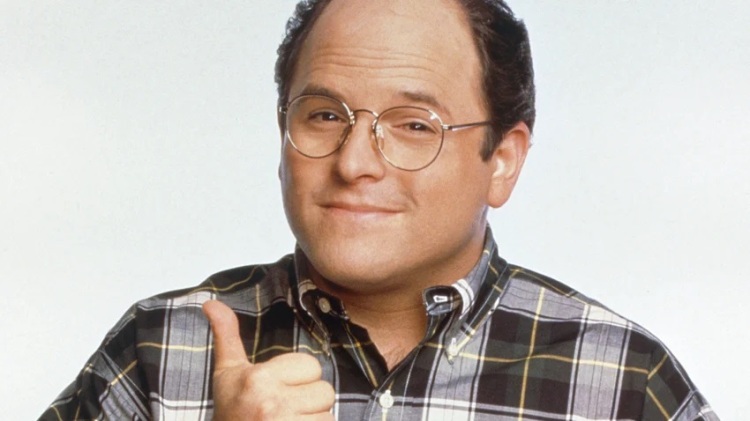
Welcome to this podcast installment of my look at the classic 1990s sitcom Seinfeld. Click the play button below to listen.
DISCLAIMER: Some material for this post was derived from various public sources on the Web.
An in-depth look at popular television shows, TV movies, miniseries, and the people behind them
Welcome to this podcast installment of my look at the classic 1990s sitcom Seinfeld. Click the play button below to listen.
DISCLAIMER: Some material for this post was derived from various public sources on the Web.

Welcome to this podcast installment of my look at the classic 1990s sitcom Seinfeld. Click the play button below to listen.
DISCLAIMER: Some material for this post was derived from various public sources on the Web.
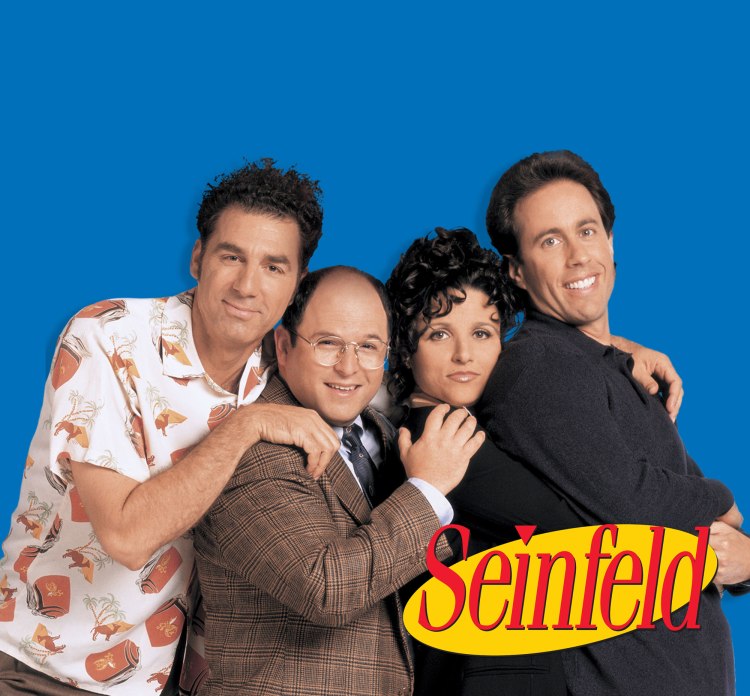
Welcome to this podcast installment of my look at the classic 1990s sitcom Seinfeld. Click the play button below to listen.
DISCLAIMER: Some material for this post was derived from various public sources on the Web.

A lot happened in the year 1989, including the debut of a TV sitcom in which nothing happened. That show, of course, was Seinfeld, and we’ll be doing a deep dive into this iconic comedy over the coming weeks.
But first, to get a sense of the times and trends that helped shape this series, here’s a quick look at the notable pop culture events that occurred in 1989.
March 1 The Berne Convention, an international copyright treaty, is ratified by the United States. The Berne Convention for the Protection of Literary and Artistic Works, usually known as the Berne Convention, was an international assembly held in 1886 in the Swiss city of Bern by ten European countries with the goal to agree on a set of legal principles for the protection of original work. They drafted and adopted a multi-party contract containing agreements for a uniform, crossing border system that became known under the same name. Its rules have been updated many times since then. The treaty provides authors, musicians, poets, painters, and other creators with the means to control how their works are used, by whom, and on what terms. In some jurisdictions these type of rights are being referred to as copyright. The United States became a party in 1989.
As of November 2022, the Berne Convention has been ratified by 181 states out of 195 countries in the world, most of which are also parties to the Paris Act of 1971. The Berne Convention introduced the concept that protection exists the moment a work is “fixed”, that is, written or recorded on some physical medium, its author is automatically entitled to all copyrights in the work and to any derivative works, unless and until the author explicitly disclaims them or until the copyright expires. A creator need not register or “apply for” a copyright in countries adhering to the convention. It also enforces a requirement that countries recognize rights held by the citizens of all other parties to the convention. Foreign authors are given the same rights and privileges to copyrighted material as domestic authors in any country that ratified the convention. The countries to which the convention applies created a Union for the protection of the rights of authors in their literary and artistic works, known as the Berne Union.
March 4 Time Inc. and Warner Communications announce plans for a merger forming Time Warner (Now Warner Bros. Discovery). During the summer of that same year, Paramount Communications (formerly Gulf+Western) launched a $12.2 billion hostile bid to acquire Time Inc. in an attempt to end a stock swap merger deal between Time and Warner Communications. This caused Time to raise its bid for Warner to $14.9 billion in cash and stock. Paramount responded by filing a lawsuit in a Delaware court to block the Time/Warner merger. The court ruled twice in favor of Time, forcing Paramount to drop both the Time acquisition and the lawsuit, and allowing the formation of the two companies’ merger which was completed on January 10, 1990.
Effectively, Time took over Warner, resulting in a new corporate structure and the new combined company being called “Time Warner”. The Pathfinder website was launched in 1994, with content from the Time, People and Fortune magazines. It was shut down in 1999. In 2008, Time Inc. launched Maghound, an internet-based magazine membership service that featured approximately 300 magazine titles from both Time Inc. brands and external publishing companies. On January 19, 2010, Time Inc. acquired StyleFeeder, a personal shopping engine. In August 2010, Time Inc. announced that Ann S. Moore, its chairman and chief executive, would step down as CEO and be replaced by Jack Griffin, an executive with Meredith Corporation, the nation’s second-largest publisher of consumer magazines. In September 2010, Time Inc. entered into a licensing agreement with Kolkata-based ABP Group, one of India’s largest media conglomerates, to publish Fortune India magazine and the yearly Fortune India 500 list. Griffin was ousted after a brief tenure, eventually being replaced by Laura Lang, who served about a year.
May 1 Disney-MGM Studios at Walt Disney World opens to the public for the first time. Disney’s Hollywood Studios is a theme park at the Walt Disney World Resort in Bay Lake, Florida, near Orlando. Based on a concept by Marty Sklar, Randy Bright, and Michael Eisner, the park opened on May 1, 1989, as the Disney-MGM Studios (Theme) Park, and was the third of four theme parks built at Walt Disney World. Spanning 135 acres (55 ha), the park is dedicated to the imagined worlds from film, television, music, and theater, drawing inspiration from the Golden Age of Hollywood. Disney’s Hollywood Studios was initially developed as both a theme park inspired by show business and an operating production studio, with active film and television production services, an animation facility branch, and a functioning backlot.
Construction on the combined park and studio began in 1987, but was accelerated when the construction of the similarly-themed Universal Studios Florida began a few miles away. To increase public interest and the variety of film representation within the park, Disney entered into a licensing agreement with Metro-Goldwyn-Mayer (MGM), from which the park’s original name was derived. The park’s production facilities were removed throughout the 2000s, and many of the park’s soundstages were retrofitted for newer attractions and guest use. The park’s current name took effect in 2008, with the removal of the MGM-branding throughout the park. In the 2010s, the park began to distance itself from the original studio backlot intention and entered a new direction of immersive theming and attraction development inspired by imagined worlds from Hollywood storytellers.
The park’s representative icon was originally the Earffel Tower from the park’s opening until 2001 when the Sorcerer’s Hat—a stylized version of the magical hat from Fantasia—was erected in the park’s central hub. The latter then served as the park’s icon until its removal in January 2015. Since then, the park has been identified and represented in marketing by the Hollywood Tower Hotel, with the Chinese Theatre serving as the park’s visual centerpiece. In 2018, the park hosted 11.258 million guests, ranking it the fifth most-visited theme park in North America and the ninth most-visited theme park in the world.
June 4 Jerome Robbins’ Broadway wins the Tony Award for Best Musical and five other Tonys. Jerome Robbins’ Broadway is an anthology comprising musical numbers from shows that were either directed or choreographed by him. The shows represented include, for example, The King and I, On the Town and West Side Story. Robbins won his fifth Tony Award for direction. The show opened on Broadway on February 26, 1989 at the Imperial Theatre and closed on September 1, 1990 after 633 performances and 55 previews.
Directed and choreographed by Jerome Robbins with Grover Dale as co-director, the cast featured Jason Alexander as the narrator, Charlotte d’Amboise, Faith Prince, Debbie Shapiro, Susann Fletcher and Scott Wise. With an elaborate production and a cast of 62, the show reportedly cost $8 million to produce, and was expected to recoup about 40 percent from the New York run, according to Bernard B. Jacobs (President of the Shubert Organization). “In a season that was so bereft of original musicals that Kenny Loggins on Broadway and Barry Manilow at the Gershwin were categorized as such, this reminder of Broadway’s glory days was greeted with relief and rejoicing (and six Tony Awards). It featured extended sequences from West Side Story and Fiddler on the Roof.”
July 18 Actress Rebecca Schaeffer is murdered by an obsessed fan, leading to stricter stalking laws in California. Rebecca Schaeffer was an American actress and model. She began her career as a teen model before moving on to acting. In 1986, she landed the role of Patricia “Patti” Russell in the CBS comedy My Sister Sam. The series was canceled in 1988, and she appeared in several films, including the black comedy Scenes from the Class Struggle in Beverly Hills.
At the age of 21, she was shot and killed by Robert John Bardo, a 19-year-old obsessed fan who had been stalking her. Schaeffer’s death helped lead to the passage in California of legislation aimed at preventing stalking. Bardo killed Schaeffer at her home in West Hollywood. At the time of her death, she had been stalked by Bardo for three years. He had previously been obsessed with child peace activist Samantha Smith, who died in a plane crash in 1985. He then wrote numerous letters to Schaeffer, one of which she answered. In 1987, he traveled to Los Angeles hoping to meet with Schaeffer on the set of My Sister Sam, but Warner Bros. security turned him away. He returned a month later armed with a knife, but security guards again prevented him from gaining access. He returned to his native home in Tucson, Arizona, and lost focus on Schaeffer for a while as his obsession shifted toward pop singers Tiffany, Debbie Gibson and Madonna. Bardo watched Schaeffer in the black comedy Scenes from the Class Struggle in Beverly Hills in 1989, in which she appeared in bed with another actor. He became enraged by the scene, apparently out of jealousy, and decided that Schaeffer should be punished for “becoming another Hollywood whore”.
Arthur Richard Jackson had stalked and stabbed actress Theresa Saldana in 1982, and Bardo learned that Jackson had used a private investigator to obtain Saldana’s address. Bardo then paid a detective agency in Tucson $250 to find Schaeffer’s home address in California’s Department of Motor Vehicles (DMV) records. His brother helped him get a Ruger GP100 .357 handgun. Bardo traveled to Los Angeles a third time and roamed the neighborhood where Schaeffer lived, asking people if she actually lived there. Once he was certain that the address was correct, he rang the doorbell. Schaeffer was preparing for an audition for The Godfather Part III and was expecting a script to be delivered, so she answered the door. Bardo showed her a letter and autograph that she had previously sent him; after a short conversation, she asked him not to come to her home again. He went to a diner nearby and had breakfast, then returned to her apartment an hour later. She answered the door with “a cold look on her face”, Bardo later said. He pulled out the handgun and shot her in the chest at point-blank range in the doorway of her apartment building; according to Bardo, she fell and said only, “Why?”
Schaeffer was rushed to the emergency room of Cedars-Sinai Medical Center, where she was pronounced dead 30 minutes after her arrival. She was buried at Ahavai Sholom Cemetery in Portland. Tucson Police Chief Peter Ronstadt arrested Bardo the next day after motorists reported a man running through traffic on Interstate 10. He immediately confessed to the murder. Marcia Clark, later known for her role as lead prosecutor in the O. J. Simpson murder case, prosecuted the case against him. Bardo was convicted of capital murder in a bench trial and was sentenced to life in prison without the possibility of parole.
As a result of this incident, federal law regarding the release of personal information through the DMV was changed. The Driver’s Privacy Protection Act, which prevents the DMV from releasing private addresses, was enacted in 1994. Schaeffer’s death also helped prompt the 1990 passing of America’s first anti-stalking laws, including California Penal Code 646.9. At the time of her death, Schaeffer was dating director Brad Silberling. Her death influenced his film Moonlight Mile (2002) about a man’s grief after his fiancée is murdered. Shortly after Schaeffer’s death, Pam Dawber and her My Sister Sam co-stars Joel Brooks, David Naughton, and Jenny O’Hara filmed a public service announcement for the Center to Prevent Handgun Violence in her honor.
July 31 The Game Boy hits the shelves in North America. The Game Boy is an 8-bit fourth generation handheld game console developed and manufactured by Nintendo. It was first released in Japan on April 21, 1989, in North America later the same year, and in Europe in late 1990. It was designed by the same team that developed the Game & Watch series of handheld electronic games and several Nintendo Entertainment System (NES) games: Satoru Okada, Gunpei Yokoi, and Nintendo Research & Development. It is Nintendo’s second handheld game console and combines features from both the Game & Watch handheld and NES home system.
The console features a dot-matrix screen with adjustable contrast dial, five game control buttons (a directional pad, two game buttons, and “START” and “SELECT”), a single speaker with adjustable volume dial and, like its rivals, uses cartridges as physical media for games. The color scheme is made from two tones of gray with accents of black, blue, and dark magenta. All the corners of the portrait-oriented rectangular unit are softly rounded, except for the bottom right, which is curved. At launch, it was sold either as a standalone unit, or bundled with one of several games, among them Super Mario Land and Tetris. Several accessories were also developed, including a carrying pouch, a camera, and a printer.
The Game Boy received mixed reviews from critics and was deemed as technologically inferior to its fourth-generation competitors (Sega’s Game Gear, Atari’s Lynx, and NEC’s TurboExpress). Its lack of a backlight, graphics, bulky design and price were met with criticism, but it also received praise for its battery life, library of games and durability in its construction. It quickly outsold the competition, selling one million units in the United States within a few weeks. An estimated 118.69 million units of the Game Boy and its successor, the Game Boy Color, have been sold worldwide, making it the third best-selling video game console of all time. It is one of the most recognizable devices from the 1990s, becoming a cultural icon in the years following its release. Several redesigns were released during the console’s lifetime, including the Game Boy Pocket in 1996 and the Game Boy Light in 1998 (Japan only). Production of the Game Boy continued until 2003, well after the release of its second successor, the Game Boy Advance, in 2001.
August 30 Leona Helmsley is convicted of federal income tax evasion. Helmsley was an American businesswoman. Her flamboyant personality and reputation for tyrannical behavior earned her the nickname “Queen of Mean.” After allegations of non-payment were made by contractors hired to improve Helmsley’s Connecticut home, she was investigated and convicted of federal income tax evasion and other crimes in 1989. Although having initially received a sentence of sixteen years, she was required to serve only nineteen months in prison and two months under house arrest. During the trial, a former housekeeper testified that she had heard Helmsley say: “We don’t pay taxes; only the little people pay taxes”, a quote which was identified with her for the rest of her life.
October 5 A jury in Charlotte, North Carolina convicts televangelist Jim Bakker of fraud and conspiracy. On October 24, he is sentenced to 45 years in prison and fined $500,000. In 1979, Bakker and PTL came under investigation by the Federal Communications Commission (FCC) for allegedly misusing funds raised on the air. The FCC report was finalized in 1982 and found that Bakker had raised $350,000 that he told viewers would go towards funding overseas missions but that was actually used to pay for part of Heritage USA. The report also found that the Bakkers used PTL funds for personal expenses.
FCC commissioners voted four to three to drop the investigation, after which they allowed Bakker to sell the only TV station that he owned, therefore bypassing future FCC oversight. The FCC forwarded its report to the U.S. Department of Justice, which declined to press charges, citing insufficient evidence. Bakker used the controversy to raise more funds from his audience, branding the investigation a “witch-hunt” and asking viewers to “give the Devil a black eye”. A confidential 1985 Internal Revenue Service (IRS) report found that $1.3 million in ministry funds was used for the Bakkers’ personal benefit from 1980 to 1983. The report recommended that PTL be stripped of its tax-exempt status, but no action was taken until after the Jessica Hahn scandal broke in 1987.
Art Harris and Michael Isikoff wrote in The Washington Post that politics may have played a role in the three government agencies taking no action against PTL despite the evidence against them, as members of the Reagan administration were not eager to go after television ministers whose evangelical followers made up their base. The PTL Club’s fundraising activities between 1984 and 1987 were reported by The Charlotte Observer, eventually leading to criminal charges against Bakker. Bakker and his PTL associates sold $1,000 “lifetime memberships”, entitling buyers to an annual three-night stay at a luxury hotel at Heritage USA during that period. According to the prosecution at Bakker’s fraud trial, tens of thousands of memberships were sold but only one 500-room hotel was ever finished. Bakker sold “exclusive partnerships” which exceeded capacity, raising more than twice the money needed to build the hotel. Much of the money paid Heritage USA’s operating expenses, and Bakker kept $3.4 million.
After a 16-month federal grand jury probe, Bakker was indicted in 1988 on eight counts of mail fraud, 15 counts of wire fraud and one count of conspiracy. In 1989, after a five-week trial which began on August 28 in Charlotte, North Carolina, a jury found him guilty on all 24 counts. Judge Robert Daniel Potter sentenced Bakker to 45 years in federal prison and imposed a $500,000 fine. At the Federal Medical Center, Rochester in Rochester, Minnesota, he shared a cell with activist Lyndon LaRouche and skydiver Roger Nelson. The United States Court of Appeals for the Fourth Circuit upheld Bakker’s conviction on the fraud and conspiracy charges, voided Bakker’s 45-year sentence and $500,000 fine and ordered a new sentencing hearing in February 1991. The court ruled that Potter’s sentencing statement about Bakker, that “those of us who do have a religion are sick of being saps for money-grubbing preachers and priests”, was evidence that the judge had injected his religious beliefs into Bakker’s sentence. A sentence-reduction hearing was held on November 16, 1992, and Bakker’s sentence was reduced to eight years. In August 1993, he was transferred to a minimum-security federal prison in Jesup, Georgia.
Bakker was paroled in July 1994, after serving almost five years of his sentence. His son, Jay, spearheaded a letter-writing campaign to the parole board advocating leniency. Celebrity lawyer Alan Dershowitz acted as Bakker’s parole attorney, having said that he “would guarantee that Mr. Bakker would never again engage in the blend of religion and commerce that led to his conviction.” Bakker was released from Federal Bureau of Prisons custody on December 1, 1994, owing $6 million to the IRS.

A lot happened in the year 1989, including the debut of a TV sitcom in which nothing happened. That show, of course, was Seinfeld, and we’ll be doing a deep dive into this iconic comedy over the coming weeks.
But first, to get a sense of the times and trends that helped shape this series, here’s a quick look at the notable sporting events that occurred in 1989.
November 4-5, 1988 The NBA welcomes two new expansion teams for the 1988–89 season: the Charlotte Hornets and the Miami Heat.
January 11 The National Collegiate Athletic Association (NCAA) adopts Proposition 42, which withdraws athletic scholarships from athletes who fail to meet minimal academic standards.
March 22 Pete Rozelle, National Football League (NFL) commissioner since 1960, announces he will step down when a replacement is found.
March 22 Clint Malarchuk of the National Hockey League’s Buffalo Sabres suffers an almost fatal injury when another player accidentally slits his throat with a skate blade.
April 1 Bill White becomes president of the National League of Major League Baseball (MLB), becoming the first African American to head a major sports league.
April 3 The Michigan Wolverines men’s basketball team defeats the Seton Hall Pirates to win the 1989 NCAA Men’s Division I Basketball Tournament.
April 3 Future Hall-of-Fame outfielder Ken Griffey Jr makes his major league baseball debut.
April 8 Baseball pitcher Jim Abbott, who was born without a right hand, joins the starting rotation of the California Angels as a rookie, without playing a single minor league game.
April 15 In one of the biggest tragedies in European Football (soccer), 97 supporters of Liverpool FC are killed as a result of a fatal human crush, in addition to 766 non-fatal injuries.
April 23-24 UCLA quarterback Troy Aikman is chosen as the NFL’s number one draft pick by the Dallas Cowboys. Oklahoma State running back Barry Sanders is selected with the number three pick by the Detroit Lions. Deion Sanders is picked at number five by the Atlanta Falcons.
May 7 Basketball legend Michael Jordan makes “The Shot” during Game 5 of the NBA Eastern Conference First Round playoffs, winning the game and series for the Chicago Bulls over the Cleveland Cavaliers.
May 25 The Calgary Flames defeat the Montreal Canadiens four games to two to win the franchise’s first Stanley Cup in the National Hockey League.
June 13 The Detroit Pistons beat the Los Angeles Lakers to win the 1989 NBA Finals.
August 22 Nolan Ryan of the Texas Rangers becomes the first (and so far, only) pitcher in Major League Baseball history to record 5,000 career strikeouts.
August 24 Record-setting baseball player Pete Rose agrees to a lifetime ban from the sport following allegations of illegal gambling, thereby preventing his induction into the Baseball Hall of Fame.
September 1 Commissioner of Baseball A. Bartlett Giamatti dies of a heart attack.
September 13 MLB club owners elect Fay Vincent as the eighth commissioner of Major League Baseball.
October 3 Former NFLHall-of-Fame player Art Shell becomes the first black NFL head coach in the modern era.
October 12 The Dallas Cowboys and the Minnesota Vikings complete the Herschel Walker trade, which helps the Cowboys win three NFL Super Bowl championships, thanks to the draft picks that they receive in return.
October 15 Los Angeles Kings star Wayne Gretzky becomes the leading scorer in the history of the National Hockey League with 1,851 career points, passing Gordie Howe.
October 17 At approximately 5:04 pm, prior to the start of Game 3 of the MLB World Series, the Loma Prieta earthquake strikes California, causing severe damage to both Oakland and San Francisco, including Candlestick Park.
October 26 NFL owners elect Paul Tagliabue as NFL commissioner, succeeding Pete Rozelle.
October 28 The Oakland Athletics beat the San Francisco Giants to win the 1989 World Series of Major League Baseball.
November 19 The United States national soccer team qualifies to play in the 1990 FIFA World Cup after 40 years of absences.
January 1, 1990 The 1989 Miami Hurricanes football team defeats Alabama in the Sugar Bowl to win the NCAA championship.
January 28, 1990 The San Francisco 49ers defeat the Denver Broncos in Super Bowl XXIV, concluding for the 1989-90 NFL season.

A lot happened in the year 1989, including the debut of a TV sitcom in which nothing happened. That show, of course, was Seinfeld, and we’ll be doing a deep dive into this iconic comedy over the coming weeks.
But first, to get a sense of the times and trends that helped shape this series, here’s a quick look at the notable music that was published in 1989.
“Like a Prayer” is a song by American singer Madonna from her 1989 fourth studio album of the same name. It was released as the album’s lead single on March 3, 1989, by Sire Records. Written and produced by the singer and Patrick Leonard, the song heralded an artistic and personal approach to songwriting for Madonna, who believed that she needed to cater more to her adult audience. Musically, “Like a Prayer” is a pop rock and gospel track that also incorporates elements of funk music. It features background vocals from a choir and also a rock guitar. Thematically, the song talks about a passionate girl in love with God, who becomes the only male figure in her life. Its lyrics contain liturgical words, but they have been interpreted by some people to have dual meanings of sexual innuendo and religion.
“Like a Prayer” was acclaimed by music critics and was a commercial success. It topped the charts in many countries including Australia, Canada, Denmark, Italy, Mexico, New Zealand, Spain, Switzerland and the United Kingdom. In the United States, “Like a Prayer” became Madonna’s seventh number-one single on the Billboard Hot 100, where it stayed for three consecutive weeks, and also topped Billboard’s Dance Club Songs component chart. It was certified platinum by the Recording Industry Association of America (RIAA), for shipment of one million copies. Globally, “Like a Prayer” has sold over five million copies, with two million sold in the United States alone. Rolling Stone listed it among the 500 Greatest Songs of All Time.
The accompanying music video for “Like a Prayer”, directed by Mary Lambert, portrays Madonna witnessing a white woman being killed by a group of white men. While a black man is arrested for the murder, Madonna hides in a church for safety, seeking strength to go forth as a witness. The video depicts a choir and Catholic symbols such as stigmata. It also features the Ku Klux Klan’s burning crosses and a dream about kissing a black saint. The Vatican condemned the video, while family and religious groups protested against its broadcast. They also boycotted products by soft drink manufacturer Pepsi, who had used the song in their commercial. The company canceled their sponsorship contract with Madonna, but allowed her to retain the $5 million fee.
Madonna has performed the song on five of her concert tours, most recently on the Madame X Tour (2019–2020). “Like a Prayer” has been covered by many artists throughout the years and is considered to be one of the best songs of Madonna’s catalog. It is noted for the mayhem surrounding the music video and the various interpretations of its content, leading to discussions among music and film scholars. Along with its parent album, “Like a Prayer” has been considered a turning point in Madonna’s career, with critics starting to acknowledge her as an artist rather than a mere pop singer.
“Eternal Flame” is a song by American pop rock group the Bangles for their third studio album, Everything (1988). The power ballad was written by group member Susanna Hoffs with the established hit songwriting team of Billy Steinberg and Tom Kelly. Upon its 1989 single release, “Eternal Flame” became a number-one hit in nine countries, including Australia, Sweden, the United Kingdom, and the United States. Since its release, it has been covered by many musical artists, including Australian boy band Human Nature, who reached the Australian top 10 with their version, and British girl group Atomic Kitten, who topped four national charts with their rendition.
“Another Day in Paradise” is a song recorded by English drummer and singer-songwriter Phil Collins. Produced by Collins along with Hugh Padgham, it was released as the first single from his number-one album …But Seriously (1989). As with his song for Genesis, “Man on the Corner”, the track has as its subject the problem of homelessness and paradise; as such, the song was a substantial departure from the dance-pop music of his previous album, No Jacket Required (1985). Collins sings the song from a third-person perspective, as he observes a man crossing the street to ignore a homeless woman, and he implores listeners not to turn a blind eye to homelessness because, by drawing a religious allusion, “it’s just another day for you and me in paradise”. Collins also appeals directly to God by singing: “Oh Lord, is there nothing more anybody can do? Oh Lord, there must be something you can say.”
The song was Collins’ seventh and final Billboard Hot 100 No. 1 single, the last No. 1 single of the 1980s and the first No. 1 single of the 1990s. It was also a worldwide success, eventually becoming one of the most successful songs of his solo career. It won Collins and Padgham the Grammy Award for Record of the Year at the 1991 awards ceremony, while it was also nominated for Song of the Year, Best Pop Vocal Performance, Male and Best Music Video, Short Form. “Another Day in Paradise” also won an award for British Single at the 1990 Brit Awards.
Despite the awards gained following its release, the song also generated controversy over its subject matter and has received a largely unfavorable reaction from music critics. The live performance of the song at the 1991 Grammy Awards by Collins and David Crosby, who provided backing vocals on the track, was released on the 1994 album Grammy’s Greatest Moments Volume I. In 2009, Collins’ version was listed 86th on Billboard’s Greatest Songs of All Time. “Another Day in Paradise” has since been covered by several artists, including Brandy and her brother Ray J, Jam Tronik, Axxis, Novecento, Brad Arnold and Hank Marvin.
“The Look” is a song by Swedish pop duo Roxette. It was released in early 1989 as the fourth single from their second studio album, Look Sharp! (1988). It became an international hit, and was one of the most successful singles of 1989. It topped the charts in 25 countries, and was the first of their four number ones on the Billboard Hot 100. The song received mostly positive reviews from music critics.
“Love Shack” is a song by American new wave band the B-52’s from their fifth studio album, Cosmic Thing (1989). It was released on June 20, 1989, and was produced by Don Was. The song was a comeback for the band following their decline in popularity in the mid-1980s and the death of guitarist Ricky Wilson in 1985. “Love Shack” is considered the band’s signature song and has been a concert staple since its release. Commercially, the single topped the charts in Australia, Ireland, and New Zealand and reached number two on the UK Singles Chart, number three on the US Billboard Hot 100 (becoming their first top-40 hit), and number five on the Canadian RPM Top Singles chart. Rolling Stone named “Love Shack” the best single of 1989 and ranked it 246th on its list of the 500 Greatest Songs of All Time. The song was also named one of the 365 Songs of the Century in 2001.
On January 23, 1989, Tone Loc’s album, Loc-ed After Dark, hit the top charts. It was released via Delicious Vinyl. Production was handled by Matt Dike, Michael Ross and The Dust Brothers. The album reached the number-one spot on the Billboard 200 chart and was certified double platinum by the Recording Industry Association of America. It featured three singles: “Wild Thing”, “Funky Cold Medina”, and “I Got It Goin’ On”. The album’s cover is based on Donald Byrd’s 1963 album A New Perspective and also features the headlight of a Jaguar e-type sports car.
Full Moon Fever is a studio album by Tom Petty that debuted on April 24, 1989. It was released by MCA Records. It features contributions from members of his band the Heartbreakers, notably Mike Campbell, as well as Jeff Lynne, Roy Orbison (who died prior to its release), and George Harrison, Petty’s bandmates in the Traveling Wilburys. The record shows Petty exploring his musical roots with nods to his influences. The songwriting is mainly collaborations between Petty and Lynne, who was also a producer on the album. Full Moon Fever became a commercial and critical success, peaking at No. 3 on the U.S. Billboard 200 and being certified 5 times platinum in the United States and 6 times platinum in Canada. In 2019, the album was inducted into the Grammy Hall of Fame.
A lot happened in the year 1989, including the debut of a TV sitcom in which nothing happened. That show, of course, was Seinfeld, and we’ll be doing a deep dive into this iconic comedy over the coming weeks.
But first, to get a sense of the times and trends that helped shape this series, here’s a quick look at the notable books that were published in 1989.
The Power of One is a novel by Australian author Bryce Courtenay, first published in 1989. Set in South Africa during the 1930s and 1940s, it tells the story of an English boy who, through the course of the story, acquires the name of Peekay. (In the movie version, the protagonist’s given name is Peter Phillip Kenneth Keith, but not in the book. The author identifies “Peekay” as a reference to his earlier nickname “Piskop”: Afrikaans for “Pisshead.”) It is written from the first person perspective, with Peekay narrating (as an adult, looking back) and trusting the reader with his thoughts and feelings, as opposed to a detailed description of places and account of actions. A film adaptation was released in 1992.
Billy Bathgate is a 1989 novel by author E. L. Doctorow that won the 1989 National Book Critics Circle award for fiction for 1990, the 1990 PEN/Faulkner Award for Fiction, the 1990 William Dean Howells Medal, and was the runner-up for the 1990 Pulitzer Prize and the 1989 National Book Award. A film based on the novel was released in 1991 to very mixed reviews.
The Remains of the Day is a 1989 novel by the Nobel Prize-winning British author. The protagonist, Stevens, is a butler with a long record of service at Darlington Hall, a stately home near Oxford, England. In 1956, he takes a road trip to visit a former colleague, and reminisced about events at Darlington Hall in the 1920s and 1930s. The work received the Booker Prize for Fiction in 1989. A film adaptation of the novel, made in 1993 and starring Anthony Hopkins and Emma Thompson, was nominated for eight Academy Awards. In 2022, it was included on the “Big Jubilee Read” list of 70 books by Commonwealth authors, selected to celebrate the Platinum Jubilee of Elizabeth II.
The Russia House is a spy novel by the British writer. The title refers to the nickname given to the portion of the British Secret Intelligence Service that was devoted to spying on the Soviet Union. A film based on the novel was released in 1990 starring Sean Connery and Michelle Pfeiffer, and directed by Fred Schepisi. The BBC produced a radio play starring Tom Baker.
Clear and Present Danger is a political thriller novel. A sequel to The Cardinal of the Kremlin (1988), main character Jack Ryan becomes acting Deputy Director of Intelligence in the Central Intelligence Agency, and discovers that he is being kept in the dark by his colleagues who are conducting a covert war against a drug cartel based in Colombia. It debuted at number one on The New York Times bestseller list. A film adaptation, featuring Harrison Ford reprising his role as Ryan, was released on August 3, 1994.
The Dark Half is a horror novel. Publishers Weekly listed The Dark Half as the second best-selling book of 1989 behind Tom Clancy’s Clear and Present Danger. The novel was adapted into a feature film of the same name in 1993. Stephen King wrote several books under a pseudonym, Richard Bachman, during the 1970s and 1980s. Most of the Bachman novels were darker and more cynical in nature, featuring a far more visceral sense of horror than the psychological, gothic style common in many of King’s most famous works. When King was identified as Bachman, he wrote The Dark Half – about an author – in response to his outing.
The book’s central villain, George Stark, was named in honor of Richard Stark, the pen name of writer Donald E. Westlake under which he wrote some of his darkest, most violent books. King telephoned Westlake personally to ask permission. King’s own “Richard Bachman” pseudonym was also partly named for Stark: King had been reading a Richard Stark novel at the time he chose the pen name.
The Pillars of the Earth is a historical novel by British author Ken Follett published in 1989 about the building of a cathedral in the fictional town of Kingsbridge, England. Set in the 12th century, the novel covers the time between the sinking of the White Ship and the murder of Thomas Becket, but focuses primarily on the Anarchy. The book traces the development of Gothic architecture out of the preceding Romanesque architecture, and the fortunes of the Kingsbridge priory and village against the backdrop of historical events of the time. Before this novel was published, Follett was known for writing in the thriller genre. The Pillars of the Earth became his best-selling work. It was made into an 8-part miniseries in 2010, and a video game in 2017.
The book was listed at no. 33 on the BBC’s Big Read, a 2003 survey with the goal of finding the “nation’s best-loved book”. The book was selected in the United States for Oprah’s Book Club in 2007. It is the first book in the Kingsbridge Series, the others being a sequel, set 150 years later, entitled World Without End (2007), and A Column of Fire (2017) set in Elizabethan England. A fourth novel, The Evening and the Morning (2020), a prequel set in 997 AD, was released on September 15, 2020.
A Time to Kill is a 1989 legal thriller and debut novel. The novel was rejected by many publishers before Wynwood Press eventually gave it a 5,000-copy printing. When Doubleday published The Firm, Wynwood released a trade paperback of A Time to Kill, which became a bestseller. Dell published the mass market paperback months after the success of The Firm, bringing Grisham to widespread popularity among readers. Doubleday eventually took over the contract for A Time to Kill and released a special hardcover edition. In 1996, the novel was adapted into a namesake film, starring Sandra Bullock, Matthew McConaughey, and Samuel L. Jackson. In 2011, it was further adapted into a namesake stage play by Rupert Holmes. The stage production opened at the Arena Stage in Washington, D.C. in May, 2011 and opened on Broadway in October, 2013. The novel spawned two sequels currently, Sycamore Row, released in 2013, and A Time for Mercy, released in 2020.
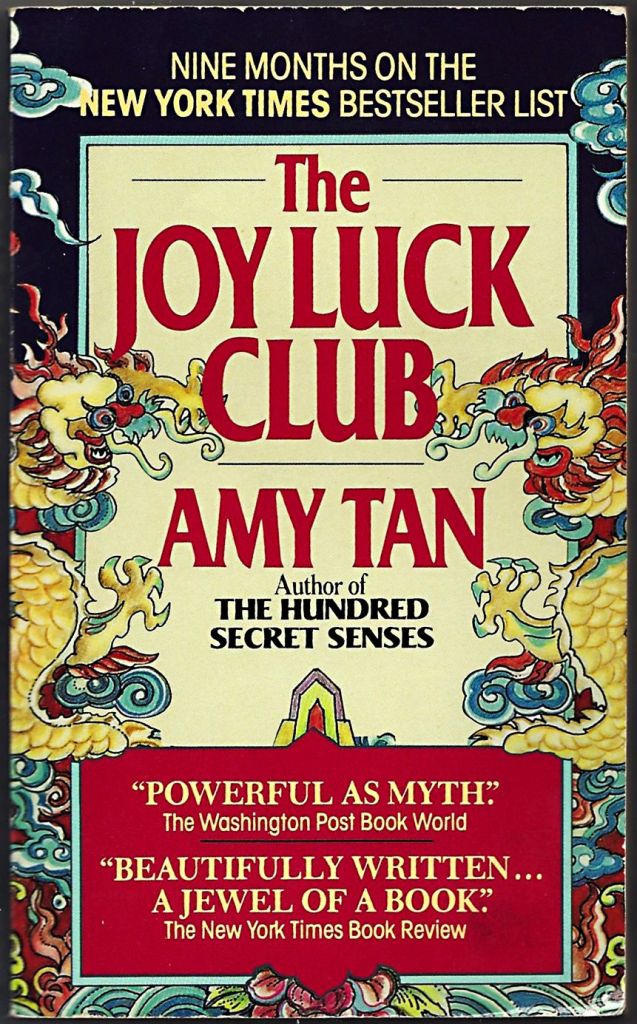
This novel focuses on four Chinese immigrant families in San Francisco who start a club known as The Joy Luck Club, playing the Chinese game of mahjong for money while feasting on a variety of foods. The book is structured similarly to a mahjong game, with four parts divided into four sections to create sixteen chapters. The three mothers and four daughters (one mother, Suyuan Woo, dies before the novel opens) share stories about their lives in the form of short vignettes. Each part is preceded by a parable relating to the themes within that section. In 1993, the novel was adapted into a feature film directed by Wayne Wang and starring Ming-Na Wen, Lauren Tom, Tamlyn Tomita, France Nguyen, Rosalind Chao, Kieu Chinh, Tsai Chin, Lisa Lu, and Vivian Wu. The screenplay was written by the author Amy Tan along with Ronald Bass. The novel was also adapted into a play, by Susan Kim, which premiered at Pan Asian Repertory Theatre in New York.

A lot happened in the year 1989, including the debut of a TV sitcom in which nothing happened. That show, of course, was Seinfeld, and we’ll be doing a deep dive into this iconic comedy over the coming weeks.
But first, to get a sense of the times and trends that helped shape this series, here’s a quick look at the other notable television programs that premiered in 1989.
Shining Time Station is an American children’s television series jointly created by British television producer Britt Allcroft and American television producer Rick Siggelkow. The series was produced by Quality Family Entertainment (the American branch of The Britt Allcroft Company), in association with Catalyst Entertainment in seasons 2 and 3, for New York City’s PBS station WNET, and was originally taped in New York City during its first season and in Toronto during the rest of its run. It incorporated sequences from the British television show Thomas & Friends, which was in turn based on the books of The Railway Series written by the Reverend Wilbert Awdry.
The series aired on PBS from January 29, 1989, until June 11, 1993, with four hour-long “Family Specials” premiering in primetime throughout 1995. Elements from the show were incorporated into the 2000 Thomas and Friends film Thomas and the Magic Railroad. The initial 1989 season featured a cast that included Ringo Starr as Mr. Conductor, Didi Conn as Stacy Jones, Brian O’Connor as Horace Schemer, Leonard Jackson as Harry Cupper, Jason Woliner as Matt Jones and Nicole Leach as Tanya Cupper. The show was retooled for the second (1991) and third (1993) seasons, with only Conn and O’Connor reprising their prior roles. George Carlin replaced Starr as Mr. Conductor, while Erica Luttrell, Ari Magder, Danielle Marcot, and Tom Jackson joined the primary cast in newly created roles.
In addition to the three main seasons, a Christmas special featuring the original cast, aired in 1990, and four “family specials” aired in 1995 featuring the second cast. Providing the musical numbers for the show was “The Jukebox Band”, a group of puppets. In 1996, only Carlin appeared in a spin-off series called Mr. Conductor’s Thomas Tales, which featured only six episodes with five Thomas stories and one Music video each. The station Interior was kept for the spin-off.
Coach is an American sitcom television series that aired for nine seasons on ABC from February 28, 1989 to May 14, 1997, with a total of 200 half-hour episodes. The series stars Craig T. Nelson as Hayden Fox, head coach of the fictional NCAA Division I-A Minnesota State University Screaming Eagles football team. For the last two seasons, Coach Fox and the supporting characters coached the Orlando Breakers, a fictional National Football League expansion team. The program also starred Jerry Van Dyke as Luther Van Dam and Bill Fagerbakke as Michael “Dauber” Dybinski, assistant coaches under Fox. The role of Hayden’s girlfriend (and later wife) Christine Armstrong, a television news anchor, was played by Shelley Fabares.
Chip ‘n Dale: Rescue Rangers is an American animated adventure comedy television series produced by Walt Disney Television Animation. Created by Tad Stones and Alan Zaslove, it featured established Disney characters Chip ‘n’ Dale in a new setting. The series premiered on The Disney Channel on March 4, 1989, after the episode “Catteries Not Included” aired on August 27, 1988, as a preview. The series continued in September with a two-hour special, Rescue Rangers: To the Rescue, later divided into five parts to air as part of the weekday run. The final episode aired on November 19, 1990.
On September 18, 1989, the series entered national syndication. It aired afternoons along with and following DuckTales on a network that would become Fox before transferring to a new channel. TaleSpin, a series based on characters from The Jungle Book, was added to the lineup, just before The Disney Afternoon aired on this new channel, following Rescue Rangers. From 1990 to 1993, reruns were aired as a part of The Disney Afternoon. It was syndicated on Toon Disney upon launch in 1998 but was removed a decade later. The entire run became available (as one season) as part of Disney+ as of its launch on November 12, 2019, fully remastered in high definition. The series was initially released on Blu-ray on January 25, 2022, via Disney Movie Club, then everywhere else on February 15, 2022.
Quantum Leap is an American science fiction television series, created by Donald P. Bellisario, that premiered on NBC and aired for five seasons, from March 26, 1989, to May 5, 1993. The series stars Scott Bakula as Dr. Sam Beckett, a physicist who involuntarily leaps through spacetime during experiments in time travel, by temporarily taking the place of other people to correct what he consistently discovers were historical mistakes. Dean Stockwell co-stars as Admiral Al Calavicci, Sam’s womanizing, cigar-smoking companion and best friend, who appears to him as a hologram and researches and shapes his opinions of the past. The series features a mix of humor, drama, romance, social commentary, and science fiction. It was ranked number 19 on TV Guide’s “Top Cult Shows Ever” in 2007. A revival series was ordered by NBC, which premiered on September 19, 2022.
Reruns of the original The Mickey Mouse Club began airing on The Disney Channel with the channel’s 1983 launch. While the show was popular with younger audiences, the Disney Channel executives felt it had become dated over the years, particularly as it was aired in black-and-white. Their answer was to create a brand-new version of the club, one targeted at contemporary audiences. Notably, the all-new “club-members” would wear Mouseketeer varsity jackets instead of iconic Mickey Mouse ears. This show was called The All-New Mickey Mouse Club (also known as “MMC” to fans). This version of the series is notable for featuring a number of cast members who went on to achieve global success in music and acting: Ryan Gosling, Britney Spears, Christina Aguilera, future NSYNC band members Justin Timberlake and JC Chasez, Keri Russell, Deedee Magno, future En Vogue member Rhona Bennett, Nikki DeLoach, and Chase Hampton. Nick Carter was selected to join the program at the age of 12, however, he decided to join the developing boy band, Backstreet Boys.
Throughout the run, Fred Newman was the main adult co-host from the beginning of the series until season 6. In the first season, Newman was joined by other co-host Mowava Pryor. She was then replaced by Terri Eoff from the fourth season until the sixth season. By the show’s final season (1994), two original members Chase Hampton and Tiffini Hale became the co-hosts. This was the first version of the club to have any studio audience, though a moderately small group. Former Mouseketeer Don Grady guest-starred in the season 1 finale. Grady, along with fellow Mouseketeers Annette Funicello, Bobby Burgess, Tommy Cole, Sharon Baird, and Sherry Alberoni were reunited on the 100th episode, during the show’s third season. Funicello later appeared on the show again, in an interview with the Mouseketeer Lindsey Alley.
Saved by the Bell is an American television sitcom created by Sam Bobrick for NBC. The series premiered, in primetime, on August 20, 1989, a Sunday night. Targeted at kids and teens, Saved by the Bell was broadcast in the United States on Saturday mornings, later as the flagship series in NBC’s TNBC lineup. A retooling of the Disney Channel series Good Morning, Miss Bliss, the show follows a group of high school friends and their principal at the fictional Bayside High School in Los Angeles. Primarily focusing on lighthearted comedic situations, it occasionally touches on serious social issues, such as drug use, driving under the influence, homelessness, remarriage, death, women’s rights, and environmental issues. The series starred Mark-Paul Gosselaar, Dustin Diamond, Lark Voorhies, Dennis Haskins, Tiffani-Amber Thiessen, Elizabeth Berkley, and Mario Lopez.
The series ran for four seasons, airing its final episode, again in primetime, on May 22, 1993, a Saturday night. The show spawned two spin-off series: Saved by the Bell: The College Years (1993–1994), a primetime series that follows several of the characters to college, and Saved by the Bell: The New Class (1993–2000), a Saturday morning series that follows a new group of students at Bayside High School. The series also spawned two TV movies, Saved by the Bell: Hawaiian Style in 1992 and Saved by the Bell: Wedding in Las Vegas in 1994. In later years, Saved by the Bell has been classified as educational and informational. The show was named one of the “20 Best School Shows of all Time” by AOL TV.
Doogie Howser, M.D. is an American medical sitcom that ran for four seasons on ABC from September 19, 1989, to March 24, 1993, totaling 97 episodes. Created by Steven Bochco and David E. Kelley, the show stars Neil Patrick Harris in the title role as a teenage physician who balances the challenge of practicing medicine with the everyday problems of teenage life.
Baywatch is an American action drama television series about lifeguards who patrol the beaches of Los Angeles County, California, and Hawaii, starring David Hasselhoff. It was created by Michael Berk, Douglas Schwartz, and Gregory J. Bonann, who produced the show throughout its 11-season run. The series focuses on both professional and personal challenges faced by the characters, portrayed by a large rotating ensemble cast that notably includes Pamela Anderson, Alexandra Paul, Gregory Alan Williams, Jeremy Jackson, Parker Stevenson, David Chokachi, Billy Warlock, Erika Eleniak, David Charvet, Yasmine Bleeth, and Nicole Eggert.
The show was canceled after its first season on NBC, but survived through syndication and later became the most-watched television series in the world, with a weekly audience of over 1.1 billion viewers despite consistently negative critical reviews, earning it a reputation as a pop cultural phenomenon and frequent source of allusion and parody. The show ran in its original title and format from 1989 to 1999. From 1999 to 2001, with a setting change and large cast overhaul, it was known as Baywatch: Hawaii. It spawned a spin-off series, Baywatch Nights, which aired for two seasons from 1995 to 1997, and a 2017 feature film adaptation.
Family Matters is an American television sitcom that debuted on ABC on September 22, 1989, and ended on May 9, 1997. However it moved to CBS, where it was shown from September 19, 1997, to July 17, 1998. A spin-off of Perfect Strangers, the series revolves around the Winslow family, a middle-class African-American family living in Chicago, Illinois. Midway through the first season, the show introduced the Winslows’ nerdy neighbor Steve Urkel (Jaleel White), who was originally scripted to appear as a one-time character. However, he quickly became the show’s breakout character (and eventually the main character), joining the main cast.
Running for nine seasons, Family Matters became the second-longest-running live action U.S. sitcom with a predominantly African-American cast, behind only The Jeffersons (11 seasons). It aired for 215 episodes, being ranked third, behind only Tyler Perry’s House of Payne (280+ as of 2021), and The Jeffersons (253). Family Matters was the last live-action scripted primetime show that debuted in the 1980s to leave the air; the only scripted show that started in the 1980s and lasted longer in continuous production was The Simpsons.
The Simpsons is an American animated sitcom created by Matt Groening for the Fox Broadcasting Company. The series is a satirical depiction of American life, epitomized by the Simpson family, which consists of Homer, Marge, Bart, Lisa, and Maggie. The show is set in the fictional town of Springfield and parodies American culture and society, television, and the human condition. The family was conceived by Groening shortly before a solicitation for a series of animated shorts with producer James L. Brooks. He created a dysfunctional family and named the characters after his own family members, substituting Bart for his own name; he thought Simpson was a funny name in that it sounded similar to “simpleton”. The shorts became a part of The Tracey Ullman Show on April 19, 1987. After three seasons, the sketch was developed into a half-hour prime time show and became Fox’s first series to land in the Top 30 ratings in a season (1989–1990).
Since its debut on December 17, 1989, more than 750 episodes of the show have been broadcast. It is the longest-running American animated series, longest-running American sitcom, and the longest-running American scripted primetime television series, both in terms of seasons and number of episodes. A feature-length film, The Simpsons Movie, was released in theaters worldwide on July 27, 2007, and grossed over $527 million, with a sequel in development as of 2018. The series has also spawned numerous comic book series, video games, books, and other related media, as well as a billion-dollar merchandising industry. The Simpsons is a joint production by Gracie Films and 20th Television.
The Simpsons received widespread acclaim throughout its early seasons in the 1990s, which are generally considered its “golden age”. Since then, it has been criticized for a perceived decline in quality. Time named it the 20th century’s best television series, and Erik Adams of The A.V. Club named it “television’s crowning achievement regardless of format”. On January 14, 2000, the Simpson family was awarded a star on the Hollywood Walk of Fame. It has won dozens of awards since it debuted as a series, including 35 Primetime Emmy Awards, 34 Annie Awards, and 2 Peabody Awards. Homer’s exclamatory catchphrase of “D’oh!” has been adopted into the English language, while The Simpsons has influenced many other later adult-oriented animated sitcom television series.
A lot happened in the year 1989, including the debut of a TV sitcom in which nothing happened. That show, of course, was Seinfeld, and we’ll be doing a deep dive into this iconic comedy over the coming weeks.
But first, to get a sense of the times and trends that helped shape this series, here’s a quick look at the notable films that premiered in 1989.
Bill & Ted’s Excellent Adventure is a 1989 American science fiction comedy film directed by Stephen Herek and written by Chris Matheson and Ed Solomon. The first installment of the Bill & Ted franchise stars Keanu Reeves, Alex Winter and George Carlin. Winter and Reeves reprised their roles in two sequels: Bill & Ted’s Bogus Journey (1991) and Bill & Ted Face the Music (2020).
Heathers is a 1989 American black comedy film written by Daniel Waters and directed by Michael Lehmann, in both of their respective film debuts. The film stars Winona Ryder, Christian Slater, Shannen Doherty, Lisanne Falk, Kim Walker, and Penelope Milford. Its plot portrays four teenage girls—three of whom are named Heather—in a clique at an Ohio high school, one of whose lives is disrupted by the arrival of a misanthrope intent on murdering the popular students and staging their deaths as suicides. It has since become popular as a cult film and is regarded in polls as one of the greatest coming-of-age films of all time.
Major League is a 1989 American sports comedy film produced by Chris Chesser and Irby Smith, written and directed by David S. Ward, that stars Tom Berenger, Charlie Sheen, Wesley Snipes, James Gammon, Bob Uecker, Rene Russo, Margaret Whitton, Dennis Haysbert, and Corbin Bernsen. It is the first installment in the Major League film series and spawned two sequels (Major League II and Major League: Back to the Minors), neither of which repeated the success of the original film.
Say Anything… is a 1989 American teen romantic comedy drama film written and directed by Cameron Crowe (in his feature directorial debut). The film follows the romance between Lloyd Dobler (John Cusack), an average student, and Diane Court (Ione Skye), the class valedictorian, immediately after their graduation from high school. The film received positive reviews from critics. In 2002, Entertainment Weekly ranked Say Anything… as the greatest modern movie romance, and it was ranked number 11 on Entertainment Weekly’s list of the 50 Best High School Movies.
Field of Dreams is a 1989 American sports fantasy drama film written and directed by Phil Alden Robinson, based on Canadian novelist W. P. Kinsella’s 1982 novel Shoeless Joe. The film stars Kevin Costner as a farmer who builds a baseball field in his cornfield that attracts the ghosts of baseball legends, including Shoeless Joe Jackson (Ray Liotta) and the Chicago Black Sox. Amy Madigan, James Earl Jones, and Burt Lancaster (in his final film role) also star. The film received generally positive reviews from critics, and was nominated for three Academy Awards: Best Picture, Best Original Score and Best Adapted Screenplay. In 2017, it was selected for preservation in the United States National Film Registry by the Library of Congress as “culturally, historically, or aesthetically significant.”
Indiana Jones and the Last Crusade is a 1989 American action-adventure film directed by Steven Spielberg, from a story co-written by executive producer George Lucas. It is the third installment in the Indiana Jones franchise and a sequel to Raiders of the Lost Ark (1981). Harrison Ford returns in the title role, while his father is portrayed by Sean Connery. Other cast members featured include Alison Doody, Denholm Elliott, Julian Glover, River Phoenix, and John Rhys-Davies. In the film, set largely in 1938, Indiana searches for his father, a Holy Grail scholar, who has been kidnapped and held hostage by the Nazis while on a journey to find the Holy Grail. The Last Crusade was released by Paramount Pictures. This film was a financial success, earning $475.8 million at the worldwide box office, and won the Academy Award for Best Sound Effects Editing. A sequel, Indiana Jones and the Kingdom of the Crystal Skull, followed in 2008. A fifth film is scheduled for release in Summer 2023.
Dead Poets Society is a 1989 American drama film directed by Peter Weir, written by Tom Schulman, and starring Robin Williams. Set in 1959 at the fictional elite conservative boarding school Welton Academy, it tells the story of an English teacher who inspires his students through his teaching of poetry. The film was a commercial success and received numerous accolades, including Academy Award nominations for Best Director, Best Picture, and Best Actor for Robin Williams. The film won the BAFTA Award for Best Film, the César Award for Best Foreign Film and the David di Donatello Award for Best Foreign Film. Schulman received an Academy Award for Best Original Screenplay for his work.
Star Trek V: The Final Frontier is a 1989 American science fiction film directed by William Shatner and based on the television series Star Trek created by Gene Roddenberry. It is the fifth installment in the Star Trek film series, and takes place shortly after the events of Star Trek IV: The Voyage Home (1986). Its plot follows the crew of the USS Enterprise-A as they confront renegade Vulcan Sybok, who is searching for God at the center of the galaxy. It had the highest opening gross of any Star Trek film at that point and was number one in its first week at the box office; however, its grosses quickly dropped in subsequent weeks. The film received generally mixed to negative reviews by critics on release, and, according to its producer, “nearly killed the franchise.” The next entry in the series, Star Trek VI: The Undiscovered Country (1991), received a much more positive reception.
Ghostbusters II is a 1989 American supernatural comedy film directed and produced by Ivan Reitman, and written by Dan Aykroyd and Harold Ramis. The film stars Bill Murray, Aykroyd, Sigourney Weaver, Ramis, Rick Moranis, Ernie Hudson, and Annie Potts. It is the sequel to the 1984 film Ghostbusters and the second film in the Ghostbusters franchise. Set five years after the events of the first film, the Ghostbusters have been sued and put out of business after the destruction caused during their battle with the deity Gozer. When a new paranormal threat emerges, the Ghostbusters reunite to combat it and save the world. Ghostbusters II was released on June 16, 1989 to generally negative reviews. Critics responded unfavorably to what they perceived as largely a copy of the original and a softening of its cynical, dark humor to be more family-friendly, although the performances of Peter MacNicol and Rick Moranis were repeatedly singled out for praise.
As the sequel to the then-highest-grossing comedy film of all time, Ghostbusters II was expected to dominate the box office. Instead, the film earned $215.4 million during its theatrical run compared with the original’s $282.2 million, making it the eighth-highest-grossing film of the year. The film failed to replicate the cultural impact and following of Ghostbusters. Although some critics retrospectively praised it, Ghostbusters II is generally seen as a poor follow-up to Ghostbusters and responsible for stalling the franchise for decades. The film spawned a series of merchandise including video games, board games, comic books, music, toys, and haunted houses. Despite the relative failure of Ghostbusters II, a second sequel was pursued through to the early 2010s. Following the 2016 series reboot, Ghostbusters: Answer the Call, a sequel to Ghostbusters II titled Ghostbusters: Afterlife was released in 2021.
Batman is a 1989 superhero film based on the DC Comics character of the same name, created by Bob Kane and Bill Finger. Produced by Jon Peters and Peter Guber, it is the first installment of Warner Bros.’ initial Batman film series. The film was directed by Tim Burton and stars Jack Nicholson, Michael Keaton, Kim Basinger, Robert Wuhl, Pat Hingle, Billy Dee Williams, Michael Gough, and Jack Palance. The film takes place early in the title character’s war on crime and depicts his conflict with his archenemy The Joker. Batman was both critically and financially successful, earning over $400 million in box office totals. Critics and audiences particularly praised Nicholson and Keaton’s performances, Burton’s direction, the production design, and Elfman’s score. It was the fifth-highest-grossing film in history at the time of its release.
The film received several Saturn Award nominations and a Golden Globe nomination for Nicholson’s performance, and won the Academy Award for Best Art Direction. It also inspired the equally successful Batman: The Animated Series, paving the way for the DC Animated Universe, and has influenced Hollywood’s modern marketing and development techniques of the superhero film genre. The film was followed by three sequels: Batman Returns (1992), with both Burton and Keaton returning; Batman Forever (1995), which featured Val Kilmer in the lead role; and Batman & Robin (1997), which featured George Clooney in the role.
Honey, I Shrunk the Kids is a 1989 American comic science fiction film. It is the first installment of a film franchise and served as the directorial debut of Joe Johnston. The film stars Rick Moranis, Matt Frewer, Marcia Strassman, and Kristine Sutherland. In the film, a struggling inventor accidentally shrinks his kids, along with the neighbors’ kids, down to the size of a quarter-inch. After being accidentally thrown out with the trash, they must work together and venture their way back through a backyard wilderness filled with dangerous insects and man-made hazards. It was distributed by Buena Vista Pictures Distribution. It was an unexpected box office success, grossing $222 million worldwide (equivalent to $485.3 million in 2021) and becoming the highest-grossing live-action Disney film of all time, a record it held for five years. Its success led to two sequels, beginning with Honey, I Blew Up the Kids in 1992, as well as a television series and several theme-park attractions. An animated short film, Tummy Trouble starring Roger Rabbit, was shown in theaters with the film during its box office run.
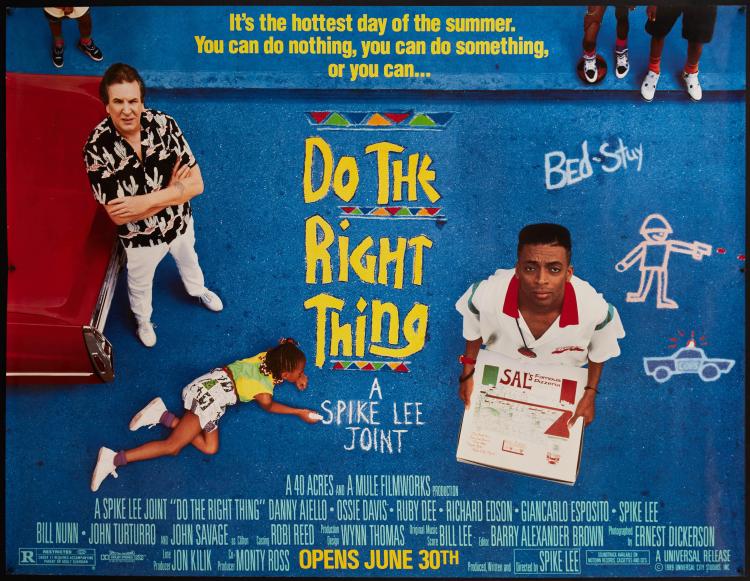
Do the Right Thing is a 1989 American comedy-drama film produced, written, and directed by Spike Lee. It stars Lee, Danny Aiello, Ossie Davis, Ruby Dee, Richard Edson, Giancarlo Esposito, Bill Nunn, John Turturro, and Samuel L. Jackson, and is the feature film debut of Martin Lawrence and Rosie Perez. The story explores a Brooklyn neighborhood’s simmering racial tension between its African-American residents and the Italian-American owners of a local pizzeria, culminating in tragedy and violence on a hot summer day. The film was a critical and commercial success and received numerous accolades, including Academy Award nominations for Best Original Screenplay and Best Supporting Actor for Aiello’s portrayal of Sal the pizzeria owner. It is often listed among the greatest films of all time. In 1999, the film was deemed “culturally, historically, or aesthetically significant” by the Library of Congress, and was selected for preservation in the National Film Registry.
The Karate Kid Part III is a 1989 American martial arts drama film, the third entry in the Karate Kid franchise and a sequel to The Karate Kid Part II (1986). It stars Ralph Macchio, Pat Morita, Robyn Lively, and Thomas Ian Griffith in his film debut. As was the case with the first two films in the series, it was directed by John G. Avildsen and written by Robert Mark Kamen, with stunts choreographed by Pat E. Johnson and music composed by Bill Conti. In the film, the returning John Kreese, with the help of his best friend Terry Silver, attempts to gain revenge on Daniel and Mr. Miyagi which involves hiring a ruthless martial artist and harming their relationship. Though moderately successful at the box office, The Karate Kid Part III received generally negative reviews, with criticism aimed at its rehashing of elements found in its two predecessors, though Griffith’s performance as Silver received praise from some critics. It was followed by The Next Karate Kid in 1994.
Weekend at Bernie’s is a 1989 American black comedy film directed by Ted Kotcheff and written by Robert Klane, loosely based on the 1959 novella The Two Deaths of Quincas Wateryell by Jorge Amado. The film stars Andrew McCarthy and Jonathan Silverman as young insurance corporation employees who discover that their boss, Bernie, is dead, after arriving at his house. While attempting to convince people that Bernie is still alive until they can leave to prevent them from being falsely suspected for causing his death, they discover that Bernie had ordered their own assassinations to cover up his embezzlement. It grossed $30 million on a $15 million budget. The film’s success inspired a sequel, Weekend at Bernie’s II (1993).
Lethal Weapon II is a 1989 American buddy cop action film directed by Richard Donner, and starring Mel Gibson, Danny Glover, Joe Pesci, Joss Ackland, Derrick O’Connor and Patsy Kensit. It is a sequel to the 1987 film Lethal Weapon and the second installment in the Lethal Weapon film series. Gibson and Glover respectively reprise their roles as LAPD officers, Martin Riggs and Roger Murtaugh, who protect an irritating federal witness (Pesci), while taking on a gang of South African drug dealers hiding behind diplomatic immunity. The film was nominated for an Academy Award for Best Sound Editing (for Robert G. Henderson). The film received mostly positive reviews and earned more than $227 million worldwide.
License to Kill is a 1989 spy film, the sixteenth in the James Bond series produced by Eon Productions, and the second and final film to star Timothy Dalton as the MI6 agent James Bond. It sees Bond suspended from MI6 as he pursues the drug lord Franz Sanchez, who has ordered an attack against Bond’s CIA friend Felix Leiter and the murder of Felix’s wife after their wedding. License to Kill was the fifth and final Bond film directed by John Glen, the last to feature Robert Brown as M and Caroline Bliss as Miss Moneypenny. It was also the last to feature the work of the screenwriter Richard Maibaum, the title designer Maurice Binder and the producer Albert R. Broccoli, all of whom died in the following years.
License to Kill was the first Bond film to not use the title of an Ian Fleming story. Originally titled License Revoked, the name was changed during post-production due to American test audiences associating the term with driver’s license. Although its plot is largely original, it contains elements of the Fleming novel Live and Let Die and the short story “The Hildebrand Rarity”, interwoven with a sabotage premise influenced by Akira Kurosawa’s film Yojimbo. For budget reasons, License to Kill became the first Bond film shot entirely outside the United Kingdom: principal photography took place on location in Mexico and the US, while interiors were filmed at Estudios Churubusco instead of Pinewood Studios. The film earned over $156 million worldwide and received generally positive reviews, with praise for the stunts, but attracted criticism for its darker tone, which carried into Dalton’s portrayal of Bond.
When Harry Met Sally… is a 1989 American romantic comedy-drama film written by Nora Ephron and directed by Rob Reiner. It stars Billy Crystal as Harry and Meg Ryan as Sally. The story follows the title characters from the time they meet in Chicago just before sharing a cross-country drive, through twelve years of chance encounters in New York City. The film addresses but doesn’t resolve questions along the lines of “Can men and women ever just be friends?” Columbia Pictures released When Harry Met Sally… in selected cities, letting word of mouth generate interest, before gradually expanding distribution. The film grossed $92.8 million in North America, and was released to critical acclaim. Ephron received a British Academy Film Award, an Oscar nomination, and a Writers Guild of America Award nomination for her screenplay. The film is ranked 23rd on AFI’s “100 Years… 100 Laughs” list of the top comedy films in American cinema and number 60 on Bravo’s “100 Funniest Movies”. In early 2004, the film was adapted for the stage in a production starring Luke Perry and Alyson Hannigan.
Friday the 13th Part VIII: Jason Takes Manhattan is a 1989 American slasher film written and directed by Rob Hedden, and starring Jensen Daggett, Scott Reeves, Peter Mark Richman, and Kane Hodder as Jason Voorhees, reprising his role from Friday the 13th Part VII: The New Blood. It is the eighth installment in the Friday the 13th franchise. Set several years after The New Blood, the film follows Jason as he stalks a group of high school graduates on a ship en route to New York City. It was the final film in the series to be distributed by Paramount Pictures in the United States until 2009, with the subsequent installments being distributed by New Line Cinema. Jason Takes Manhattan grossed $14.3 million at the domestic box office, making it the poorest-performing film in the Friday the 13th series to date. The film received overwhelmingly negative reviews for what critics saw as weak humor, unintelligent plotting, and a failure to effectively deliver on the promise of its subtitle. The next installment in the series, Jason Goes to Hell: The Final Friday, was released in 1993.
Turner & Hooch is a 1989 American buddy cop comedy film starring Tom Hanks and Beasley the Dog as the eponymous characters respectively. The film also co-stars Mare Winningham, Craig T. Nelson and Reginald VelJohnson. It was directed by Roger Spottiswoode and co-written by Daniel Petrie Jr., who also served as an executive producer. Following the film’s success, it spawned a franchise including a television movie sequel, and a legacy sequel television series. Touchstone Pictures acquired the screenplay for Turner & Hooch for $1 million, which was the highest amount ever paid by Touchstone for any script at the time.
A Nightmare on Elm Street 5: The Dream Child is a 1989 American gothic slasher film directed by Stephen Hopkins and written by Leslie Bohem. It is the fifth installment in the A Nightmare on Elm Street franchise, and stars Lisa Wilcox, and Robert Englund as Freddy Krueger. The film follows Krueger, using a now pregnant Alice Johnson’s baby’s dreams to claim new victims. The Dream Child grossed $22.1 million on a budget of $8 million, a steep decline in box office receipts from Dream Warriors and The Dream Master, while still a box office success and the highest grossing slasher film of 1989. It received mostly negative reviews from critics.
Uncle Buck is a 1989 American comedy film written, directed by John Hughes, and starring John Candy and Amy Madigan with supporting roles by Jean Louisa Kelly (in her film debut), Macaulay Culkin, Gaby Hoffmann, Garrett M. Brown and Elaine Bromka. The film tells the story of a bachelor who babysits his brother’s rebellious teenage daughter and her younger brother and sister while the parents are away. Uncle Buck was released by Universal Pictures and grossed $79.2 million against a $15 million budget. The film was met with mixed reviews.
Sex, Lies, and Videotape, is a 1989 American independent drama film written and directed by Steven Soderbergh. The plot tells the story of a troubled man who videotapes women discussing their sexuality and fantasies, and his impact on the relationships of a troubled married couple and the wife’s younger sister. Sex, Lies, and Videotape won the Palme d’Or at the 1989 Cannes Film Festival, making Soderbergh the youngest solo director to win the award; he was 26 at the time. The film was influential in revolutionizing the independent film movement in the early 1990s. In 2006, Sex, Lies, and Videotape was added to the United States Library of Congress’ National Film Registry, deemed “culturally, historically, or aesthetically significant”.
Crimes and Misdemeanors is a 1989 American existential comedy-drama film written and directed by Woody Allen, who stars alongside Martin Landau, Mia Farrow, Anjelica Huston, Jerry Orbach, Alan Alda, Sam Waterston, and Joanna Gleason. The film was met with critical acclaim, receiving three Academy Award nominations: Allen, for Best Director and Best Original Screenplay, and Landau, for Best Actor in a Supporting Role. Several publications have ranked Crimes and Misdemeanors as one of Allen’s greatest films.
The Fabulous Baker Boys is a 1989 American romantic comedy-drama musical film, written and directed by Steve Kloves. Primarily set in Seattle, Washington, the film follows a piano duo consisting of brothers, who hire an attractive singer to revive their waning career. After a period of success, complications ensue when the younger brother develops a romantic interest in the singer. Brothers Jeff and Beau Bridges star as the titular musicians, with Michelle Pfeiffer playing lounge singer Susie Diamond. The Fabulous Baker Boys was released to critical acclaim, receiving praise for its three leads’ performances, particularly Pfeiffer’s. The National Board of Review named it one of the year’s 10 best films. However, the film underperformed at the box office, grossing $18.4 million against its $11.5 million budget.
The Fabulous Baker Boys was nominated for four Academy Awards at the 62nd Academy Awards: Best Actress (for Pfeiffer), Best Cinematography, Best Film Editing, and Best Original Score. Pfeiffer won nearly every acting award for which she was nominated during the 1989-1990 awards season, including the Golden Globe Award for Best Actress in a Motion Picture – Drama, but lost the Academy Award to Jessica Tandy. The film is best remembered for Pfeiffer’s sultry performance of “Makin’ Whoopee” on top of a grand piano, which several media publications consider to be one of the most famous and sexiest scenes in film history.
Halloween 5: The Revenge of Michael Myers is a 1989 American slasher film co-written and directed by Dominique Othenin-Girard, and starring Donald Pleasence and Danielle Harris. The fifth installment in the Halloween series, it follows serial killer Michael Myers who again returns to the town of Haddonfield to murder his niece, Jamie Lloyd, who, traumatized from his previous attack on her, has been institutionalized following her attempt to murder her foster mother. The film received generally negative reviews from critics and was a box office disappointment, only grossing $11.6 million domestically against a $5.5 million budget.
Henry V is a 1989 British historical drama film adapted for the screen and directed by Kenneth Branagh, based on William Shakespeare’s play of the same name about King Henry V of England. The film stars Branagh in the title role with Paul Scofield, Derek Jacobi, Ian Holm, Emma Thompson, Alec McCowen, Judi Dench, Robbie Coltrane, Brian Blessed, and Christian Bale in supporting roles. The film received worldwide critical acclaim and is considered to be one of the best Shakespeare film adaptations ever made. For her work on the film, Phyllis Dalton won an Academy Award for Best Costume Design and Kenneth Branagh, in his directorial debut, received Oscar nominations for Best Actor and Best Director.
My Left Foot: The Story of Christy Brown, also known simply as My Left Foot, is a 1989 biographical comedy-drama film directed by Jim Sheridan adapted by Sheridan and Shane Connaughton from the 1954 memoir of the same name by Christy Brown. A co-production of Ireland and the United Kingdom, it stars Daniel Day-Lewis as Brown, an Irish man born with cerebral palsy, who could control only his left foot. Brown grew up in a poor working-class family, and became a writer and artist. Brenda Fricker, Ray McAnally, Hugh O’Conor, Fiona Shaw, and Cyril Cusack are featured in supporting roles. The film was theatrically released on February 24, 1989 to critical and commercial success. Reviewers praised the film’s screenplay and direction, its message, and especially the performances of Day-Lewis and Fricker, while the film grossed $14.7 million on a £600,000 budget.
At the 62nd Academy Awards, the film received five nominations, including for the Best Picture, with Day-Lewis and Fricker winning Best Actor and Best Supporting Actress, respectively. In 2018, the British Film Institute ranked it as the 53rd greatest British film of the 20th century.
All Dogs Go to Heaven is a 1989 animated musical fantasy adventure comedy-drama film directed by Don Bluth and co-directed by Gary Goldman (his directorial debut) and Dan Kuenster. It tells the story of Charlie B. Barkin (voiced by Burt Reynolds), a German Shepherd that is murdered by his former friend, Carface Carruthers (voiced by Vic Tayback, in his penultimate film role). Charlie withdraws from his place in Heaven to return to Earth where his best friend, Itchy Itchiford (voiced by Dom DeLuise), still lives, in order to take revenge on Carface. Instead, he ends up befriending a young orphan girl named Anne-Marie (voiced by Judith Barsi in her final film role; posthumously). In the process, Charlie learns an important lesson about kindness, friendship and love.
The film is an Irish, British and American venture, produced by Goldcrest Films and Sullivan Bluth Studios Ireland Ltd. On its cinema release, it competed directly with Walt Disney Feature Animation’s The Little Mermaid, released on the same day. While it did not repeat the box-office success of Sullivan Bluth’s previous feature films, An American Tail and The Land Before Time, it was successful on home video, becoming one of the biggest-selling VHS releases ever. It inspired a theatrical sequel, a television series, and a holiday direct-to-video film.
The Little Mermaid is a 1989 American animated musical fantasy film produced by Walt Disney Feature Animation and released by Walt Disney Pictures. The 28th Disney animated feature film, it is loosely based on the 1837 Danish fairy tale of the same name by Hans Christian Andersen. The film tells the story of a teenage mermaid princess named Ariel, who dreams of becoming human and falls in love with a human prince named Eric, which leads her to make a magic deal with the sea witch, Ursula, to become human and be with him. The Little Mermaid was written and directed by John Musker and Ron Clements and produced by Musker and Howard Ashman, who also wrote the film’s songs with Alan Menken. Menken also composed the film’s score. The film stars the voices of Jodi Benson, Christopher Daniel Barnes, Pat Carroll, Samuel E. Wright, Jason Marin, Kenneth Mars, and Buddy Hackett.
Walt Disney planned to put the story in a proposed package film containing Andersen’s stories, but scrapped the project. In 1985, while working on The Great Mouse Detective (1986), Clements and Musker decided to adapt the fairy tale and proposed it to Disney Studios chairman Jeffrey Katzenberg, who initially declined due to its similarities to a proposed sequel to the 1984 film Splash, but ultimately approved of it. Ashman became involved and brought in Menken. With supervision from Katzenberg, they made a Broadway-style structure with musical numbers as the staff was working on Oliver & Company (1988). Katzenberg warned that the film would earn less since it appealed to females, but he eventually became convinced that it would be Disney’s first blockbuster hit. The Little Mermaid was released to theaters to critical acclaim, earning praise for the animation, music, and characters. It was also a commercial success, garnering $84 million at the domestic box office during its initial release, and $235 million in total lifetime gross worldwide.
Along with the major success of both the 1986 Disney animated film The Great Mouse Detective and the 1988 Disney/Amblin live-action/animated film Who Framed Roger Rabbit, The Little Mermaid is given credit for breathing life back into the art of Disney animated feature films after some films produced by Disney were struggling. It also marked the start of the era known as the Disney Renaissance. The film won two Academy Awards for Best Original Score and Best Original Song (“Under the Sea”). The film’s success led to a media franchise. A direct-to-video sequel was released in 2000, focusing on Ariel’s daughter, Melody. A prequel followed in 2008. The first film was adapted into a stage musical with a book by Doug Wright and additional songs by Alan Menken and new lyricist Glenn Slater opened in Denver in July 2007 and began performances on Broadway January 10, 2008, starring Sierra Boggess. Other derived works and material inspired by the film, include a live-action film adaptation, directed by Rob Marshall, currently scheduled for release in 2023, and a 2019 live musical presentation of the film aired on ABC as part of “The Wonderful World of Disney.”
Steel Magnolias is a 1989 American comedy-drama film directed by Herbert Ross and starring Academy Award winner Sally Field, Dolly Parton, Shirley MacLaine, Daryl Hannah, Olympia Dukakis and Julia Roberts. The picture is a film adaptation of Robert Harling’s 1987 play of the same name about the bond a group of women share in a small-town Southern community, and how they cope with the death of one of their own. The supporting cast features Tom Skerritt, Dylan McDermott, Sam Shepard and Kevin J. O’Connor. Robert Harling based the story in part on his sister, Susan Harling Robinson. She died in 1985 of complications from Type 1 diabetes. In the film, Julia Roberts plays Shelby, the character based on Susan.
Back to the Future Part II is a 1989 American science fiction film directed by Robert Zemeckis from a screenplay by Bob Gale and a story by both. It is the sequel to the 1985 film Back to the Future and the second installment in the Back to the Future franchise. The film stars Michael J. Fox, Christopher Lloyd, Lea Thompson, Thomas F. Wilson, Elisabeth Shue (replacing Claudia Wells), and Jeffrey Weissman (replacing Crispin Glover), and follows Marty McFly (Fox) and his friend Dr. Emmett “Doc” Brown (Lloyd) as they travel from 1985 to 2015 to prevent Marty’s son from sabotaging the McFly family’s future. When their arch-nemesis Biff Tannen (Wilson) steals Doc’s DeLorean time machine and uses it to alter history for his benefit, the duo must return to 1955 to restore the timeline. Back to the Future Part II was released by Universal Pictures. The film initially received mixed reviews from critics and grossed over $332 million worldwide in its initial run, making it the third highest-grossing film of 1989.
National Lampoon’s Christmas Vacation is a 1989 American Christmas comedy film and the third installment in National Lampoon magazine’s Vacation film series. Christmas Vacation was directed by Jeremiah S. Chechik, written and co-produced by John Hughes, and starring Chevy Chase, Beverly D’Angelo, and Randy Quaid with supporting roles by Miriam Flynn, William Hickey, Mae Questel, Diane Ladd, John Randolph, E.G. Marshall, Doris Roberts, Juliette Lewis, and Johnny Galecki, and special appearances by Julia Louis-Dreyfus, Nicholas Guest, Ellen Hamilton Latzen, Brian Doyle-Murray, and Natalia Nogulich. Based on Hughes’ short story “Christmas ’59” that was published in National Lampoon, it tells the story of the Griswold family spending Christmas vacation at home with their relatives and the ensuing mayhem.
The War of the Roses is a 1989 American satirical black comedy film based upon the 1981 novel of the same name by Warren Adler. The film follows a wealthy couple with a seemingly perfect marriage. When their marriage begins to fall apart, material possessions become the center of an outrageous and bitter divorce battle. The film co-stars Michael Douglas, Kathleen Turner, and Danny DeVito. The three actors had previously worked together in Romancing the Stone and its sequel The Jewel of the Nile. DeVito directed the film, which also had producer James L. Brooks and actor Dan Castellaneta working on a project outside of The Simpsons. The opening title sequence was created by Saul Bass and Elaine Makatura Bass. In both the novel and the film, the married couple’s family name is Rose, and the title is an allusion to the battles between the warring houses of York and Lancaster who were contending for the English throne during the late Middle Ages. In Germany, the film was such a huge success that its German title Der Rosenkrieg became synonymous with high-conflict divorce and is now regularly used in the media.
Enemies, A Love Story is a 1989 American romantic drama film directed by Paul Mazursky, based on the 1966 novel Enemies, A Love Story (Yiddish: Soynim, di Geshikhte fun a Libe) by Isaac Bashevis Singer. The film stars Ron Silver, Anjelica Huston, Lena Olin and Margaret Sophie Stein. The film received positive reviews from critics and three nominations at the 62nd Academy Awards; Best Supporting Actress (for Huston and Olin) and Best Adapted Screenplay.
Driving Miss Daisy is a 1989 American comedy-drama film directed by Bruce Beresford and written by Alfred Uhry, based on his 1987 play of the same name. The film stars Jessica Tandy, Morgan Freeman, and Dan Aykroyd. Freeman reprised his role from the original Off-Broadway production. The story defines Daisy and her point of view through a network of relationships and emotions by focusing on her home life, synagogue, friends, family, fears, and concerns over a twenty-five-year period. Driving Miss Daisy was a critical and commercial success upon its release and at the 62nd Academy Awards received nine nominations, and won four: Best Picture, Best Actress (for Tandy), Best Makeup, and Best Adapted Screenplay. As of 2022, it is the most recent PG-rated film to have won Best Picture.
Glory is a 1989 American historical war drama film directed by Edward Zwick about the 54th Massachusetts Infantry Regiment, one of the Union Army’s earliest African-American regiments in the American Civil War. It stars Matthew Broderick as Colonel Robert Gould Shaw, the regiment’s commanding officer, and Denzel Washington, Cary Elwes, and Morgan Freeman as fictional members of the 54th. The screenplay by Kevin Jarre was based on the books Lay This Laurel (1973) by Lincoln Kirstein and One Gallant Rush (1965) by Peter Burchard and the personal letters of Shaw. The film depicts the soldiers of the 54th from the formation of their regiment to their heroic actions at the Second Battle of Fort Wagner. Glory was co-produced by TriStar Pictures and Freddie Fields Productions, and distributed by Tri-Star Pictures in the United States. It premiered in limited release in the United States on December 14, 1989, and in wide release on February 16, 1990, grossing $27 million worldwide on an $18 million budget. The film was nominated for five Academy Awards and won three, including Best Supporting Actor for Washington. It also won awards from the British Academy of Film and Television Arts, the Golden Globe Awards, the Kansas City Film Critics Circle, the Political Film Society, and the NAACP Image Awards.
Born on the Fourth of July is a 1989 American biographical anti-war drama film based on the 1976 autobiography by Ron Kovic. Directed by Oliver Stone, and written by Stone and Kovic, it stars Tom Cruise, Kyra Sedgwick, Raymond J. Barry, Jerry Levine, Frank Whaley, and Willem Dafoe. The film depicts the life of Kovic (Cruise) over a 20-year period, detailing his childhood, his military service and paralysis during the Vietnam War, and his transition to anti-war activism. It is the second installment in Stone’s trilogy of films about the Vietnam War, following Platoon (1986) and preceding Heaven & Earth (1993). Upon release, Born on the Fourth of July was praised by critics for its story, Cruise’s performance and Stone’s direction. The film was successful at the box office as it grossed over $162 million worldwide, becoming the tenth highest-grossing film of 1989. At the 62nd Academy Awards, it received eight nominations, including Best Picture and Best Actor for Cruise, his first nomination, and the film won for Best Director, Stone’s second in that category, and Best Film Editing. The film also won four Golden Globe Awards for Best Motion Picture – Drama, Best Actor – Motion Picture Drama, Best Director and Best Screenplay.
Roger & Me is a 1989 American documentary film written, produced, directed by, and starring Michael Moore, in his directorial debut. Moore portrays the regional economic impact of General Motors CEO Roger Smith’s action of closing several auto plants in his hometown of Flint, Michigan, reducing GM’s employees in that area from 80,000 in 1978 to about 50,000 in 1992. As of August 2015, GM employs approximately 7,200 workers in the Flint area, according to The Detroit News, and 5,000 workers according to MSNBC. In 2013, the film was selected for preservation in the United States National Film Registry by the Library of Congress as being “culturally, historically or aesthetically significant.”
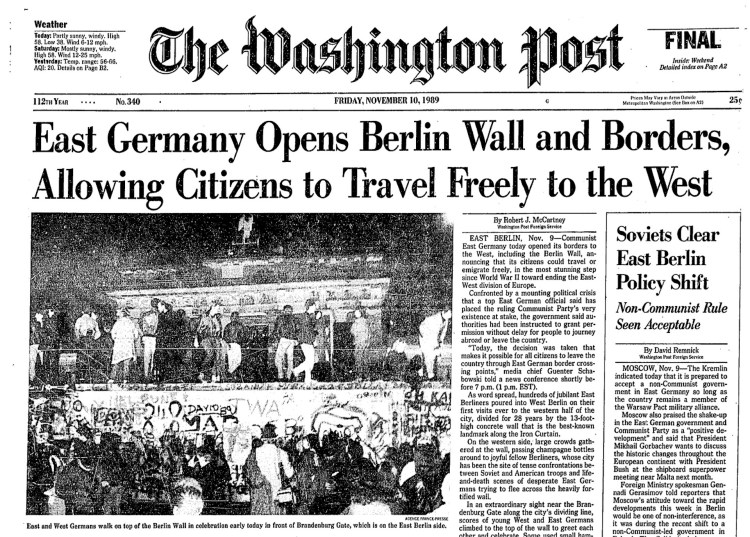
A lot happened in the year 1989, including the debut of a TV sitcom in which nothing happened. That show, of course, was Seinfeld, and we’ll be doing a deep dive into this iconic comedy over the coming weeks.
But first, to get a sense of the times and trends that helped shape this series, here’s a quick look at the world in 1989.
January 1 The Canada–United States Free Trade Agreement goes into effect.
January 7 Emperor Shōwa, the 124th Emperor of Japan according to the traditional order of succession, dies in his sleep.
January 10 Harris Trust and Savings Bank of Chicago settles a government enforcement action by agreeing to pay $14 million in backpay to women and minorities, the largest such settlement ever obtained from a single employer.
January 11 President Ronald Reagan delivers his farewell address to the nation.
January 13 Bernhard Goetz is sentenced to one year in prison and fined $5,000 for shooting four young men on the New York subway in 1984.
January 16 A Hispanic Miami police officer shoots and kills a speeding black motorcyclist in the Overtown section of Miami, Florida, starting three days of rioting.
January 17 Stockton massacre: Patrick Edward Purdy kills five children, wounds 30 and then shoots himself in Stockton, California.
January 20 George H. W. Bush is inaugurated as the 41st President of the United States and Dan Quayle is sworn in as the 44th Vice President of the United States.
January 24 Serial killer Ted Bundy is executed in Florida’s electric chair. Joel Steinberg is convicted of manslaughter in the beating death of a 6-year-old child he was raising.
February 14 Ayatollah Khomeini Supreme leader of Iran issues a fatwa calling for the death of Indian-born British author Salman Rushdie for releasing the novel The Satanic Verses.
February 15 The Soviet Union announces that all of its troops have left Afghanistan.
February 21 14K Triad is arrested for International Drug Trafficking.
February 23 The US Senate rejects President Bush’s nomination for Defense Secretary former Texas Senator, John Tower.
March 10 President Bush nominates Dick Cheney for Defense Secretary.
March 15 The Bush Administration puts a ban on the import of semi-automatic assault rifles.
March 17 Dick Cheney is confirmed and sworn in as defense secretary.
March 22 US Congress passes a bill to protect the job of whistleblowers who expose government waste or fraud.
March 24 In Alaska’s Prince William Sound, the Exxon Valdez spills 240, 000 barrels of oil.
April 14 The US Government seizes the Lincoln Savings and Loan Association as part of the massive 1980s savings and loan crisis, which costs taxpayers nearly $200 billion in bailouts and many people their life savings.
April 15 – June 5 the 1989 Tiananmen Square protests: More than 1,000,000 Chinese protesters march through Beijing demanding greater democracy, leading to a crackdown.
April 17 The House Committee on Standards of Official Conduct charges House Speaker Jim Wright with improperly evading limits on outside income and accepting improper gifts.
April 19 Trisha Meili better known as the “Central Park Jogger” is raped and assaulted while jogging in Central Park, which results in the infamous “Central Park Five” prosecution (later known as the “Exonerated Five” in the years after).
April 19 USS Iowa explodes while on maneuvers killing multiple sailors.
May 26 United States House of Representatives Majority Whip Tony Coelho resigns, saying he wants to spare his family from an investigation into his finances.
May 31 Jim Wright announces his resignation as Speaker of the House of Representatives.
June 3 In Webster v. Reproductive Health Services, the Supreme Court gives the states new authority to restrict abortions.
June 4 Poland holds its first free elections under Communist rule in over 40 years. The result of this election begins the collapse of communism.
June 6 The United States House of Representatives elects Tom Foley as its new speaker. President Bush vetoes a minimum-wage bill passed by Congress on May 17 that would have increased the minimum wage to $4.55 an hour
June 21 In Texas v. Johnson the United States Supreme Court rules, 5 to 4, that burning the Flag of the United States is protected speech under the First Amendment.
June 26 In Penry v. Lynaugh, the Supreme Court rules, 5 to 4, that states can execute murderers as young as 16 or who are mentally challenged.
July 19 United Airlines Flight 232 crash-lands at Sioux Gateway Airport in Sioux City, Iowa, killing 112 of 296 passengers.
August 9 The Financial Institutions Reform, Recovery, and Enforcement Act of 1989, a measure to rescue the United States savings and loan industry, is signed into law by President Bush, launching the largest federal rescue to date.
August 10 United States Army General Colin Powell becomes the first black Chairman of the Joint Chiefs of Staff after being nominated by President Bush.
August 20 In Beverly Hills, California, Lyle and Erik Menendez shoot their wealthy parents to death in the family’s den.
August 23 Yusef Hawkins is shot to death in the Bensonhurst section of Brooklyn, New York, sparking racial tensions between African Americans and Italian Americans.
September 21 Hurricane Hugo makes landfall in South Carolina, causing $7 billion in damage.
October 1 Denmark becomes the first country to legalize same-sex civil unions.
October 17 The 6.9 magnitude Loma Prieta earthquake shakes the San Francisco Bay Area. Sixty-three people are killed and the 1989 baseball World Series is postponed for ten days.
October 20 The US Senate convicts Judge Alcee Hastings of the United States District Court for the Southern District of Florida of perjury and conspiracy to obtain a bribe, and removes him from office. A federal jury in New York City convicts Rep. Robert García of extortion and conspiracy.
October 23 US Congress fails to override President Bush’s veto of a bill that would have restored funding for abortions for poor women who are the victims of rape or incest.
November 3 The US Senate convicts Judge Walter Nixon of the United States District Court for the Southern District of Mississippi of lying under oath to a federal grand jury and removes him from office.
November 7 Lieutenant Governor Douglas Wilder wins the Virginia gubernatorial race, becoming the first African-American elected Governor in the United States. David Dinkins becomes the first African-American mayor of New York City.
November 8 US Congress passes legislation to raise the minimum wage from $3.35 to $4.25 an hour by April 1991. President Bush signs this bill on November 17.
November 9 East German official Günter Schabowski accidentally states in a live press conference that new rules for traveling from East Germany to West Germany will be put into effect immediately. This forces East Germany to open checkpoints in the Berlin Wall, allowing its citizens to pass freely to West Germany for the first time in decades.
November 16 Six Jesuit priests, their housekeeper, and her teenage daughter, are murdered by US-trained Salvadoran soldiers.
November 17- November 28 The Velvet Revolution, or Gentle Revolution, ushers in a non-violent transition of power in Czechoslovakia.
December 7 A Miami, Florida jury convicts police officer William Lozano for the January 16 deaths of a black motorcyclist and his passenger.
December 16- 18 Mail bombings kill a federal judge in Birmingham, Alabama and a lawyer in Savannah, Georgia.
December 20 Operation Just Cause is launched in an attempt to overthrow Panamanian dictator Manuel Noriega.

 SCREEN TIME WITH SAM